
December 11, 2025 - PBS News Hour full episode
12/11/2025 | 57m 46sVideo has Closed Captions
December 11, 2025 - PBS News Hour full episode
December 11, 2025 - PBS News Hour full episode
Problems playing video? | Closed Captioning Feedback
Problems playing video? | Closed Captioning Feedback
Major corporate funding for the PBS News Hour is provided by BDO, BNSF, Consumer Cellular, American Cruise Lines, and Raymond James. Funding for the PBS NewsHour Weekend is provided by...
December 11, 2025 - PBS News Hour full episode
12/11/2025 | 57m 46sVideo has Closed Captions
December 11, 2025 - PBS News Hour full episode
Problems playing video? | Closed Captioning Feedback
How to Watch PBS News Hour
PBS News Hour is available to stream on pbs.org and the free PBS App, available on iPhone, Apple TV, Android TV, Android smartphones, Amazon Fire TV, Amazon Fire Tablet, Roku, Samsung Smart TV, and Vizio.
Providing Support for PBS.org
Learn Moreabout PBS online sponsorshipAMNA NAWAZ: Good evening.
I'm Amna Nawaz.
GEOFF BENNETT: And I'm Geoff Bennett.
On the "News Hour" tonight: The# U.S.
Senate rejects propos.. plans to address a spike in health care# premiums under the Affordable Care Act.
AMNA NAWAZ: Ukraine pushes for# security guarantees against Russia,## as international pressure to# accept the peace plan grows.
GEOFF BENNETT: And economists warn of major# risks created by private credit that could## pose as large a threat as the housing# market did before the Great Recession.
MARK ZANDI, Chief Economist, Moody's# Analytics: One of the issues with private## credit is the lack of transparency.
It's# very opaque.
It'.. where it's highly regulated and# you know exactly what's going on.
(BREAK) GEOFF BENNETT: Welcome to the "News Hour."
The U.S.
Senate failed to pass two dueling# pieces of health care legi.. leaving Affordable Care Act tax credits all# but certain to expire at the end of the year.
AMNA NAWAZ: As lawmakers prepare for# year-end recess with no agreement in sight,## tens of millions of Americans who rely# on the ACA are being left in limbo.## The expired subsidies would lead to a sharp rise# in health insurance premiums starting next month.
Congressional correspondent Lisa Desjardins# was at the Capitol today and joins us now.
So, Lisa, walk us through what happened today.
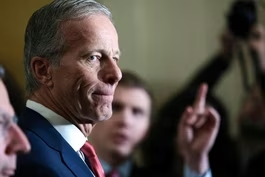
LISA DESJARDINS: What we had today in the# Senate was Republicans and Democrats each## having one shot to put up a bill to deal# with these expiring enhanced tax credits.
Now, these are just -- these are enhanced# credits on top of what was originally in## Obamacare.
So we saw both parties put up# bills, but, frankly, Amna, those bills,## neither one of them seemed likely to pass.
Let# me go through what they proposed, first of all.
Now, the Republican plan is to limit the# enhanced subsidies and essentially move## them into health care savings accounts.# Now, that plan failed.
It got 51 votes,## but that's short of the 60 that was needed.# Democrats, they're planning a little bit## more straightforward, a three-year extension# of the enhanced subsidies as they are now.
That plan also failed, but, interestingly enough,# Amna, 51 votes.
So we had two plans today that## both got a majority vote, but both short of the# bipartisan 60 votes that's needed in the Senate.
And we have learned a couple of things.
The Senate# clearly is not at a point where there are even## having these bipartisan talks that are needed to# come up with a compromise plan.
The other thing we## learned today, as the leaders said on the floor,# that there is both political and policy divide.
SEN.
JOHN THUNE (R-SD): Democrats' so-called## plan is a three-year extension of the# status quo, no reforms.. no rethinking of the way that Obamacare works,# just a three-year extension of the status quo.
SEN.
CHUCK SCHUMER (D-NY): Republicans# will have to answer to the American people,## explain to the country why they chose# higher health care costs over real## solutions.
They must -- Republicans must# answer for why people will lose coverage.## Republicans must answer why families see# premiums double and triple over the next year.
LISA DESJARDINS: Not a great sign# when you get into the finger-pointing,## especially when millions of# Americans waiting for a solution.
I talked to Senator Thune, especially afterward.# He said there are senator-to-senator talks.
He's## not given up on some possible way forward,# but time is running out.
And Senator Schumer## seemed more in the attitude of he thinks this# might be it for the year, but we will see.
AMNA NAWAZ: So it's not clear# if the Senate's going to do## anything more on this.
What about# the House?
What's happening there?
LISA DESJARDINS: OK, the House, very interesting.
House leadership, the Republican# leadership, Speaker Johnson,## they are not putting forward a plan to extend# these health care subsidies right now.
However,## other Republicans are.
There is a group of# bipartisan members together.
There are 35 of them,## one example, last week, who -- there you# see them -- proposed a one-year extension.
There are a couple different versions of# that idea.
These groups are now trying to## do a run-around the leadership with a discharge# petition.
We have talked about this on the show.## That needs 218 signatures.
I just checked# a few minutes ago.
Neither one of these## extensions that these some few Republicans are# proposing is anywhere close to that number yet.
And they also may not have enough time to# get that done by the end of the year.
But## here's the tricky part.
This is very# political.
When I talk to Democrats,## I think there clearly is a majority# in the House for a one-year extension.
But the politics are such that that# may not come to the House for and## it certainly doesn't look like it will# come before next week.
So there's a will,## but not a way potentially in the House right now.
AMNA NAWAZ: So there's a lot of# competing dynamics at play here.
As you speak to your sources, give us your# analysis overall of where things stand right now.
LISA DESJARDINS: Well, let's# break this down simply,## because I know it is confusing.# And even for members in Congress,## they kept pulling me aside to say, help# me understand what's going on here.
So let's look at this in terms of three# major problems that are faced -- that's## facing Congress here.
First of all, Democrats, for# their point, Democrats, on their end, they oppose## the reforms in large form that the Republicans# want.
That's a problem in the Senate especially.
Now, Republicans, they're divided on an# extension.
There are a lot of moderate## Republicans who, frankly, are vulnerable# in the next election who want to extend## this and they want to do it now.# But the Republicans don't agree.
Finally, something that hasn't come up yet,# abortion policy, Amna.
This is a huge issue in## the Senate.
There are Republicans who want to# -- who are very nervous about the way forward## and want to make kind of more conservative# policy on abortion.
Democrats don't like that.
So that's a big hangup as well.
And all of this# leads to this point now.
Others say there's a## problem because none of this changes health care# costs in general.
It just moves money around.
AMNA NAWAZ: And, finally, Lisa, I know# that calendar is always a big issue here,## right?
Walk us through what's ahead.
LISA DESJARDINS: You know I love# doing -- looking at the cale.. Time is tight.
And, in fact, it's actually# even worse than people realize.
So let's## take a look really quickly.
Here we are today,# December 11.
Now, look, at the end of the month,## that's when these enhanced tax credits expire.# OK, so it seems like Congress would have time.
No, those days in that red-orange color, those# are the final days that Congress plans to be here## before leaving for the holiday.
Now, how about# January?
Another problematic deadline coming up,## at the end of January is when government# funding runs out for most government agencies.
So they're up against the clock on a couple# of issues, not ready to deal with either one## of them.
Now, we know from KFF that there# is a real moment here.
And I talked to one## of their experts today, Cynthia Cox,# about where she thinks things stand.
CYNTHIA COX, Program on the ACA Director, KFF: I# think it's looking more and more likely that these## enhanced premium tax credits are going to expire.# Even if there was some sort of last-minute deal.## We're probably looking at people's premium# payments going up significantly in January.
LISA DESJARDINS: A reminder of who that affects.# So that's not most Americans.
It is a smaller## portion of the American health care market, but# it is 24 million Americans who are on Obamacare## right now.
Most of them would see premiums go up,# Cynthia Cox saying double beginning in January.
And we also know from the Congressional Budget# Office that around two million people would just## fall off of insurance altogether.
And, Amna,# that's not just hypothetical.
That's already## happening.
We know in Massachusetts, where# open enrollment closes in just days from now,## that already 10,000 people have not# signed up again, won't have insurance.
And that is going to cause real health# care and financial problems ahead.
AMNA NAWAZ: Lisa Desjardins, thank you, as always.
LISA DESJARDINS: You're welcome.
GEOFF BENNETT:## We start the day's other headlines with a rare## Republican rebuke of one of# President Trump's priorities.
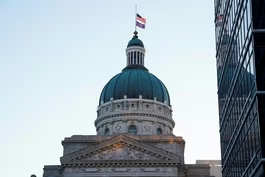
Indiana's Republican-led Senate# voted this afternoon against a## plan to redraw its state's electoral map.
MAN: Nineteen ayes, 31 no's.# This bill has been defeated.
GEOFF BENNETT: Twenty-one Republicans# joined all 10 Democrats in voting down## the measure.
Outside the chamber, critics# of the redistricting plan celebrated.
The vote comes after months of pressure# from President Trump, who has been pushing## Republican-led states to redraw their maps# ahead of next year's midterm elections.
A grand jury in Virginia has again refused# to bring a new indictment against New York## Attorney General Letitia James for mortgage# fraud.
It's the second time in about a week## that the Justice Department has failed# to resurrect its case against James.
Last month, a judge threw# out an original indictment,## finding that the prosecutor in the case,# Lindsey Halligan, had been illegally## appointed to her role.
A similar case against# another of President Trump's perceived foes,## former FBI Director James Comey, was also# dismissed last month for similar reasons.
Kilmar Abrego Garcia has left an immigration# detention center in Pennsylvania after a## federal judge in Maryland ordered his release,# saying his monthslong detention was troubling.## The native of El Salvador and Maryland resident# was mistakenly deported by the administration this## past spring and then returned to the U.S.
in June# to face human smuggling charges, which he denies.
The White House says it will# appeal his release.
It comes as## the administration's immigration policies# were under scrutiny by lawmakers today.
KRISTI NOEM, U.S.
Homeland Security# Secretary: Joe Biden left us... (CROSSTALK) REP.
DANIEL GOLD.. GEOFF BENNETT: In a contentious# House hearing, Homeland Security## Secretary Kristi Noem defended the Trump# administration's hard-line immigration policies.
KRISTI NOEM: We're ending illegal immigration,# returning sanity back to our immigration system.## We will never yield.
We will never# waver.
And we will never back down.
GEOFF BENNETT: And there was also# this moment when Secretary Noem## was asked how many U.S.
military# veterans her agency has deported.
KRISTI NOEM: Sir, we have not deported# U.S.
citizens or military veterans.
REP.
SETH MAGAZINER (D-RI): We are joined on Zoom# by a gentleman named Sae Joon Park.
He is a United## States Army combat veteran.
Will you join me in# thanking Mr.
Park for his service to our country?
KRISTI NOEM: Sir, I'm grateful for every single# person that has served our country and follows## our laws and knows that our law is important# and every one of them needs to be enforced.
REP.
SETH MAGAZINER: And can you please# tell Mr.
Park why you deported him?
GEOFF BENNETT: M.. top military officials over the legality# of troop deployments to U.S.
cities.
The## White House says the deployments are# necessary in fighting lawlessness,## while critics describe them as an abuse of# military power that violates states' rights.
The oil tanker that was taken yesterday by U.S.# forces off the coast of Venezuela will make its## way to an American port, where authorities will# seize the oil on board.
That's according to White## House Press Secretary Karoline Leavitt.# This afternoon, she described the tanker## as a sanctioned shadow vessel carrying what she# called black market oil, which she said justified.
KAROLINE LEAVITT, White House Press# Secretary: The United States currently## has a full investigative team on the# ground, on the vessel and individuals## on board the vessel are being interviewed,# and any relevant evidence is being seized.## The vessel will go to a U.S.
port, and the# United States does intend to seize the oil.
However, there is a legal process for the seizure## of that oil and that legal# process will be followed.
GEOFF BENNETT: Also today, the# U.S.
imposed sanctions on three## of Venezuelan President Nicolas# Maduro's nephews, among others,## as the Trump administration continues# to increase pressure on that country.
Meantime, the face of Venezuela's resistance# movement, Nobel laureate Maria Corina Machado,## waved to a cheering crowd in Oslo late last# night, where she is being celebrated as this## year's Nobel Peace Prize winner.
It was# her first public appearance in 11 months.
MARIA CORINA MACHADO, Venezuela# Opposition Leader: Venezuela will be free.
GEOFF BENNETT: At a press conference today,## Machado vowed to keep fighting for her# homeland's democracy and credited what .. called the decisive actions of President# Trump for weakening the Maduro regime.
Here at home, state health officials are# reporting rising cases of the measles in two## separate outbreaks in the Eastern and Western U.S.# New cases are cropping up along the Utah-Arizona## border, as well as in South Carolina, where# more than 250 people have been quarantined.
Arizona has logged 172 measles cases since# August and Utah has seen 82.
In South Carolina,## 111 people have been sickened in# just the last two months.
Nationwide,## the number of measles cases is nearing# 2,000, the highest number since 1992.
Days of relentless rain have sent rivers rising# toward record levels in the Pacific Northwest.## The National Weather Service says the atmospheric# river began to subside today, but not before## dumping more than a foot of rain in some areas.# Washington is under a statewide emergency,## with tens of thousands under evacuation# orders, especially around the Seattle area.
Those who've stayed are doing what# they can to keep the floodwaters out.
MAN: We're just trying to build a wall, like a# little island perimeter around the property here,## to keep the water out from the house.
GEOFF BENNETT: Meantime, in# parts of Western Washington,## rivers are continuing to swell, prompting# numerous water rescues and road closures.
Disney announced a billion-dollar investment# in OpenAI today to bring iconic characters like## Mickey Mouse and Luke Skywalker to the Sora video# tool.
The three-year licensing deal will allow## fans to create and share videos with more than 200# Disney, Marvel, Pixar, and Star Wars characters.
Disney CEO Bob Iger said the agreement will# "extend the reach of our storytelling through## generative A.I.
while respecting and# protecting creators and their works."
The deal comes as Hollywood tries to navigate the## opportunities and challenges# that generative A.I.
presents.
Artificial intelligence is also gracing the cover# of "TIME" magazine, which named the architects of## A.I.
as its person of the year for 2025.
That# includes Nvidia CEO Jensen Huang and OpenAI## boss Sam Altman, among others.
The publication# said this was the year when the potential for## A.I.
-- quote -- "roared into view" and that# there will be no turning back or opting out.
An A.I.
boom has, of course, been driving# a long-running rally on Wall Street.
And,## today, the Dow Jones industrial average jumped# more than 600 points to a new all-time high.## The Nasdaq lost ground, giving back about 60# points.
The S&P 500 managed a modest gain.
Still to come on the "News Hour": an# investigation delves into connections## between the misogynist influencers the# Tate brothers and the Trump inner circle;## the president's tariffs come with a steep# price for stores and restaurants that## import Italian pasta; and we explore some# of the best video games released this year.
Ukraine's president today floated# a possible compromise to a Russian## demand that Kyiv give up territory in# the Eastern Donetsk region.
Volodymyr## Zelenskyy spoke after he met with# senior administration officials and## sent new edits to the document at the heart# of the U.S.
push to end the war in Ukraine.
Nick Schifrin is here following all of this.
So, Nick, what does Zelenskyy say today about# this crucial question, the fate of Donetsk?
NICK SCHIFRIN: It is crucial, Geoff,# because any Ukrainian withdrawal from## territory it controls today would# be illegal under Ukrainian law.## And this is by far the most contentious# part of the peace plan for Zelenskyy.
So let's take a look at the map.
Zelenskyy# says and other European officials confirmed## to me that the current deal would# have Ukraine give up the portion of## the Donetsk region that it controls.# It's that white portion right there## inside the Donbass.
Russia has failed# to capture it through 11 years of war.
That would give Russia control over the entire# Donbass.
Zelenskyy said today that the U.S.## is now calling that area -- quote -- "free# economic zone."
Russia calls it demilitarized.
And in a meeting with the Americans that# included Jared Kushner, Steve Witkoff,## Secretaries Rubio and Hegseth, Zelenskyy said# that he told the Americans -- quote -- "Our## position is to remain where we stand,"# meaning on the front lines, and later added:## "The Russians want the entire Donbass,# but we clearly do not accept this."
Zelenskyy said to the Americans:# "Who would govern this territory## if it's demilitarized?"
He quoted them# saying -- quote -- "They do not know."
But, later, when asked by journalists whether he# was willing to accept this proposal, he replied:## "This will be answered by the people of Ukraine,## whether in the format of elections# or in the format of a referendum."
And that suggests he's considering not# rejecting this proposal, and instead coming## up with a compromise and asking Ukrainians# this fundamental question: Are they willing## to give up territory in exchange for a U.S.# security guarantee and economic investment?
GEOFF BENNETT: So what then# are the other sticking points?
NICK SCHIFRIN: One of the major# sticking points is the fate of## the Zaporizhzhia nuclear power plant.# This is Europe's largest power plant,## and Russia occupied it in the first# days after the full-scale invasion.
Zelenskyy said today and European# officials confirmed to me that## the U.S.
is now proposing that the plant be# jointly run by the U.S.
and Russia.
Ukraine,## of course, wants Russia to give up the# plant entirely.
Another major issue,## will the U.S.
recognize territory# that is currently occupied by Russia?
European officials tell me that the# U.S.
recently inserted a phrase of## legal recognition for territories that Russia# has occupied since 2014 or since the full-scale## invasion in 2022.
And now Ukraine and its# European allies in the most recent drafts## sent to the United States last night, they# have removed that language from the draft.
Zelenskyy also said this, that he# wants any security guarantee from the## United States to be a treaty, and that# would have to be approved by Congress.
VOLODYMYR ZELENSKYY, Ukrainian President: We# believe this document should be approved by## the United States Congress.
This would mean real,## solid, legally binding security# guarantees for our country.
NICK SCHIFRIN: Zelenskyy said there was no# -- quote -- "ultimatum deadline," Geoff,## but that the U.S.
wants a -- quote --# "understanding of where we stand" by Christmas.
GEOFF BENNETT: You mentioned# Ukraine's European allies.## What are they saying about all of this today?
NICK SCHIFRIN: Today, the coalition of the# willing, that's led by the United Kingdom## and France, they met virtually to talk about# how they can support Ukraine in the future,## including sending troops into# Ukraine to enforce a cease-fire.
And, afterward, NATO Secretary-General Mark# Rutte had a really stark warning that his## Europe -- to his European colleagues that we,# as in NATO, might be Russia's next target.
MARK RUTTE, NATO Secretary-General: I fear that# too many are quietly complacent.
Too many don't## feel the urgency.
And too many believe that time# is on our side.
It is not.
The time for action is## now.
Conflict is at our door.
Russia has brought# war back to Europe, and we must be prepared.
NICK SCHIFRIN: Geoff, that is a fundamental# divide.
You have a NATO secretary-general## talking about Russian invasion of Europe# possible and the White House releasing a## document, national security strategy,# talking about strategic stability with## Russia and creating economic investments# with Russia as part of a Ukraine deal.
That's a real divide right at the heart# of the transatlantic relationship.
GEOFF BENNETT: Indeed.
Nick Schifrin, our thanks to you, as always.
NICK SCHIFRIN: Thank you.
AMNA NAWAZ:## Lately, investors and economists are warning about# a piece of the financial system that could pose a## risk, potentially similar in ways to the housing# crash that preceded the financial crisis in 2008.
It's part of what's been called the shadow# banking system, the private credit market,## an alternative type of lending to companies# that doesn't involve traditional banks.
We asked economics correspondent Paul Solman# to explain how it works, what's at stake,## and why alarm bells are sounding in some quarters.
PAUL SOLMAN: Bought an aftermarket car part in## recent years?
Good chance# it came from First Brands.
JOHN BASQUILL, Senior Reporter, Global# Trade Review: First Brands was a large## supplier of auto parts, things# like wiper blades, spark plugs.
PAUL SOLMAN: Over a decade the# company borrowed heavily to grow,## gobbling up 20 companies employing# 25,000 people, until this fall, that is.
JOHN BASQUILL: The lenders had become a# bit concerned about some of the financial## goings-on at the company and requested some extra# information which First Brands couldn't provide.
PAUL SOLMAN: What happened?
Went# bust.
And who were its lenders?## Many came from the world of private# credit, a part of the global financial## system that's exploded in recent years and# has some key players in finance rattled.
JAMIE DIMON, Chairman, J.P.
Morgan Chase: I should# probably shouldn't say this, but when you see one## cockroach, there's probably more.
And so we should# -- everyone should be forewarned on this one.
PAUL SOLMAN: One such roach, First Brands.
JEFFREY GUNDLACH, CEO, DoubleLine Capital: I# have been saying this for probably two years now,## that the next big crisis in the financial# markets is going to be private credit.
PAUL SOLMAN: OK, but what# exactly is private credit?
MARK ZANDI, Chief Economist, Moody's Analytics:# Private credit is just lending by nonbanks,## financial institutions like pension funds,# insurance companies, sovereign wealth funds,## but not going through the banking# system, thus the word private.
It's grown very rapidly.
It's now a# sizable player in the financial system.
PAUL SOLMAN: Growing from a $40 billion market# in the year 2000 to nearly $2 trillion today.
NATASHA SARIN, President, Budget Lab at Yale# University: The reason for that growth is that,## after the Great Recession, regulators realized# that large financial institutions had been## really exposed to making relatively# risky bets without having enough of## a backstop internally in the form# of capital that they held that was## available for the bank to draw down on# in case some of those bets went sour.
And so the result of the aftermath# of the crisis and the post-crisis## regulation in Dodd-Frank was to say that,# in order to take those types of risks,## it would be more expensive# for banks going forward.
PAUL SOLMAN: As a result, most banks# pulled back from riskier lending.
NATASHA SARIN: And private credit# stood ready, in some sense, to take## advantage and meet the need of the market# to be able to make those types of loans.
PAUL SOLMAN: For investors, returns on# those loans were, well, mouthwatering,## nearly double the rate of government bonds# or other loans.
So what's the problem?
MARK ZANDI: One of the issues with private credit# is, the lack of transparency is very opaque.
It's## not like the banking system, where it's highly# regulated and exactly what's going on.
Here,## we don't know very much because it is private.
And# so that makes it a little bit more disconcerting.
PAUL SOLMAN: For example, private credit firms can# report the value of their loans according to their## own internal models, rather than the market price,# marking to model instead of marking to market.## Problem is, it's nearly impossible to verify that# the loans are worth what they're claimed to be.
MARK ZANDI: Most times, no big deal.
That's# probably just fine.
But when you get into## kind of a risk-off environment,# when things are moving quickly,## prices are falling rapidly, that's when# mark to model becomes more of an issue.
PAUL SOLMAN: A loan mark to model could# even become a loan marked to zilch.
So how serious is the risk posed by private# credit to the American economy as a whole?
MARK ZANDI: It's consequential, but# it's still on the small side.
And I## don't think it's at a place# yet where it could do us in.
NATASHA SARIN: In some sense, it's a yarn# that you start to pull and you're worried## that it's both potentially unraveling, but# also that it's potentially connected to all## the other parts of the financial system.
And# the system is still very much reliant on all## of these different pieces in a way that# regulators don't yet fully appreciate.## And I worry none of us fully appreciate the# possibility of cascading downturn risk as well.
MARC ROWAN, CEO, Apollo Global# Management: Most of the market## is investment grade.
Credit stats ar.. PAUL SOLMAN: Look, says Marc Rowan, CEO of# private credit giant Apollo Global Management: MARC ROWAN: There are good banks# and bad banks and good insurance## companies and bad insurance companies# and good asset managers and bad asset## managers.
But there's nothing# that I see that is systemic.
PAUL SOLMAN: Systemic risk,# that's the danger, which starts## with risk to, well, viewers like you.
TOM GOBER, Insurance Fraud Examiner: A## very large percent of the population is# affected by this higher risk without knowing.
PAUL SOLMAN: Insurance fraud examiner Tom Gober.
TOM GOBER: I look after policyholders and# annuitants.
If you have a life insurance## policy or an annuity, I'm trying to# help that you know you're going to## be safe.
But now there's a lot of# pensioners who are also counting## on the same insurance companies# that are taking all these risks.
PAUL SOLMAN: And suppose insurance policy# and annuity holders get skittish and start## withdrawing their, or, I should say, our money,## the money that backs up the private# credit loans, putting them in jeopardy?
In fact, recent headlines have featured# bankruptcies of firms financed largely by## private credit, Renovo, Tricolor and, where# the story began, First Brands.
A cockroach## operating in the dark accused of engaging# in blatant sleight of hand accounting.
JOHN BASQUILL: The company or group companies# would make a sale, generate an invoice,## and then sell that invoice or the sort of debt# that generates to a third-party investor.
And## there were huge, multibillion-dollar investments# in invoices that First Brands was generating.
PAUL SOLMAN: Those billions came# in large part from private credit,## that is, private loans backed# by invoices.
Unfortunately,## the head of First Brands was allegedly faking# those invoices and selling them more than once.
And, worse still: JOHN BASQUILL: We're talking about a company# that's now being accused.. billions of dollars to fund its founder# and CEO's personal extravagant lifestyle.
PAUL SOLMAN: That's why the new CEO of the# company is suing his predecessor for malfeasance,## while a spokesman for the old CEO says# he -- quote -- "categorically denies## the baseless and speculative allegations# contained in the First Brands complaint."
But the point is, First Brands, financed# in the so-called shadow banking industry,## was operating in the shadows, which leads to# the question of the day regarding the private## credit industry.
Were First Brands and its# fellow private credit failures anomalies or## an early harbinger of risks not unlike those# that triggered the financial crisis of 2008?
For the "PBS News Hour," Paul Solman.
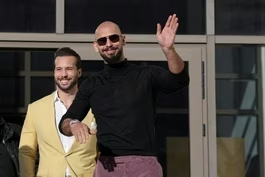
GEOFF BENNETT: Now a new investigation into the## political maneuvers that led to the# release of Andrew and Tristan Tate,## right-wing influencers charged with# rape, human trafficking and other crimes.
The Tates, who are major players with big social# media followings in the so-called manosphere,## are facing criminal investigations in Romania# and criminal charges in the U.K.
for alleged sex## crimes.
The brothers had been barred from leaving# Romania for years as prosecutors built their case.## But, in February, the Romanian government# suddenly lifted the travel ban and allowed## the two to board a plane to Florida, which they# announced in this video recorded on the plane.
Both men have denied the criminal allegations.# A new report from The New York Times reveals## how the Trump administration and some# members of the president's family may## have been involved in a larger movement in# conservative circles to support the Tates.
For more, we're joined now by# New York Times investigative## reporter Megan Twohey, who helped break the story.
Thanks for being with us.
MEGAN TWOHEY, The New York# Times: Happy to be with you.
GEOFF BENNETT: So, for the unfamiliar,# tell us more about who the T.. are and the criminal allegations# they were facing in Romania.
MEGAN TWOHEY: So, Andrew Tate and his# brother Tristan to a lesser extent are## two of the most influential figures# in the so-called manosphere world.
They -- Andrew's a former kickboxer, who# has built a huge, massive online audience## by preaching brazen masculinity and chauvinism# to a young male audience.
He and his brother## also ran a porn business for about 10 years,# bragging about how they lured and steered women## into making sexual content for paying customers# online, and with them taking a lot of the profit.
And they have also sold courses to young# men on how to make money and exploit women.
GEOFF BENNETT: And, as we mentioned, the# Romanian courts originally required the## Tates to remain in that country as the# cases were built against them.
But then## seemingly overnight back in February, they# were seen on this plane headed to Florida.
Your reporting links that shift to# the relationships they cultivated## with influential figures on the political right,## to include members of Donald Trump's own family.# What did you learn about those relationships?
MEGAN TWOHEY: Yes.
So, Andrew and Tristan, they .. Romania since like the mid-2010s.
And in 2022,# they started to come under investigation.
There## ultimately have been under investigation in three# countries, in Romania, where they're accused of## trafficking dozens of women into their porn# business and Andrew's been accused of rape.
They also have been accused, they're# facing charges in Britain of rape and## trafficking.
They have also been under criminal# investigation here in the United States.
But,## remarkably, as they started to come under# growing numbers of criminal investigations,## they forged really close alliances with people# on the American right, ranging from media## figures like Tucker Carlson and Candace# Owens to members of the Trump family,## first starting with Donald Trump# Jr.
and then with Barron Trump.
And those -- we found in the course of our# reporting that those sort of strategic alliances## culminated in their release from# Romania in February of this year.
GEOFF BENNETT: How?
How did that all# happen?
How did the U.S.
involvement## in their case ramp up after Trump's reelection?
MEGAN TWOHEY: So, the prosecutors in# Romania had barred the brothers from## traveling.
They have been arguing as they# have been investigating these brothers## that they pose a public risk and a flight# risk, a public danger and a flight risk.
And so they have like repeatedly been# seeking to confine them in the country.## And that changed in February,# when the prosecutors -- like,## an extraordinary order came down from# the highest levels of the Romanian## government instructing prosecutors to# reach a compromise with the brothers.
And then those travel bans were lifted, which was# something that the prosecutors did not want to do,## according to our sources.
And what we have learned# is that was really a culmination.
Once Trump was## reelected, there were supporters of the Tates# here in the United States who ascended into## the administration, including a special diplomatic# envoy named Richard Grenell, who we found through## our reporting had at least two conversations# with Romanian officials about the Tates' case.
And then within days of that second# conversation, the order came down in Romania## ordering the compromise that led to the lifting# of the travel bans.
And we have been told that## the Romanian prime minister believed that# that would appease the Trump administration.
GEOFF BENNETT: What did your reporting find about## the involvement of Donald Trump# Jr.
and Barron Trump specifically?
MEGAN TWOHEY: Yes.
So, the -- so, Andrew Tate.. shrewd in cultivating these alliances# with people on the American right,## including in the Trump family.
And so his# relationship with Don Jr.
stretches back to 2017,## when Andrew had posted a positive tweet# about his father and Don Jr.
had liked it.
And, anyway, soon, they were hanging# out at Trump Tower here in New York.## And that stretched up through him# coming under investigation and## being placed on house arrest in Romania.# Don Jr.
was one of the people who posted## online supporting in defense of the Tates# and critical of the Romanian investigation.
And then we found that, by 2024,# Barron Trump, the youngest son,## was also a fan of Andrew and that# they actually spoke by Zoom last year## with a mutual friend, who told me that# Barron is a big fan of the Tates and that,## on this call, they had actually discussed# the Romanian case and how they thought it## was just an effort to silence the Tates, a# politically motivated criminal investigation.
GEOFF BENNETT: Your reporting points to a network## of powerful conservative figures# who have championed the Tates,## but not everyone on the right shares# that view.
So what are the fault lines?
MEGAN TWOHEY: Within hours of the travel bans# being lifted, the brothers were on a private## plane to Florida.
And their arrival was, I think,# a little bit bumpier than they had expected.
While on the one hand, they have garnered a# lot of support from certain media and other## conservative figures and even members of# the Trump family here in the United States,## there were also a lot of conservatives, other# conservatives, more traditional conservatives## who were outraged that they had come back to# the United States, Megyn Kelly, Ben Shapiro.
The Republican Governor Ron DeSantis said# that they weren't welcome in his state.## And the Florida attorney general actually# launched an investigation of them there.
GEOFF BENNETT: Megan, how was the White# House responding to your reporting?
MEGAN TWOHEY: Well, we went to the White# House and Barron Trump and Donald Trump## Jr.
with a lot of detailed questions# and spelling out all of our findings.
Don Jr.
did not respond.
We got no response for# Barron Trump.
The White House basically gave us## one line, which was that they say the White House# has no involvement in the Tates' legal cases.
GEOFF BENNETT: Megan Twohey of The New York# Times, thanks for sharing your reporting with us.
MEGAN TWOHEY: Thanks so much for having me.
AMNA NAWAZ:## Yesterday, Italian cuisine gained a new# honor, becoming the first gastronomic## style to be recognized as intangible cultural# heritage by UNESCO, the U.N.
's cultural body.
But, as Deema Zein, American cooks# face a new potential tariff that may## double the cost of an essential part# of that cuisine, pasta from Italy.
DEEMA ZEIN: For Diana Calcagno, pasta is part# of her family's history.
She manages Vace,## an Italian grocer and deli in Washington, D.C.,## and nearby Bethesda, Maryland, which# her parents founded almost 50 years ago.
DIANA CALCAGNO, Manager, Vace: It's a# lot of connection with our customers.## It's generation after generation, so their# fathers, and then they brought their children,## and then now they bring their# children for pasta and pizza night.
DEEMA ZEIN: But one of the store's staples,# pasta from Italy, may soon be under threat.
DIANA CALCAGNO: In spaghetti, bucatini.# Then I also ordered orecchiette.
DEEMA ZEIN: Forcing her to# stock up on what she can.
DIANA CALCAGNO: Some customers have asked us, oh,## are you going to still be carrying some pastas?# And we just kind of started.. writing down a bunch of things and trying to# figure out how we were going to handle it.
DEEMA ZEIN: Vace is one of many businesses# across the country making preparations## after a recent announcement from# the U.S.
Department of Commerce.
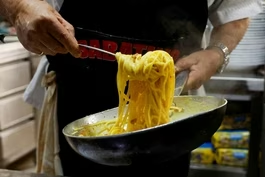
As early as January, pasta from 13 major Italian# producers will face a 92 percent tariff on top## of the existing 15 percent tariff on all goods# from Europe.
That's nearly 107 percent in all.
DIANA CALCAGNO: It's giving me goose bumps# thinking about that right now.
Like, when## I found out that -- that amount, it really did# hit a little bit, because I was just like, man,## it was uncertain being -- not knowing if people# were willing to pay it and.
We're still uncertain.
DEEMA ZEIN: For customers,## the news was pasta-tively frustrating# after years .. WOMAN: I don't know, it# just doesn't seem very fair.
MAN: Not to be able to buy# pasta is really terrible,## because pasta is a very primary# food that everybody should access.
CHIARA DONEGANI, Aston University: Pasta# is not a strategic product.
Pasta is## a basic product.
It's the iconic# symbol of the Mediterranean diet.
DEEMA ZEIN: Chiara Donegani is a researcher# and professor at Aston University in the## U.K.
She co-authored an article about# what she dubs "The Great Pasta War."
While the U.S.
government alleges that the# coming tariffs are in response to Italian## pasta makers dumping their product at# unfair prices in the American market,## Donegani has not found# evidence of that in the data.
CHIARA DONEGANI: The Italian pasta sold# to the U.S., it is usually priced higher,## not lower.
And the second indicator is the market# share, and Italian companies' market share are## broadly stable over that period, with no sign# of predatory pricing to squeeze out competitors.
DEEMA ZEIN: For Italian pasta makers,# the tariff could be a fatal blow,## especially for small and medium size producers.
Margherita Mastromauro is president of the## pasta makers sector of Unione# Italiana Food, a trade group.
MARGHERITA MASTROMAURO, Unione Italiana# Food (through translator): The United## states imports approxima.. worth around $700 million.
The duty would# essentially mean a halt to imports of this## pasta into the American market, because,# obviously, it would mean that the price## of pasta would more than double, making it# completely unprofitable and uncompetitive.
DEEMA ZEIN: Academic Donegani,# who is originally from Italy,## sees the tariffs as not about economic fairness.
CHIARA DONEGANI: It exerts political pressure# and basically it signals that no sector is safe.
DEEMA ZEIN: The tariffs are preliminary and# will be finalized by the 2nd of January.## While pasta from Italy only makes up# about 12 percent of the U.S.
market,## some grocers here are already seeing the impacts.
MAX EVANS, Owner, A. Litteri: Saturday was# the first day ever that reminded me of the## pandemic.
It was the same thing where I# just -- I looked at the shelves halfway## through the day and I could not believe# how much we had sold of just pasta.
DEEMA ZEIN: Max Evans owns A. Litteri, a small# Italian grocer in Northeast Washington, D.C.,## he's ordering more supply to keep up with customer# demand and he says not all pasta is created equal.
MAX EVANS: Italian pasta, it's like Italian# wine.
It's specific to the region where it's## produced.
There's such a vast array.# I mean, I don't think you're going to## find that from American producers in# the kind of numbers and availability.
DEEMA ZEIN: Ultimately, it's# his customers that will have## to fork out to keep Italian pasta on their plates.
MAN: Italian pasta, particularly Italian# pasta here, is the best in the city.## And the fact that it's getting tariffed that# much, A, is going to disincentivize people## from coming.
But then, B, it's just like, why are# we doing nonsense?
Like, so it's just ridiculous.
DEEMA ZEIN: Back in Maryland, Diana Calcagno says,# even though the tariffs haven't kicked in yet,## her suppliers are already raising prices,# which she worries will keep customers away.
DIANA CALCAGNO: People are not splurging as much# on, let's say, a $25 bottle of wine.
Instead,## they will focus on just the main meal.
I have had# some customers complain about pricing already.## And I'm a little scared of what it's going to# be like when the other stuff starts going up.
DEEMA ZEIN: For now, she's hoping that there# may still be a reprieve in the coming tariffs.
For the "PBS News Hour," I'm Deema Zein.
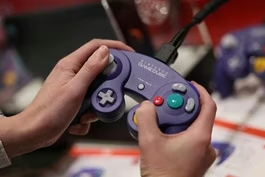
GEOFF BENNETT:## the video game industry is getting ready to# celebrate its top achievements at the annual## Game Awards, an award show dedicated to honoring# the very best in game design, storytelling, music,## and more in gaming.
The show, now in its 11th# year has grown into a major spectacle, drawing## millions of viewers from around the world to see# which of their favorite games will win any awards.
Senior arts correspondent Jeffrey Brown has# more for our arts and culture series, Canvas.
TIMOTHEE CHALAMET, Actor: And the# game of the year is Baldur's Gate 3.
(CHEERING) JEFFREY BROWN: I.. biggest entertainment events of the year.
The# show, often described as the Oscars of gaming,## celebrates writers, performers and the# latest technology shaping the industry.
And it's not just game# developers taking the stage.
AL PACINO, Actor: We are# all trying to tell a story.
JEFFREY BROWN: Film, television and music stars# have all been drawn in, often called on to present## awards, promote upcoming big budget titles and# even showcase games they are helping create.
Major entertainment figures like Elle Fanning,# Keanu Reeves, Snoop Dogg, and Jordan Peele are## now acting in and producing games.
And the line# between gaming and film and TV grows more porous.## Think The Last of Us, which started as a video# game and then became an HBO series, or the film## adaptation of the popular survival game Minecraft,# one of the highest grossing movies of this year.
While action or shoot-em-up type themes# still get plenty of attention, other genres## are pulling in large audiences, such as slice# of life role playing games like Consume Me,## where you play as a teen struggling with# the pressures of dieting, or Expelled,## where you attempt to solve a mystery# in a 1920s British boarding school.
ACTRESS: The other girls won't play by the rules.
JEFFREY BROWN: And who's playing?
That's evolving# too.
Today, 60 percent of American adults play## video games every week,average age of players 36.# And women now make up the majority at 52 percent.
This year's Game Awards are expected to draw# millions of viewers rooting for favorites in## categories like best action game, best performance# and the night's top prize, game of the year.
And joining me now is James Mastromarino.
He## serves as gaming editor for NPR and is# a producer for the show "Here & Now."
Nice to have you.
JAMES MASTROMARINO, Gaming Editor,# .. JEFFREY BROWN: So we laid out# a lot of this .. but for those who are still not aware so# much of this world, how big a deal is the## industry?
How much change have you seen in# terms of the craft and the art behind it?
JAMES MASTROMARINO: Well, it's a massive,# massive industry.
By some counts,## it's bigger than Hollywood and# the recording industry combined.## And people spend dozens of hours each week playing# games that have come a long way since the arcade.
I mean, games, it's almost an insufficient# category, because it can encompass things## that are basically playable visual novels to# grand cinematic games like Death Stranding 2,## to classic sort of beat-em-ups# and other action sort of titles.
So really anything that you think could be# a game, there probably is a game about that.
JEFFREY BROWN: We're going to go through a# few categories and you can give some examples.
So, first, a narrative-driven# game that you love from this year.
JAMES MASTROMARINO: Sure.
Well I think the sta.. which comes from a French studio, an independent# studio that no one really saw this game coming.## And it's sort of like what you# would get if you crossed like an## existentialist novel with like a French# New Wave film and made it a video game.
ACTRESS: You're fighting to change things.
JAMES MASTROMARINO: With fantastical# characters and this really lovable## cast.
It really blew me away.
It# has so many twists and turns and## it's really trying to tell something# that's very heartfelt and compelling.
And then you also have something that has## like grand cinematic ambitions like# Death Stranding 2, which I mentioned.
ACTOR: Was it you, Higgs, huh?# Was it you that killed Lou?
JAMES MASTROMARINO: Its designer, Hideo Kojima,# has been making these games that really do feel## like playable movies.
It even stars Hollywood# actors like Norman Reedus and Lea Seydoux## and Elle Fanning.
So that's a rather ambitious,# really far-reaching kind of science fiction game.
JEFFREY BROWN: So, like the movie# industry you have got some of them## coming from big studios or big companies.
JAMES MASTROMARINO: Correct.
JEFFREY BROWN: A.. JAMES MASTROMARINO: Right.
Right.
Well, you# have your Microsofts.. We call these the AAA studios because# they make kind of like the top-line,## most expensive products.
Ironically,# they have been kind of faltering in## recent years.
We have seen lots of# layoffs as big tech has sort of gone## through some shakeups that's impacted the# entertainment industry associated with it.## It's the independent studios that have# been really getting a lot of traction.
Some of them come out, again, absolutely from# nowhere and take the world by storm.
And as an## example of that, at the Game Awards this year,# the kind of big premiere award ceremony for the## industry, half of the games of the year nominees# are from independent studios, so fully half.
JEFFREY BROWN: So how about what you refer to as## multiplayer games where you can# play with a friend or family?
JAMES MASTROMARINO: Oh, sure.
Yes,# I mean, getting back to the arcades.
JEFFREY BROWN: Yes.
Yes.
JAMES MASTROMARI.. is playing with your friends and family.
JEFFREY BROWN: Yes.
JAMES MASTROMARI.. which is a game about two writers that are thrown## in this sort of virtual reality# space based on their writings.
ACTRESS: So you want to go through# more of your crazy stories?
ACTRESS: My crazy stories?
JAMES MASTROMARINO: But it's exclusively playable# by two people.
You have to have a partner.
JEFFREY BROWN: You have to have a partner.
JAMES MASTROMARINO: There's no# way to pla.. a studio that specializes in this sort# of thing.
It blew a lot of people away.
And then you have also got your classics, like# Mario Kart, which got a new revised, updated## version, Mario Kart World, with the Nintendo# Switch 2, a new console.
And as always, Mario Kart## is just a great time for families.
I can attest# to that when I played a ton over the holidays.
ACTOR: Let's go.
Let's go.
JEFFREY BROWN: All right, now,# you referred to this earlier,## the performances, the way that's been# growing.
And that includes a lot of## well-known actors coming into this world.# Give us some standouts from this past year.
JAMES MASTROMARINO: Yes, well, Clair Obscur:## Expedition 33 and Death Stranding 2# both pulled from Hollywood actors.
So you had Charlie Cox, Daredevil from# that series, who was in Clair Obscur,## and a really emotional performance from# Jennifer English, who is an actor that## really got famous from Baldur's Gate 3, one# of the biggest games of the last few years.
And then Death Stranding 2, so# much, so much Hollywood talent,## just -- and the very performances in the game are# modeled after the likenesses of these actors.
So,## Norman Reedus is the star of that# game from "The Walking Dead."
You have got another called Dispatch, which has# the voice talents of Aaron Paul of "Breaking Bad."
AARON PAUL, Actor: That's not how bees work,# but if we kill the queen, we rot the hive.
JAMES MASTROMARINO: And Jeffrey# Wright, one of my favorite actors .
So these two industries are really converging.## They're more and more starting# to pull from the same talent.
JEFFREY BROWN: Now, I have to ask this, I feel,## that there's been a longtime reputation# for violence in video games.
I venture## to say some of the people watching this,# that's what they think of as video games.
To what extent is that still true?
JAMES MASTROMARINO: Well, I mean, violent# video games still do good numbers.
I mean,## if you go back, a lot of that reputation was## forged in the 1990s with ultra-violent# video games like Mortal Kombat and Doom.
Doom has a very celebrated sequel this year.# It's still going strong.
But as I have mentioned,## games can encompass so many different# categories of play now that it's not just## about shooting or swinging a sword.# It can be about running a bookshop,## or selling antiques, or just trying to# be a good neighbor in like a small town.
JEFFREY BROWN: And the meshing of media, whether# it's games to films, games to series, one of them,## of course, The Last of Us, and the meshing# of actors crossing over, that will continue?
JAMES MASTROMARINO: Yes.
Absolutely.
"The Last of Us," the HBO show,# ca.. So Jeffrey Wright, another name I have# mentioned, was in The Last of Us Part 2,## the video game, and is now in season two of# "The Last of Us" on HBO.
So a lot of actors## are basically cross-training.
They can do# whatever you want, whether it's being on## camera or in a sound stage hooked up with all# that motion capture gear to be in a video game.
JEFFREY BROWN: All right, James# Mastromarino, thank you very much.
JAMES MASTROMARINO: Thank you so much.
AMNA NAWAZ:## Joseph Martinez is the longtime principal# of Carpenter Community Charter School in## Los Angeles.
And families know him# as the principal who literally picks## up trash in the morning and# dresses up for school plays,## but also as the steady hand through fires,# immigration fears, and lockdown drills.
In tonight's Brief But Spectacular,## Martinez makes the case for why public# education remains a smart investment.
JOSEPH MARTINEZ, Principal, Carpenter# Community Charter: Public education, to me,## is equivalent to our democracy.
If we don't# have a strong public education system that## will accept everyone, that will be competitive# with all the private schools in the area, then## I don't see our democracy thriving# as it has for the past 250 years.
I am the principal of Carpenter# Community Charter in Studio City,## Los Angeles, California.
I'm responsible# for approximately 900 students daily.## Whatever it takes to engage children at an# elementary school, I am game for it.
I have## been everything from Elliott from "E.T.,"# Willy Wonka.
I have been Woody, the cowboy,## setting the tone and embrace elementary# school for all that it has to offer.
There is no job that is above or below me,# if that's cutting the grass or if that's## picking up trash.
I hope that they# see that everybody has to pitch in,## that they have to participate in# order for their community to thrive.
So I'm born and raised in Las Vegas, Nevada.# Everybody in my family worked in the service## industry.
My mother and my grandmother both# worked in the kitchens at various hotels.
My## father was a bellman.
So I grew up watching# everybody in my family be service-oriented.
As a school administrator in Los Angeles now, I# try to have that same mentality.
I think of it as## a hotel to give everybody the greatest experience# in elementary school that they could have.
One of the reasons why I'm not in private# education is because we accept everyone.## LAUSD is a sanctuary school district and that# means that any family that enrolls their child## for school has a safe place for that child# to be at school so that they can learn.
We don't turn anyone away.
At all LAUSD public# schools, we have meetings and we have resources## for immigrant families that are facing a crisis# or any kind of a situation involving ICE.
My father came from Mexico.
He did not have# his citizenship until very late in his life.## So I understand the struggles and the challenges# of immigrant families and their children.
I love## building relationships.
I would go visit# my parents when they worked in hotels,## and I was always amazed at how much of a family# it really was with my mother and the people she## worked with in the kitchens or my father and# the people he worked with that were all bellmen.
Whatever job I was going to have in the future,## I wanted to have that.
So that's my favorite# part of my job is building community,## building relationships and building a# support network for our school community.
My name is Joseph Martinez, and this is my Brief## But Spectacular take on bringing# hospitality to public education.
AMNA NAWAZ: And you can watch more Brief But## Spectacular videos online# at PBS.org/NewsHour/Brief.
And that is the "News Hour"# for tonight.
I'm Amna Nawaz.
GEOFF BENNETT: And I'm Geoff Bennett.
For all of us here at the "News Ho..
A Brief But Spectacular take on why schools matter
Video has Closed Captions
Clip: 12/11/2025 | 3m 30s | A principal's Brief But Spectacular take on bringing hospitality to education (3m 30s)
How the Tate brothers became connected with the Trump family
Video has Closed Captions
Clip: 12/11/2025 | 7m 43s | Investigation delves into the Tate brothers and their connection to the Trump family (7m 43s)
A look at some of the best video games of 2025
Video has Closed Captions
Clip: 12/11/2025 | 9m 7s | A look at some of the best video games of 2025 (9m 7s)
News Wrap: Indiana GOP rejects redrawing electoral maps
Video has Closed Captions
Clip: 12/11/2025 | 6m 57s | News Wrap: Indiana GOP votes down effort to redraw electoral maps in rare Trump rebuke (6m 57s)
Senate rejects plans to address rising health care premiums
Video has Closed Captions
Clip: 12/11/2025 | 6m 43s | Senate rejects plans to address sharp rise in health care premiums (6m 43s)
Trump's tariffs could double price of imported Italian pasta
Video has Closed Captions
Clip: 12/11/2025 | 5m 57s | Trump's tariffs raise costs for stores and restaurants that import Italian pasta (5m 57s)

Ukraine pushes for security guarantees as pressure grows
Video has Closed Captions
Clip: 12/11/2025 | 4m 39s | Ukraine pushes for security guarantees against Russia as pressure grows on peace plan (4m 39s)
Why private credit is creating concerns among economists
Video has Closed Captions
Clip: 12/11/2025 | 7m 43s | Why private credit is creating major concerns among economists (7m 43s)
Providing Support for PBS.org
Learn Moreabout PBS online sponsorship
- News and Public Affairs

FRONTLINE is investigative journalism that questions, explains and changes our world.

- News and Public Affairs

Today's top journalists discuss Washington's current political events and public affairs.









Support for PBS provided by:
Major corporate funding for the PBS News Hour is provided by BDO, BNSF, Consumer Cellular, American Cruise Lines, and Raymond James. Funding for the PBS NewsHour Weekend is provided by...