
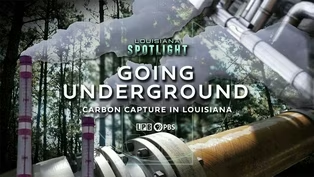
Going Underground – Carbon Capture in Louisiana
Episode 15 | 56m 45sVideo has Closed Captions
LPB examines the science and policies behind carbon capture.
As greenhouse gas emissions rise, Louisiana is considering carbon capture and storage to reduce emissions from industrial facilities. The technology would capture carbon dioxide before it reaches the atmosphere and store it deep underground. As proposed projects pop up across the state, questions about the technology’s costs, benefits and unforeseen impacts rise.
Problems playing video? | Closed Captioning Feedback
Problems playing video? | Closed Captioning Feedback
Louisiana Spotlight is a local public television program presented by LPB
Going Underground – Carbon Capture in Louisiana
Episode 15 | 56m 45sVideo has Closed Captions
As greenhouse gas emissions rise, Louisiana is considering carbon capture and storage to reduce emissions from industrial facilities. The technology would capture carbon dioxide before it reaches the atmosphere and store it deep underground. As proposed projects pop up across the state, questions about the technology’s costs, benefits and unforeseen impacts rise.
Problems playing video? | Closed Captioning Feedback
Where to Watch Louisiana Spotlight
Louisiana Spotlight is available to stream on pbs.org and the PBS app.
Providing Support for PBS.org
Learn Moreabout PBS online sponsorshipI'm Rusty Bayles.
I was born in Natchitoches, Louisiana.
I came from a small ranching operation.
I was a combat engineer, a free elser, and also a paratrooper.
Works in the special operations projects and task.
In that 28 years, we lived all over the world.
I guess when I was a young man, I couldn't wait to get off the ranch.
I was tired of filler with cows and feeding horses at about 3 or 4 years into the Marine Corps.
I couldn't wait to get back.
When I retired from the Marine Corps in 1993.
This is where we wanted to come back to, and I wanted to come back here and just do what I wanted to do for the rest of my life, and that was raise cattle, drive tractors and ride horses and work cows.
I wanted my family to be here.
Rural environment, country.
And I like it.
It's kind of a place like my wife and I really enjoyed living.
I came back in 1993 after 28 years in Marine Corps, purchased some more property, has property that was family property that I added out other period of time.
You know, I think I've been a pretty good steward.
I've done everything I could to keep up the land value.
I'm raising cattle.
I'm raising hay crops.
And I wanted to do what I could to make it profitable for me, but also for for conservation purposes.
The land can be used for other people later down the land.
One of the first things I realized when I came back was that you have to manage your land, and your land comes your family.
And I don't know, I can't tell you the number of hours I spend on tractors or horses or fence lines, keeping them clean.
Keep them clear with his family concept.
This is what I want to leave to my children and to my grandchildren.
So it's family to me.
And you treat it like family.
You treat it good.
You treat it well.
Probably about two, two and a half years ago, I received a letter from a leasing company that wanted to lease my land.
I wasn't sure what they wanted to do with it, but there's something about putting carbon in the ground.
It was putting CO2 in the ground.
Sequestering.
I raised my hand and said, no, not here.
Carbon capture technology.
Will it live up to expectations?
This legislative session, new bills address property rights, local control and who gets a say in what happens next?
Today, Pineville State Representative and Speaker Pro Tempore Mike Johnson follows a combination of new bills into the state Capitol, all taking aim at carbon capture, sequestration.
Carbon capture and storage, or sequestration.
Is the idea that you can capture carbon dioxide and then mechanically inject it into pipelines, and then into deep sailing aquifer formations?
It's largely the idea that that we've been hearing about for permanent sequestration.
There are lots of other ways to capture and store carbon, but the way that we're really hearing around an industry in Louisiana is this idea of long term deep storage.
The idea is to address the fact that we've been burning too many fossil fuels over the last number of centuries, and it's gotten to a point that we absolutely must reverse the amount of greenhouse gas emissions we have in our atmosphere.
Unfortunately, what we see is that carbon capture and storage is being used to extend the life of the very same fossil fuels that have gotten us here in the first place.
And so we're very concerned about what that means in terms of the continuation of the use of fossil fuels in a way that doesn't make Louisiana safer, and in a way that also makes our lives a lot more expensive.
I did some research on it.
I couldn't find the light.
I talked to my representatives.
They had they were a little bit more knowledgeable than I was at the time, and they kind of explained to me what it was.
They won't take carbon that they take off of natural gas facilities, like it's having parish put it to pipeline, take it down and injected into my land research as much as I could.
It was on anything about it that I liked.
Nothing.
I think in my viewpoint, they were turning my property into a toxic dump site.
I recently had the property appraised at $3,400 an acre.
They're offering me $360 an acre to put something below the land that I own.
I can say right now, with a large degree of certainty, I don't know anybody that's in favor of it.
I know I have not found a single person that wants to give up their land.
My name is Philip Landry.
I'm a landowner and I've lived here in Vernon.
Paris.
That's 88.
This is a family land.
We have a few hundred acres here, and we raise.
Hey, horses.
We have recreation here.
We hunt and fish on it.
We grow timber.
So it's quite a diverse piece of property.
And we hope to keep it in the family for some generations to come.
I about two years ago, I guess I was contacted by a company to lease the land here.
And they want to lease the land by the acre for upfront payment, and then they want a lease on the land for a per ton when they start injecting the carbon.
I haven't signed the lease yet.
I was kind of waiting until to see what a lot of how a lot of this shook out with the legislature and this and that.
So I still have the contract.
They've contacted me, and we're somewhat in negotiations now to try to get the price up a little bit, haggling back and forth.
I think they're at 150 now or something like that per acre, which, you know, you talk to other folks and sometimes it's a little higher than that, sometimes it's a little lower than that and the ton is $4 a tonne or something like that.
I don't see it as a property value killer.
I see it happening from reading about what Exxon's going to do, or the other companies that are coming in is they're going to inject this at about ten, zero zero zero feet, and hopefully we'll never see it again, which we have the formation here that will absorb it.
So I don't I don't see a threat to my land, getting in the aquifer or anything like that that, you know, other people are worried about.
I have confidence that they'll come in here in Do the Right Thing.
The conversation in Vernon Parish at the outset of the discussion about carbon capture has and continues to be quite heated.
There are those on the science side that say there's nothing wrong with it.
There are those on the other side that say there's not enough science behind it to justify it.
A unique component of Vernon Parish, though, is that throughout history, our natural resources have been harvested and used, but not necessarily to the best of our manage.
And so those of us who are looking for economic opportunities here are fully aware of the impact that it would have both on the state's economy and potentially here locally.
And from that vantage point, I think there are a vast number of people who are more on the fence than decidedly against carbon capture, but that need a little more information to make a decision.
And so the parish is very, very rural.
I believe it's the second parish by land area in size in the state.
But as of the last census, we're looking at about 47,000 people total.
There's been a consistent outward migration.
According to the US census since the early 90s.
And those of us who are still here are looking for those opportunities in anything that we can to help bolster and create a good standard of living for our people here, and also what the next frontier is, similar to what it would have been during the timber boom.
My understanding on the current development for the well sites or potential projects in Vernon Parish is that we're about 75% complete in the process for a permitting of a different type of, well, physically class six.
The issue has been is that the public had very little comment or input on that process, or where it was going to be located.
That is not necessarily anybody's fault, but our own in terms of not having an understanding of what that looks like, what that technology looks like.
Officially, the Greater Vernon Chamber is neutral on the project.
Our board of directors has taken the temperature of multiple people in the parish.
We do have a number of entities that are members of the chamber, lawfully operating businesses, who are obviously in support of it.
And so the best that we can do is to remain neutral in that regard, while recognizing what the potential economic benefits are to our people.
So concerning the risks, there is certainly concern over that.
I think that the the relative newness of the technology that we're talking about here plays into people's minds that it's the whether or not it's worth the risk or not.
There's simply not enough empirical data for them to make a hard and fast decision on that with any degree of success or confidence.
We had voted on it in 2020 to expand CO2 in the state, CO2 carbon sequestration to expand what had been passed in 2009.
Never thought it would come here.
We were told carbon sequestration was going to help the oil and gas industry.
And although we have a lot of all and gas here, it is so far down, it's never really been accessed nor exploited yet.
And this thing went through the Senate and the House in 2020.
There were literally no questions, literally no questions and none at the floor.
Well, there's one question at the floor.
It was a joke.
And so it's like no one thought about this, and I had to go back and look and it's like, wow, I did vote for that.
And I read the bill.
And I remember reading the bill, I remember being puzzled because, look, when I did here for 353 on the floor, I was skeptical because I, I don't believe at all in, in, in man made climate change.
I, I, I'm not into the green, patterns for trying to change climate.
I think it's a fool's errand, but but I remember thinking, okay, they're doing this.
And I got a note on my desk from the Association of Business and Industry.
I got a note from all and gas people who say we need to do this.
It's like, well, heck, maybe I'll help somebody in Cameron Parish or Lafayette where they've got all in gas.
So I, I went back and I was trying to trace together what happened.
They even went back and pulled all the video up.
It's a win win opportunity for the state in that it cleans the air and allows Louisiana businesses to take advantage of federal tax credits.
All kind of people now who are who are with me in this journey of trying to find out where we're going to go.
Couldn't believe they voted.
I had to show representative McCormick and Representative Carter that they voted for this.
No way.
I'd vote for for for carbon sequestration.
It's like, yeah, you did.
We all did.
Was unanimous vote both bodies, 980 nays.
And the bill is finally passed.
I can't with a straight face tell anyone that's a public good.
I. I can strain any way I want, and I cannot rationalize that it's not moving water that's going to be for sale or public good.
It's not going to be all that you're going to heat your home with or drive your car.
They are capturing waste off of industrial facilities, and they're burying it because someone thinks it's going to change the environment.
You know, that doesn't sell around here.
And people just they don't they don't get it.
And that's why everyone's neck is up.
You know, even after six years into this of trying to dig into what's below the surface here other than what's on paper, you know, I read what's on paper, I can see that.
But how was I to know we were going to be talking about carbonic acid and 9000ft down in water supplies, and all the things in my line of work in the Air Force was studied what was called cascading and corollary effects.
You blow a building up, it can have effects in all sorts of things around it.
You drop a bridge.
You think you're just dropping a bridge?
No, there's water and gas lines over that.
You're going to cut people's water, gas and electricity off.
It's just kind of what these things happen in lawmaking.
You put something in place and then it gets enacted.
It's like, oh God, this is a mess.
Geologists around the world have been attempting to do this for decades, and every time they do it, it fails in some way that no one saw coming.
And I'm talking about Chevron and Shell and Exxon, the world's largest oil and gas companies, have tried this to great failure for billions of dollars.
And now they're saying, we want to do the same thing, and it'll work at a much larger scale in Louisiana.
I have yet to hear a single one of these geologists explain why they think that Louisiana is different than every other place on the planet that they've tried, so we've already seen it happen in Mississippi a number of years.
Go back when people talked about clean coal, a power plant was proposed called Kemper in Mississippi.
The idea was that on a brand new power plant that was to burn coal, that they would add carbon capture and storage.
They spent billions and billions of dollars.
And the thing never worked.
Never.
Not once.
In the end, they just turned it into a gas plant.
There's not a single gas power plant on the planet that does this.
And unfortunately, the the plan by a lot of utilities is just simply to do something that we see over and over failing elsewhere.
So in Mississippi in February of 2020, there was a malfunction of a pipeline because of land sliding.
There was a large amount of rain and it moved the land.
And when this land settled as a result of that rain, the brittleness of that pipeline couldn't withstand that Earth movement, and it broke.
The location of the emergency like five minutes off of highway three.
My friend, he went on the ground at the stake in.
He kind of going out of the mouth.
I don't know if he's having a seizure or not.
Okay.
Maybe it isn't guitar.
Yeah, yeah.
I was with my family.
I'd been shopping with my family.
This incident occurred approximately seven, I think I was 709, 7:10 p.m.
and received the first radio traffic or the first phone call.
I just haven't had a radio on in my my house.
When I heard dispatch dispatched from Community Fire Department to report of a rotten egg smell and a and a yellow fog in the area between highway 433 and highway three there, in rural county.
I left the Emergency management center and responded to the town myself.
And this is a town that I'd been in a hundred times before.
This is a beautiful, small, robust country town.
It's usually people swinging even at night.
You know, you hear birds singing.
In this particular night as I entered the town, it was just a very eerie feeling.
Everything was dead quiet.
There was a chemical smell in the air as I would look from block to block.
There were vehicles that were abandoned, doors open, houses open, cars were empty.
It reminded me of a scene from The Walking Dead that particular night.
We had just gotten a new Board of Supervisors elected, and they were doing a gumbo cookoff for the community.
Everybody having a good time.
I didn't have a radio with me and passing a deputy that was walking around.
He said, hey, you heard about what happened in Yasuke?
I said, no, I have no idea.
He said, some type of an explosion.
So immediately I called Jack Willingham, which is kind of my counterpart in that county.
As soon as he answered, he said, get here now.
So I still didn't know, you know exactly what was going on, but I knew it was some type of from what we were being told, like a natural gas explosion.
At that time.
I got on the phone with the fire chief, would have been the initial responder out there in that area, Durwood Pettis of Try Community Volunteer Fire Department, and we started trying to decipher just what the problem was.
We knew that with the report of people being shortened, of breath and the port of the fog that we needed to set up outside the perimeter and make sure nobody entered without proper breathing apparatus.
And we were just the first 20 to 30 minutes of the incident.
We're trying to determine what the problem was in the area, or initial thought was possibility.
With the smell of rotten eggs and the yellow cloud or fog, we were thinking like a chlorine gas incident, but so again, we started start checking out boxes, checking off boxes, and about 35 to 40 minutes into it, Durwood, who just happened to at one time and a contractor for dinner, Barry, who was the pipeline operator at the time, made a call to Denver to say, look, if y'all had any incidents out here, that would do it, and that's it.
At that time, they said that at approximately 707, they'd had a loss of pressure on that line.
So that's when we knew more of what we were dealing with.
So that's when we began to get people in with air monitoring to determine the levels of it.
And we'll begin evacuating residents out of the area.
So we we gathered up a few of our more experienced guys and started gathering up some equipment.
Again, we didn't know what we were going into, so we we took a side by side kind of UTV type device, loaded it down with air bottles and equipment.
I was probably there within 25 minutes or something like that along the way.
I'm still trying to get information.
There's still very limited information of what's going on.
I think it's pushing around 7:00 at this time.
Peeing drive up.
They have a checkpoint with a fire truck south of that incident.
And again I asked the fire guys and the deputy was there.
It's like where y'all have, we don't know, some type of leak.
And as I'm getting my stuff out to start going that way, I did notice there was a couple of ambulances there and there were some people on the side of the road, you know, kind of in a fetal position, vomiting, that kind of thing.
We had approximately 45 people transported to the hospital in one mode or another, including two first responders.
This point, we're using gas powered vehicles to respond to the scene, as most of us do in the South.
We did have a couple of reports of ambulances struggling as they were going through the area, their vehicles cutting out, trying to cut off, turned on to the scene.
Our fire trucks, of course, had set up at a point right outside the perimeter what we call a safe zone or a cold zone when we have an instant like that.
So we really didn't struggle with them.
But getting to the people within their residence, we did have trouble.
As a matter of fact, our responders were using vehicles that were maybe not belonging as they found them abandoned there in the town, used what they could to get people out to safety.
So on this particular night, our our first responders, although they were not prepared for an instant specific CO2 incident, they did a hell of a job in going in and responding and using their their what they knew and what they could do to get the citizens out.
So my guys and myself, we all put on everything.
We had our structural firefighting gear and a self-contained breathing apparatus because we didn't know what we were going into.
So we're wearing about 80 pounds of equipment on us and breathing our own air.
First thing we notice when we get to the town is that there's an intersection at that town.
There's highway 433 that runs back, I guess it would be south off of highway three.
We encountered a vehicle sitting in the middle of the highway with the headlights on, just sitting there.
Doors open, nobody around.
Car wasn't running.
We checked that car for victims.
There was nobody in it around it.
We continued left at that point into the town of Starship.
The one thing that we noticed as soon as we got close within a couple of miles was the roar.
It was just a deafening roar getting in the town.
There's there's no movement.
There's no activity.
There's.
There's houses with lights on, front doors open.
There's, you know, a bonfire burning, which was a very good clue for me that we didn't have an explosive type gas, but it looked like the town.
I just stopped in time.
We went door to door.
There was a deputy with us that was not in protective clothing, and probably 2 or 3 houses in.
He started getting real weak and was about to collapse.
We were screaming at him to to get out of town, you know, to leave, getting his car leave.
Finally he left.
And then later I found out he ended up in the hospital.
So we're continuing on on the road.
And, I hear him say, we got another vehicle up here.
To be honest, we're like, it's going to be empty to just like all the rest of them.
And as we pull it up, our side by side starts dying.
It just starts spitting this button.
What CO2 does when it's released into the atmosphere is it takes oxygen out of the air, all gas motors or internal combustion motors, and they're required to have oxygen to operate.
So when you remove all the oxygen from the air they can't take any oxygen in.
Therefore, internal combustion engines will not operate in a dense amount of CO2 after a certain amount.
So some of our responding vehicles, including ambulances, were unable to get through effectively to get to patients.
So we'd had to set up a point outside a cold area, go in and get patients and bring them out.
We did some of this on foot and some of it using what we had within there to get people out.
We would go vehicle to vehicle, bringing residents out of the community.
So now we're in a low oxygen deficient, you know, area obviously.
And I tell him to stop.
We'll walk it.
He said.
Well, there's people in it.
When I first looked at the car and looking from the passenger side, I see a male in the back seat slumped over.
He's got foamy stuff, slobber coming out of his mouth.
I'm looking for chest rise and I don't see any.
The passenger still had a beverage in his hand, so he shattered the back glass on the passenger side and started removing him from the vehicle.
He was breathing it probably 6 or 8 times a minute.
It wasn't enough to sustain life.
So we we got him out and got him loaded.
And keep in mind, the back of our side by side is full of air bottles because we have to change our own air.
So we put him on top of all the air bottles.
And my partner said to you, you know, y'all want to go back and take him back and then come back and get these.
I said, they won't make it if we leave them there.
They're not going to make it by the time we get back.
So we made a decision there to pile them on top of each other.
We probably got a mile back from the ambulances that were parked, and you could see a little movement out of them, you know, removing them from that, that environment.
They started getting some oxygen, you know, through the normal air.
We got them back.
And at that point, our Mima area coordinator, Mississippi Emergency Management, was on the radio with us as well, and he wanted us to get a closer look at the leak.
All right.
So now they're now they're really pushing me to to go find this leak.
So we drive and our side by side dies, you know, as we get close and as we're walking into the scene, it's like.
It's like an ice storm.
There's no more.
Just regular environment everywhere you look as ice or what appears to be ice.
And what you had was a what they call a guillotine rupture of a 24 inch pipeline that ran at about 1200 psi.
It means exactly what it sounds like.
It means it was a complete split rip rupture in the line.
The CO2 in our area was actually used for enhanced oil recovery.
Okay.
And it was actually transported into Yasu County through a pipeline from the Jackson Dome, which is an underground dormant volcano in the Jackson, Mississippi area.
Our Mima guy asked, like, what do y'all see us at that?
I don't know, it's just white like white powder everywhere.
And he said, all right, get out.
But now you've got to realize that this 24 inch line bled off for approximately 4.5 hours, even though they shut off a valve on it was approximately nine miles upstream of the breakup.
It bled out for four.
It took 4.5 hours for the product to completely empty out of the line.
So from seven to probably 1130 that night, you heard the roar of a jet engine and product being released from that scene on the day of the event in February was the first time that I found out there was a CO2 transmission pipeline running through our county.
Not only the first time that I found out, but the first time that emergency management directors in Warren and Madison County who responded with me that night for assistance, found out that the same problem was running through their counties.
Although that this incident seemed to be the perfect storm when it took place because it happened at 7:00 in the cool, though he had.
It happened at 2 to 3 in the morning.
We could have had much worse results where it possibly would have resulted in death.
You know, there was just a lack of communication between the pipeline operator and first responders and knowing what product they had and the size of the line.
Since this incident took place, I've been really pushing forward with federal agencies to make sure that lawmakers make these pipeline operators do more than just check the box.
What we saw in Mississippi, which was the movement of the ground by a very small amount as a result of rains and flooding.
We saw that that the kinds of pipelines that are meant to carry this CO2 couldn't manage it.
What we know is that Louisianans can't afford to pay for industrial failure and utility failure, and we cannot afford to be a an experiment ground.
I found that they're taking something that we don't consider to be a polluted carbon that the trees need, and they're injecting that into my property.
And what I think they're doing by mixing that with the chemical that they used to put it down the pipeline with, it becomes caustic, it becomes caustic acid, and that eats through pipe concrete or whatever they got down there is my understanding that one class five permit has been issued in Bernard Parish, which means one point they drilled one hole in the ground and found out at this point in the ground, we think this is a good soil to do this between a point a class five and a class six, a whole lot of paperwork is due before they can submit and get a class six permit.
Their class six permits have been submitted, but they haven't been accepted.
And I really don't know what the holdup is.
I, I hope they will put a pause on it periodically because I'm told once a class six is done, that it's like 18 months to two years before anything would go in the ground.
I think a lot of things that are here now that a lot of people overlook, right underneath their nose.
Natural gas lines are everywhere in neighborhoods, going into everybody's house.
That's flammable, dangerous pipelines everywhere.
You know, the carbon not being flammable can handle it.
They can push it through a pipeline, put it in the ground, not going to catch on fire.
Got 25,000 miles of interstate pipelines in Louisiana.
They carry some kind of distillate or petroleum product.
The way that the oil and gas industry works is they're not going to come in here and and they try to do something stupid.
I mean, they're out to do the safest job they can, and they have the technology to do it.
Now, these deep well injection sites that they're doing with nuclear waste and all the nasty stuff in the world.
It's been proven safe.
Is it completely safe?
Nothing really is, I don't guess, but I have full confidence that they're trying to protect their liabilities as much as they are other people's liabilities.
Permitting, is a big component of what this activity entails.
Companies industry will have to apply for a class five and or class six in a permit for their carbon sequestration.
In my line of work, I read permits.
I helped write permits to make sure that we're in compliance with whatever that state or federal regulatory act Clean Air Act once again, Clean Water Act, Resource Conservation Recovery Act.
So understanding what the permit says and how it needs to be applied is a basis for making decisions on whether mitigation is required or not.
There's some there's some things that all tie this together.
You're looking at a project that is going to touch almost every media area across the environmental world.
If you're taking this carbon dioxide off of an industrial facility, hooding a system through it to turn it from a gaseous form to a supercritical, almost liquid gel type form, and then transport it somewhere to be able to be stored geologically deep underground.
That's an industrial waste.
It's hard to determine what real impacts could happen unless you understand what that waste stream comprises of.
I have seen one on a permit that's out there for public comment.
It was for the hackberry, Cameron Parish.
Well, at which they said 98.3% carbon dioxide, 1.6% cage, for which is methane.
Where I get concerned and where I focus my attention as a 1% other point, 1% other is a very small number in reality.
Right.
But when you're looking at 2 million metric tons per year over 20 years, by the time you take that calculation off, that's 40,000 metric tons of other.
And that's just one.
Well, when I looked at their information, they said once their facility, their their proposed injection wells up and running, it will provide two permanent jobs.
Two, right.
Is that economic prosperity?
Is that benefit?
That's that's where the part of my concern is, right.
When you break down the energy and conservation data, 33 applications, 104 wells, 18 parishes, of those, 104 wells, 27 are specifically Vernon and Allen Parish.
You add Beauregard in, though that number goes to 29.
You add repeats, which is central to that number goes to 41.
So nearly half of those 104 are in central.
Why?
Because we're rural, less impact big landowners that can commit large land space while the individual smaller property owner.
And by small I'm saying 100 acres or less are going to be forced into doing something that they really may not want to do.
That's my problem is a lot of these bills were heard in the Natural Resource Environment Committee.
So it sparked my interest.
But as I dug into it and I started understanding and really focused on enhanced oil recovery because they were claiming we've been doing this for 50 years through enhanced oil recovery, which I don't think you can once again put on a same scale, at all the questions that came to mind made me want to use my knowledge, my experience, not only from a permitting perspective, but from a natural resource conservation perspective.
To kind of help educate and help form, form a baseline of information.
So we're not just asked to accept what's going to happen or what's going to come because science is not settled.
I think for the average citizen, the process and the technology and how it's coming to be was really born out of economic incentives for that industry.
That being said, many of the 45 cu tax credits that are available for this technology have already been spent or spoken for.
And so I believe, in my opinion, is that that in many cases, a lot of the, a lot of the things that we would like to talk about are things that we would like to have in discussion.
It's too late for that, you know, and what they get theirs in is in tax credits.
And you understand what they do with their tax credits.
If they make $1 billion next year, they got $1 billion worth of tax credits.
They don't pay anything.
They've already got their money.
What we've actually seen with the 45.
Q is that over and over, unfortunately, that has been shown to be fraudulent or over accounted for.
If I'm a large corporation and I want to go get a 45 cu tax incentive, I simply have to file my tax return and say that's confidential and no one can check it.
That means that in order to look at whether or not those dollars are going to what they're supposed to do, took a congressional committee to conduct an investigation and look into whether or not these dollars were being appropriately spent.
And it turns out that out of roughly $1 billion in the first number of years, that that this credit existed, over 80% of those dollars were either overstated or fraudulent.
Can you imagine if that is how all of the other programs that we have in our country was, were operated with that little oversight?
Unfortunately, what this means is that the biggest corporations, the most valuable corporations on the planet, are getting less oversight for billions of dollars that just go straight to their bottom line.
When people who simply want to live and eat and keep the lights on in our country are subjected to farther scrutiny.
The concern that we have is, in the meantime, a lot of these facilities are getting built anyway, so new facilities that will have all of these additional Copa, in addition to an awful lot of new carbon dioxide and other greenhouse gases are going to get built.
And there's not even a promise of of something to balance it on the back end.
If that 45 cu were to go away, if it were to be changed and modified down, we would see a lot of these projects disappear entirely because these projects cannot exist without that federal subsidy.
And then comes in as our within the letter that they have the right to use eminent domain to take my property from me.
And Vernon Parish is not a place that eminent domain is really popular.
You go back to Fort Polk and all that land and piece of land was taken by those folks just like me, through eminent domain between the Department of the Army and the actual forest.
They own or control over 40% of the parish by land area.
Adding anything else to that footprint is obviously or obviously can be a problem.
There's a lot of confusion regarding the use of eminent domain for these projects, both in understanding what domain is and the potential number of acres that are impacted by the use of that for these projects.
When you are talking about Vernon Parish in particular, we lost a whole lot more land under eminent domain for the Department of Defense and the Department of the Army for Camp Bulk and then Fort Polk.
Then we will ever lose under these possible deal.
There's a bad taste in many people's mouths, though, because of how that's happened.
One of the, one of the problems under the prior use of eminent domain was that in taking all of that land for the benefit of the army did not necessarily correlate to an economic boom per se at the magnitude people were expecting on the backside.
That's where our frame of reference comes from.
And determining our understanding how dangerous eminent domain can be for a parish of our size.
I'm Jean Harmon, I grew up in Burning Parish, but eight years ago I moved to Arkansas and we live in Hope, Arkansas and my great great great grandfather and 2 or 3 of his brothers and all all their families moved to Louisiana in 1849.
And we lived on that land, or they did from 1849 to 1940.
So they had a great life out there that people were, you know, very, I guess you could call it was a big community of people.
In 1940, when Fort Polk was established, it was Camp Polk.
At that time, there were over 250 families living on the land where Fort Polk is now.
My family and all the families there received a letter of condemnation from the government, stating that the property was going to be purchased for the purpose of building a army training center, and that they would be given 60 days and they could take anything and everything off of their property, including their homes.
But they had to be torn down and removed completely from the property in 60 days.
They they had no idea what they were going to be facing, and they were offered the fair market value of their land.
But unfortunately, in an area like this, when 250 people are looking for land, what happens to the value of the land that's being sold when you leave there?
So not only lost their homes, their churches, their schools, they had sawmills out there, they had sugar cane mills.
They had they had their way of life.
My mom and dad and my grandfather wanting to see our family plot of cemetery so badly that we basically broke into the Fort Polk area and went around the gates and went in there, and our cemetery plot was grown up in weeds and bushes, and we had to spend days cleaning it and fixing it, you know, with eminent domain.
The taking of the land is only a part of the damage that's done to the families.
But losing your way of life is the biggest impact.
And I'm not saying that what's going to happen with CO2 will be that type of impact, but there should be total disclosure and complete transparency to all of us involved in Vernon Parish as to what's going to happen, because eminent domain is a big part of CO2 sequestration.
We have approximately 800 000 acre of land in Vernon Parish, and there's probably only 200 of that 800,000 that's available for private landowners.
The government owns a fourth of it already, all purchased through eminent domain.
And there's a few large timber companies that own the rest.
My entire family has been very supportive of Fort Polk, even though we lost our property.
But this issue is a little different to me.
I can see the benefits of training soldiers to protect our country, but I cannot clearly see the benefits of me losing the rights to my property here.
For some large corporation to have some tax credit while the individuals receive very little benefits.
In ten years ago, to keep the post, we had to expand the training range and they went in to eminent domain again and got a larger training area.
So eminent domain is not a good word for Vernon Parish.
We don't like it.
My understanding regarding eminent domain and these projects specifically is that the majority of the land was already needed well beyond the threshold that was required from a legal standpoint in terms of being able to force the sale of additional property.
And even then, it is limited to those areas that are going to be needed for pipeline purposes, transport, pipeline purposes.
So I think that there is a very, very loose case to be made for the use of eminent domain or those projects, except for the fact that the government has invested heavily in this technology throughout history, you see technologies that continue to be perfected.
I think that one unique data point that seems to be lost on many people is that we already have 55,000 miles of pipeline running through our state, a lot of it here within our parish that no one knows about, and most of that in the risk associated with it are much greater than what the science is telling us from the carbon sequestration standpoint.
On the other side of that, we do not have much data on the actual injection sites themselves.
Empirically, that tells us whether or not they would be safe for the long term in terms of the economic activity that is of a potential for our parish.
You're looking at 3 to 500 jobs for those carbon projects per project.
There's around 13.5 to $14 billion in state in state impact on these projects, not limited to Vernon Parish.
The ongoing jobs that could be created for the management of those sites, as well as the auxiliary or ancillary activities that come with it, are another component.
Long term, it would probably be best for our parish to take whatever proceeds.
It can get whatever economic benefit that it could garner and create further opportunities for economic development.
I think for those who live in Vernon Parish, the question is it's actually in my backyard.
So as much as I might be concerned about what's good for my neighbor, I'm absolutely concerned about what's best for me in my community.
The trade off there is making sure that in the event these projects do move forward, that it does position the people of Vernon Parish for their projects to be well positioned for economic growth and prosperity in the future, something we've missed out on in the past.
I being able to sequester carbon, we are continuing to be able to serve the consumer needs of customers of our manufacturing and customers.
Come on, what customers?
You around the world representative, I would say that, inquire that this topic is brought up as a possibility in this part of the state, that there has been public opposition, and I haven't seen that, Wayne, at all.
I have not seen that there are some people that are wishing it away.
There's some elected officials in other parish should say, well, I think it's all settled down.
And like then you go to their public meeting and it has not settled down.
My appreciation for the the bulk of these things is that they're going to go to absent landowners.
There are a handful of landowners around here who are being approached because they got to have the landowners to get the pipelines in, and they got to have a 5% of the landowners inside the 5000 acre unit.
But most of these are being brought in by absent landowners, which is fine.
I mean, people own land all over the place, but where that money would go to an absent landowner, I don't know that it would matriculate out into this community.
It might if it was a farmer here, if it went into Mister Mister Bales land and, you know, he could spend and develop here or or whatever, but I it it's not my appreciation that that's what it would, it would work that way here.
I don't I just don't believe it.
This is our home.
My wife and I are from here.
Home means a lot.
I came back here on purpose, like Colonel Bales did.
This is my home.
These are my family members.
My family lost land in the 40s and again in 2015.
A lot has happened in the last year.
We've kind of at a holding pattern.
State has tried to decide what it's going to do at the gubernatorial level, at the department level, trying to decide if it's going to approve or deny injection wells.
And we've continued to vocalize our concerns from our constituents.
And I will tell you, I have continued to research and to learn about this topic.
And the more that I have researched and the more that I have learned, the more concerned I am.
Do you think we have the right to change the rules in the middle of the game and think that we are business friendly state if we're going to change the rules?
Alright, hold on one second here.
Hold on one second.
There are there are provisions in our law that allow for the state to authorize the taking of land for public good.
The debate is what is the public good and whether or not the burial of carbon waste could ever be defined as public good.
But this is home, and I can't understand the public good to this.
So we are basically where we were a year ago.
We passed legislation a year ago that in some ways constrained it in some ways, kind of kept it stable.
To my understanding.
No one has gone to court over this.
No one has lost their land.
But the threat of it is what has my citizens and me concerned, the threat that they that they possibly could do it and that they would do something that is not for a public good, take land by their above the ground or below the ground.
We're not anywhere different than we were a year ago this last session.
It was a repeat of last year's session.
My colleague Mike Johnson in Pineville introduced the bill that I had last year that would allow any Paris in the state to opt out of this business activity.
And that bill was defeated 9 to 7.
It was it was a close vote.
And it's bewildering to me that that our that our colleagues don't think it's okay that we decide what we do in our own parishes.
They allow us to decide what we do with the sale of alcohol, with gambling, with all sorts of things.
And we were simply asking for the right to decide what business activity takes place here, because this is a business activity.
This is a business activity for someone to bury waste.
In this moment in time.
We are literally waiting to determine if the state is going to award the permit that has been applied for in in my home parish of Vernon.
That's that's the thing that's on my front burner.
I don't believe in burial of carbon waste at all.
I think it is a stupid idea.
I think it is tied to a stupid idea.
So what we're waiting on is to find out if our parish will be violated with an activity that 85% of my citizens do not want.
And so that's what I'm waiting for to happen in the next year, because you don't want to bring something like that to a community like this that's already lost 300,000 acres of land to the federal government to be forced into a moment like that, you just you don't want to do it.
And I I'm hopeful.
And I'm going to believe the governor is a man of his word not to do that.
I will be hopeful that we can continue to make the case that it is.
It is best when people get to decide their own futures.
And I'm also hopeful that that the people can become educated as to the the silliness of thinking that they're going to capture enough carbon to do anything.
We are being asked in Louisiana to trust companies who have failed globally to do something brand new at enormous scale in people's backyards, and each time, legislators or even local elected officials ask, can we put some guidelines?
Can we put some barriers?
Can we back this stuff up away from people's homes, in schools?
Unfortunately, what we see happens is an awful lot of lobbyists flood the Capitol here in Louisiana and say, no, no, no.
The business model can't work that way.
It has to be in people's backyards if it isn't economically viable, if it isn't technologically viable, and it isn't working, why are we doing this?
It has become so clear that we've gotten so far down the road in terms of climate change, in terms of the greenhouse gas emissions and the thresholds that we're passing every year.
It's become so clear that we have to do everything we can think of that I think there's a lot of attention being paid to the things that feel like grasping at straws.
What I would say is, let's put that money to things we know work.
Let's put that money to helping people live in their homes, in places that are hotter and more humid.
Let's put that money into ensuring that people can continue to live in our country safely and healthfully.
The only way we get to net zero is using technologies that work that we know are available today, and that includes solutions that Mother Earth has already offered us, and that includes things like reforestation.
But here in Louisiana, it also includes making sure our coastline is strong, making sure that we are rebuilding our coastline so that it can capture the carbon naturally so that not only can it capture that carbon, it can also defend against the worst kinds of impacts from those hurricanes and storm surges that so many of us have to deal with on a near annual basis now.
So it's it's solutions that have multiple benefits that are the ones that communities want to see.
About ten years ago, the only gas came through, and some people made a little money because they were going to drill a well or two, but that never played out.
So it's something new.
And I think a lot of people don't understand.
And I think a lot of people, some people don't want to understand it.
I think any industry that you bring in is going to have some kind of risk.
Now, I don't think the risk of the carbon pipelines are going to be as risky as having train cars going right through the middle of your town, the railroad cars that go right through town, they carry some of the worst chemicals that man can make ethylene glycol, propylene, fertilizers, chlorine, all this, and they're constantly derailing.
You know, nobody's jumping up and down about that.
Nobody.
They just they see it every day and it's become common.
And that that's more dangerous than what we're talking about, having carbon and pipelines and putting it 10,000ft underground.
These pipelines will be out of town a little bit.
And, you know, it's it's less risk to the general population that lives in the metropolitan areas.
And the extra income that would that the land would generate would help us maintain it like it should be maintained and manage it the way it should be managed.
Part of this land was given to me by my father as his legacy.
I've added to it by buying some.
And my purpose in life is that when I go out, I want it to be my legacy for my children and my grandchildren.
I don't have any of them right now that have any indication they want to come back, but at the time I left, I would coming back either.
I would like to give them something of value, not a toxic waste site.
I think it's devastating to my property value.
I think I could get a, you know, pretty valuable piece of property.
I think the value goes down tremendously.
Who wants to buy a toxic waste site?
I don't know what the current use would be, what the impact would be, but the legacy is this that land is worthless.
That's what I feel.
What we stand right now is that I believe they have done everything they can to fight this, I really do.
I think it's a losing battle.
If the energy company, like ExxonMobil could spend $373,000 of lobbyists, and the only thing I was able to offer, Representative Owen, was the Farm Bureau lobbyists.
Now, they they worked hard.
They did a good job.
I think this is coming.
I think it's going to come to the rural parishes.
And Vernon Parish is one of them.
Allen Parish is another one.
Cameron Parish is another.
Providing Support for PBS.org
Learn Moreabout PBS online sponsorship New Episode
- News and Public Affairs

Top journalists deliver compelling original analysis of the hour's headlines.

- News and Public Affairs

FRONTLINE is investigative journalism that questions, explains and changes our world.
 New Episode
 New Episode
 New Episode
 New Episode
 New Episode
 New Episode
 New Episode


Support for PBS provided by:
Louisiana Spotlight is a local public television program presented by LPB