
It's A Great Pumpkin
Episode 4 | 25m 21sVideo has Closed Captions
In Cherokee homelands, historic Dutch Fork pumpkin roasts with the “Little Tan."
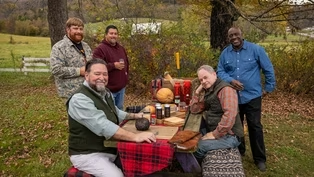
Carolina pumpkins trace back to Pumpkintown, SC, where the Cherokee shaped the Oolenoy River valley. The Savers meet Nat Bradford of Sumter, SC, champion of Dutch Fork pumpkins. Mohawk Chef Dave Smoke- McCluskey spreads Bradford’s seeds among Native growers. Together they journey to the Cherokee homeland to roast Bradford’s pumpkins alongside the “Little Tan,” grown by Cherokee horticulturists.
Problems playing video? | Closed Captioning Feedback
Problems playing video? | Closed Captioning Feedback
It's A Great Pumpkin
Episode 4 | 25m 21sVideo has Closed Captions
Carolina pumpkins trace back to Pumpkintown, SC, where the Cherokee shaped the Oolenoy River valley. The Savers meet Nat Bradford of Sumter, SC, champion of Dutch Fork pumpkins. Mohawk Chef Dave Smoke- McCluskey spreads Bradford’s seeds among Native growers. Together they journey to the Cherokee homeland to roast Bradford’s pumpkins alongside the “Little Tan,” grown by Cherokee horticulturists.
Problems playing video? | Closed Captioning Feedback
Where to Watch The Savers of Flavor
The Savers of Flavor is available to stream on pbs.org and the PBS app.
Providing Support for PBS.org
Learn Moreabout PBS online sponsorshipI, (Thomas Holloway), do declare the Dutch Fork pumpkin the most delectable in all the land.
Are you not curious to ascertain its origins?
♪ (David S) In every heirloom seed, lies a story of survival, of resilience.
A flavor forgotten by the modern world.
Join Charleston chef (Kevin Mitchell) and me, food historian (David Shields) on our mission to preserve the long lost flavors of the South.
We are The Savers of Flavor.
♪ [footsteps approach] ♪ [ Shhh! ]
Where does one look for South Carolina's native pumpkins?
By Pumpkintown, of course.
And that's what I'm researching.
Pumpkintown and its namesake pumpkins.
Here's a testimony from John Roper, who was born in the 1700's, writing about the Cherokee village at the base of Uhwarrie Mountains.
♪ The settlement was led by Chief Woolenoy, who inspired the name of the Oolenoy River.
And from their location, the tribe could view the valley and the mythical old man of the mountain, who feasted on Table Rock.
The hills are lush with oak, hickory, poplar, maple, and pine.
♪ The river valley's soil is rich and productive.
The Cherokee grew corn, beans, squash, and pumpkins.
In 1743, trader Cornelius Keith, he noted the abundance of pumpkins, and after the American Revolution, settlers who had set roots in this area named their place Pumpkintown, and they sent the seeds from their pumpkins to their relatives all across South Carolina.
♪ Now, let's go track some of the descendants of those seeds and tell their story.
♪ ♪ ♪ Kevin, you've cooked with the Dutch Fork pumpkin.
It isn't one of those, jack o'lantern pumpkins you get at Halloween.
(Kevin) No, no, not at all.
It's a beautiful tan pumpkin.
Orange flesh, really meaty.
Not overly sweet, but beautiful nonetheless.
(David S) Botanically, it's called, Cucurbita moschata.
And it's a kind of pumpkin that was grown all over the Eastern Seaboard of America by the native peoples from the Gulf all the way up to New York.
Up in New York, they now call it the "Long Island Cheese pumpkin."
A little farther south down in Virginia and North Carolina, it's called the "Cornfield pumpkin."
Down in Florida and Georgia, they call it the "Seminole pumpkin."
To the West from Alabama all the way into Louisiana, they call it the "Creole pumpkin."
And in South Carolina here, they call it the "Dutch Fork pumpkin."
(Kevin) Why do they call it the Dutch Fork pumpkin?
(David S) Interesting, Pumpkintown is not in the Dutch Fork.
But there was this man from the Dutch Fork, Colonel Thomas Watland Holloway, who lived in Pomaria, South Carolina, who adopted the pumpkin.
Bred it, saved seed from it.
And began improving it until he could get 13 pumpkins per vine.
And his skill at breeding was such that they made him the judge at the state fair for pumpkins.
[ Okay ] Soon, everyone wanted the seed from that Dutch Fork pumpkin that kept on winning the blue ribbons.
He was after a denser kind of meat for the pumpkins.
(Kevin) Those pumpkins, Dutch Forks, make beautiful pies, wonderful soup.
Very different from, you know, those canned winter squashes that we see in the North.
(David S) There's this Mohawk Chef (Dave Smoke-McCluskey), who has championed the Dutch Fork pumpkin.
He grows it and he knows so much about this pumpkin.
I thought it'd be fun to invite him along to our jaunt down to Nat Bradford's pumpkin patch in, Sumter, South Carolina.
(Kevin) Yeah, well, that's great.
You know, (Nat Bradford), hero among chefs, all the things that he grows, you know, of course, famous for the Bradford watermelon, his okra, his collards.
(David S) We'll meet him soon.
It looks like we're, it looks like we're getting close.
[ Almost there ] ♪ ♪ [car honks] ♪ (Nat) Kevin, David, welcome to Bradford Farm.
(Kevin) Tell me a little bit about the farm and what makes it the Bradford family farm.
What are you famous for?
(Nat) Obviously, what put us on the map, with you, and you already know this Kevin, is our Bradford watermelon.
It really is, it's chasing flavor.
That's what we're about today.
So, where can we find the most flavorful things that we can grow?
We've got three crops in our family.
That's our claim to fame, our signature crops are Bradford family okra, our collard greens, and our watermelon.
That's about all we had in our arsenal.
We had to go out and find the rest of them, which has been so much fun and that's how we've, landed on the Dutch Fork pumpkin.
(David S) So how did you, track down the Dutch Fork pumpkin, originally?
(Nat) I didn't track it down.
Again, it's just making friends with seed savers.
I connected with Carold Wicker, it connected with him, originally.
He saw a picture, had me, much younger, holding a cross-section of our watermelon, he saw that thick rind.
He's like, "I got to know how to get that seed," cause he needed that thick rind for his preserves.
So he wrangled his way through the co-op.
He was able to get my cell phone number and reached out to me and say, well, you can buy 'em.
You know, call "Sow True Seed," You can buy 'em, their 10 dollars a pop.
And he's like, well, "I, I might have something you're interested in."
(David S) He didn't want to spend 10 dollars.
(Nat) No, no.
He's doing the math, that's a dollar a seed.
So the next time I was passing through, his neck of the woods, we met up at his local watering hole, the Waffle House.
I thought I was going to get 30 cantaloupe seeds, and he was going to get 30 watermelon seeds, and he sat down with a box.
Like, oh no, I'm very ill prepared for this.
It's just almost a bottomless pit of heirloom seeds, with Carold.
But, the Dutch Fork was one of the first ones that he did give me.
(Kevin) Tell us what's so unique about the Dutch Fork pumpkin.
(Nat) Everyone's so used to seeing these jack o'lantern pumpkins.
They're bright orange, you know, Clemson color.
I'm a big Clemson fan, but these, there's just something mystical about them.
The color, They're tan.
Some of them have this grayish, bluish hue about them, with the wax coating.
Something rustic, something old and antiquated, and something you just don't see all the time, and it just draws you into it.
It looks different than all the pumpkins out there on the market.
You know, as soon as you consume it for the first time, you're going to be hooked on it.
This is the best pumpkin.
You're not going to want to carve it up and use it as a jack o'lantern, because these are special.
(David S) You have the bag of, of pumpkin seeds there next to your knee.
Tell us a bit about your seed saving.
(Nat) First thing that I always do, with, any crop, the Dutch Fork's the same thing.
You know, it's, it's a rare crop.
Even though we were out there looking at our pumpkins, and it looks like a big field and a lot of pumpkins.
When you think of the number of people that are growing that pumpkin in the world, it's a very, very small population.
It's still extremely at risk.
If I get in a car wreck and nobody carries on this, you know, what we started here, it's going back to people's backyards again.
First thing is saving seeds.
We'll take half the seeds, put them in a freezer and plant half, to make sure we have a back up.
Eight or nine years into growing the Dutch Fork pumpkin, and we're starting to see how it fits into the way we deliver it.
So we fit two pumpkins in a crate, and we don't want 'em taller than the crate so we can stack 'em.
That's some of the physical characteristics that we select for.
Beyond that, I mean, flavor is paramount above all.
But then we're also looking at density.
So, we can have one pumpkin this size, another pumpkin the same size, one weighs four or five pounds more.
It's got a thicker wall in it, more meat.
You know, you're getting more product in less space, which is nice.
So it's a dialogue with the plant.
You're engaging with it, you're learning from it not affecting flavor, but you're helping it fit into, you know, or at least we are, into how we can help that crop be successful, hopefully increasing its chance of sticking around for, you know, hopefully the next hundred years or more.
(David S) Well, we've been, sitting around here talking about pumpkins for a while.
I'm sort of curious to see them out in the field.
Is it possible that we can go out there right now?
(Nat) Let's go.
(Kevin) Let's do it.
♪ (David S) Walking out to see Nat's heirloom pumpkin fields, we find our other guest, Chef Dave Smoke-McCluskey has arrived.
Hey, it's Dave!
[ How's everyone doing? ]
(Nat) Good, how are you?
(McCluskey) Came by to steal some pumpkins.
(David S) Oh, man, you came to the right place.
(Nat) You don't have to steal 'em.
[ I know ] It's alright, as long as you're cooking.
(McCluskey) I'm happy to cook plenty of them.
(David S) You know, the butternut's relatively recent invention, post-World War II.
How would you characterize the flavor, Dave, I want to ask the same question to you and chef, you've tasted it too.
So we have two experts, professional experts on flavor and a grower.
(Nat) My experience is, the modern day butternut has been bred to have a tough skin, you know, so it can last long in shipping and storage.
You know, there's no chefs that's going to use that skin.
What I found is once these are roasted, the skin is edible, the flesh is edible, the seeds are edible.
There's nothing that you're going to throw away except for maybe, you know, this tough stem here.
But there's a fluffiness in the water content, in these Dutch Fork pumpkins that the butternuts don't have.
It's a sweeter flavor, and it's just got more pumpkin-ness in it than I would say the modern butternut does.
♪ (Dave S) Dave, do you work with the blossoms?
(McCluskey) I've eaten the blossoms, I've even eaten the leaves.
The leaves are great, sauteed like spinach.
A little bit of oil, a little bit fat, salt and pepper.
You get them kind of post that little hairy stage in there, and they're not bad.
But if you, if you blanch them, the hair will pop off and they're not so offensive.
But, it, they're great greens.
So shoots, greens, the pumpkin itself, and then the seeds.
(David S) Yeah, I guess the only thing you don't chew on are the roots.
(McCluskey) Right, exactly.
Well- [ Or the stems.]
You leave them there.
I've actually turned some of my, my, my greens and stems and vines back into, ash for nixtamalization.
[ Right ] And it works.
So, I kind of have a theory that the "three sisters," everything that's left over from them.
Like the cobs, the stalks, the vines, the runners, the shucks for the beans can all be turned into some type of ash to, to raise your pH in your water to nixtamalize corn.
(Nat) What I like about just chopping them up and putting them on a pan, roasting them with whatever kind of spice you want to put on them.
We tend to go savory, but I love that little crisp around the actual, you know, cube.
But it's like a little marshmallow on the inside.
(Kevin) Let's jump into the kitchen real quick and make our very own Dutch Fork pumpkin chips.
First things first, the hard part, shaving the skin off this pumpkin.
Honestly, it's a breeze after you get past this, so maybe get your nephew involved, be careful though.
After deseeding, we're going to quarter the pumpkin and then run it through the mandolin to get that classic chip shape and size.
Put them in a bowl, add lemon juice and two cups of sugar.
After a little stir, let it sit overnight in the fridge.
Then it's over to the burner, to where we'll bring to a boil, then dry on a rack and store in a jar.
And there you have it, your very own sweet and tangy Dutch Fork pumpkin chips.
Enjoy!
(David S) One of my favorite consequences of seed saving, is how food brings people together, allowing them to connect and share the dishes they cherish, from one family's table to another.
(Nat) I've had so much joy growing this pumpkin.
I'm so thrilled to be able to pass this over to you too, Dave.
(McCluskey) Thank you very much, I appreciate it.
These are such a wonderful gift as a native chef or just as a native period.
I think this, you know, retaining our foodways, retaining our ingredients is an important thing.
It nourishes the people with, first and foremost is what it should be doing.
(Nat) They're beautiful to look at.
[ They're wonderful .]
And they're even better eat.
(McCluskey) They sure are.
(Nat) Yeah, keeps us nourished.
♪ ♪ (David S) Thanks for these, Dutch Fork pumpkins.
[ Absolutely ] Does anyone making pies out of these things?
(McCluskey) Not me.
(Kevin) Well, in the South, they do, but they're not using this real pumpkin.
They're using canned pumpkin.
The Dickinson squash out of, Indiana.
(David S) Oh, yeah.
We're all familiar with that.
I see over there some candy roasters and- (Nat) We grow candy roasters.
[ You grow mammoth- ] (David S)The name actually tells you what to do with them.
(McCluskey) Right, roast it.
(David S) I did a survey of, you know, recipes from southern cookbooks and about pumpkin recipes.
And interestingly enough, the favorite recipe was, more confection.
It was called pumpkin chips.
(Kevin) Well, I'm glad you said that, because I have some here for you.
I read your mind.
[laughter] ♪ (Nat) These are surprisingly good.
(McCluskey) I like 'em.
I have an idea.
We could try cooking these the old fashioned way.
(David S) And that is?
(McCluskey) A visit to (Dave Anderson), maybe.
And, up into Cherokee country.
[ Yes, sir. ]
And, and roast them.
(McCluskey) Roast them on a fire.
(Kevin) Sounds good to me.
(David S) That sounds real interesting.
I know, Nat, that the life of a farmer probably doesn't permit you to have a road trip with us, but- (Nat) Wish I could.
(David S) Thank you for these.
And thank you for showing us your patches of candy roasters and Dutch Forks and letting us have the run of the farm.
(Nat) Absolutely, safe travels to you and say hey to David for me.
♪ ♪ ♪ (David S) Hey, fire up that GPS.
We're heading to western North Carolina, up to Cherokee Country, where we'll meet my friend David Anderson, the horticulturist.
He knows more about what pumpkins and winter squashes are grown by his people than anyone else.
[ Fantastic ] ♪ David Anderson, horticulturist extraordinaire.
This is my friend, Chef Kevin Mitchell (Kevin) Good to meet you.
(David A) Great to meet you.
(Kevin) So, tell us a little bit about this sacred land here.
(David A) So this area is known as a "Kituwah."
And it's a piece of land owned by the Eastern Band of Cherokee Indians, its about 308 acres in this track.
And right now, this is the oldest occupied site by Cherokees in history.
So this is the birthplace of the modern day Cherokee over here to my right, would be the original mound site, that there's 10 to 12,000 years of history right there, and there's 10 to 12 council houses that have been built up over time.
So you can still see the embers from the first fire in the council house.
And this is where the one fire, one people model for the Kituwah people would have come from.
So when everybody came together, they would come here and they would take an ember from that fire and then take it back to their village site.
(David S) Now, Dave, I know that you've had all sorts of connections over the years with David and, and you're a seed collector of corn and other things.
(McCluskey) To some degree, yeah.
I've kind of been cooking these foods or similar foods for, for quite a while here, for several years at least.
Probably my biggest kind of epiphany, if you will, is that most things had smoke to them because everything was cooked over an open fire.
So, we can cook the same trout or beans or pumpkin or corn or whatnot, but without that smoke flavor, there's a lot lost to it sometimes.
Or it's one dimensional, whereas if you have some of the other things that you're going to put on there, it all kind of comes together because there's a background of that smoke.
(David S) Well, smoke and pumpkins might be an interesting thing, you know.
(McCluskey) It's my favorite way to eat them.
(David S) Next, we head over to another sacred spot to finally roast and taste The Great Pumpkin .
Here we are.
(Kevin) Good afternoon.
(McCluskey) Good afternoon.
(David S) It looks like you're ready to- (McCluskey) Ready to get one on for you.
(David S) So, how long would these take to roast?
(McCluskey) Oh, probably another 45 minutes, half hour.
(David S) Alright.
I like that long pinkish one is what they call the North Georgia one.
[ Yes ] But- (McCluskey) We're in North Carolina.
[ Yeah ] [laughter] (David S) Well, this pumpkin cider is, quite a thing.
(McCluskey) Tasty.
(David A) Oh, it's wonderful.
(David S) Well, you know, one of the things which, interests me is all of your Cherokee vegetables get judged at the annual fair, right?
And, you have all these clans with their special breeds, brought in, who has the, impartial authority to, pass judgment on them?
That's me most of the time.
Yeah, it's difficult.
(David S) And you're Chumper Walker, right?
(Chumper) That's correct, yes.
(David S) Exactly what do you do?
(Chumper) I'm the extension director for the Eastern Band of Cherokee Indians.
We're a collaboration between North Carolina State University and the Eastern Band Cherokee Indians.
And we do ag extension for the Cherokee community.
(David S) So, you know all about the vegetables, cause I have a question about- [ Sure ] this little one right here.
Can you tell us about it?
(Chumper) Yeah, this is a Cherokee Tan and this is actually grown by David Anderson right here.
So, we are amazed because this is last year's crop.
This is from last fall.
And it's stayed that well preserved in an entire year.
So, you can imagine how easy it would be to carry this with you as you're moving around out doing hunting or various things to provide sustenance through the years.
(David S) Well, the thing that's so striking about this is that you can tell that this is a version of the Dutch Fork pumpkin, that Cucurbita moschata that grows native peoples from the Gulf Coast to New York.
And here is the special one from right here.
Have you ever judged those sort of greenish, blue ones that are actually shaped like pumpkins?
(Chumper) Like a pumpkin?
Yes, sir, we have, yep.
(David S) Do they ever win?
(Chumper) They do not.
[laughter] (David S) Well, it's time to take the Cherokee Tan Pumpkin off the fire and have a taste.
Oh, look at that.
(Kevin) It's beautiful.
(McCluskey) Ready for some eating.
Leave some of that skin on the table.
♪ Hard to believe it's a year old, isn't it?
(David S) Yes, sir.
Moist and steaming.
(McCluskey) Little filet action, like a fish.
♪ (David S) Taste?
(Kevin) Sure.
♪ (McCluskey) How do y'all eat these?
Little salt, little sugar or something?
Honey?
(David A) Honey, seeds, maple.
(David S) There's some, honey drizzled pumpkin right there.
(Chumper) Thank you.
(David S) And some for you as well.
Dave, I know that you like the- (McCluskey) Untainted, but I'm gonna have some of your tainted one.
Do you want some duck fat?
[ That's pretty good. ]
(David S) Yeah, I'll try that.
(McCluskey) I'll say the honey's pretty good.
(David S) Oh, yeah.
(McCluskey) Returning this to where it belongs, with the rest of the earth.
So... The star of the show.
♪ This one will be a little firmer.
Okay, so the first cut.
♪ ♪ That's a great pumpkin there.
(Kevin) Look at that.
(McCluskey) Worth getting excited about this.
(David S) Oh, look at that.
♪ ♪ [knife tapping against board] See if I get this right, you can just peel it.
(David S) Cheers.
♪ ♪ (David A) Everybody's gettin excited.
(David S) Duck fat and maple sugar.
(McCluskey) I'm known for keeping duck fat in my fridge.
(David S) It's delicious.
[ Oh, wow !]
(McCluskey) When you say squash, people think of zucchini and things like that.
It's pretty bland until you put it as a vehicle of some sorts that usually isn't very native.
(David S) Oh, yeah.
(McCluskey) I sometimes will put jerky in there, so I'll throw venison jerky in there, turkey jerky.
It just kind of gives it a bit of depth of umami.
(Everyone) Cheers!
[glass clanking] Here's to the Dutch Fork pumpkin and its little brother, the Cherokee Tan.
(McCluskey) To the Cherokee Tan.
(David S) The essence of The Savers of Flavor is captured in this native pumpkin, often known by different names, yet always delicious.
Lost, rediscovered, and embraced again for the very traits that first made it beloved.
Resilience, hardiness, and versatility.
It stands as a product of continual dialogue between the people in the land, one that, more often than not, seems to cultivate us as much as we cultivate it.
(Kevin) New England's annoyances.
If fresh meat be wanting to fill up our dish, we have carrots and pumpkins, and turnips and fish.
If there's a mind for a delicate dish, we haste to the clam-banks and take what we wish.
Stead of pottage, puddings, and custards, and pies our turnips and parsnips are common supplies.
We have pumpkins at morning and pumpkins at noon.
If it was not for pumpkins, we should be undone.
I think I can eat this Dutch Fork pumpkin any time.
(Nat) Oh, she's gonna go get it.
That ain't my pumpkin.
♪ ♪
Video has Closed Captions
Preview: Ep4 | 30s | In Cherokee homelands, historic Dutch Fork pumpkin roasts with the “Little Tan." (30s)
Providing Support for PBS.org
Learn Moreabout PBS online sponsorship
 New Episode
- Food
Christopher Kimball’s Milk Street Television
Transform home cooking with the editors of Christopher Kimball’s Milk Street Magazine.







Support for PBS provided by: