
March 27, 2026 - PBS News Hour full episode
3/27/2026 | 57m 46sVideo has Closed Captions
March 27, 2026 - PBS News Hour full episode
Friday on the News Hour, House Republicans reject a Senate deal to end the partial shutdown, even as airport lines grow longer. Israel targets Iran's nuclear facilities while Iran tries to assert more control over the Strait of Hormuz. Plus, an Army veteran faces conspiracy charges after participating in an anti-ICE protest.
Problems playing video? | Closed Captioning Feedback
Problems playing video? | Closed Captioning Feedback
Major corporate funding for the PBS News Hour is provided by BDO, BNSF, Consumer Cellular, American Cruise Lines, and Raymond James. Funding for the PBS NewsHour Weekend is provided by...
Support provided by:

March 27, 2026 - PBS News Hour full episode
3/27/2026 | 57m 46sVideo has Closed Captions
Friday on the News Hour, House Republicans reject a Senate deal to end the partial shutdown, even as airport lines grow longer. Israel targets Iran's nuclear facilities while Iran tries to assert more control over the Strait of Hormuz. Plus, an Army veteran faces conspiracy charges after participating in an anti-ICE protest.
Problems playing video? | Closed Captioning Feedback
How to Watch PBS News Hour
PBS News Hour is available to stream on pbs.org and the free PBS App, available on iPhone, Apple TV, Android TV, Android smartphones, Amazon Fire TV, Amazon Fire Tablet, Roku, Samsung Smart TV, and Vizio.
Providing Support for PBS.org
Learn Moreabout PBS online sponsorshipJOHN YANG: Good evening.
I'm John Yang.# Geoff Bennett and Amna Nawaz are away.
On the "News Hour" tonight: House# Republicans reject a Senate deal to## end the partial shutdown, even# as airport lines grow longer.
Israel targets Iran's nuclear# facilities while Iran tries## to assert more control over the Strait of Hormuz.
And an Army veteran faces conspiracy charges# after participating in an anti-ICE protest.
BAJUN MAVALWALLA, U.S.
Army Veteran: These are# the things that, when I joined the military,## I thought I was joining to protect.
You have# a right as an American to voice your opinion.
(BREAK) JOHN YANG: Welcome to the "News Hour."
It has been a dizzying and dramatic 24 hours# in the halls of Congress.
Early this morning,## the Senate unanimously passed# a plan to immediately end the## shutdown for most of the Department of# Homeland Security.
But, within hours,## House Speaker Mike Johnson rejected it because it# didn't include money for ICE and Border Patrol.
Now House Republicans are pursuing a different# approach and risking a longer shutdown.
Meanwhile,## President Trump took executive action to# pay one group, TSA workers at airports.
Congressional correspondent Lisa Desjardins is## here to help us understand all# this, if we can't understand it.
LISA DESJARDINS: Right.
JOHN YANG: TSA workers are## really the ones that have been focused on# .. LISA DESJARDINS: Let's start with them.
They haven't been paid yet, but.. President Trump signed that executive order today.
He would use money that was passed# last year from -- borrow it from the One## Big Beautiful Bill Act.
The TSA tells us that# they expect those workers to be paid by Monday.
Now, of course, all this speaks to those long# lines that Americans have been seeing at some## airports.
We do know there's a permanent effect.# Some 500 TSA workers have quit the job altogether## so far.
One of our senior producers spoke to TSA# union operative -- officer named Johnny Jones.
He said that they are appreciative, but no one's# counting on this money until it actually appears## in their bank accounts.
In addition, Jones# told our producer Murrey Jacobson that they## were stunned to realize that President# Trump could have done this.
This is the## same kind of money he's used to already# pay military members of the Coast Guard.
And one more thing, Jones said they are all tired# of being used as what they feel is as pawns.
JOHN YANG: You know, we started the# day thinking this had been settled,## that there was a deal.
What happened?
LISA DESJARDINS: OK.
Let me take you through# this; 2:30 in the morning this morning,## a rainbow suddenly appeared over the# United States Senate, as it happens.
Behind-the-scenes work had led to this deal,# and the Senate unanimously agreed on this deal## that would fund most of DHS, three-quarters# of it, everything but ICE and Border Patrol.
And, at that time, the funding formula that# they passed was exactly what Democrats wanted,## but Democrats did not get any# of the reforms that they wanted,## which is something that# Senate Leader Thune stressed.
SEN.
JOHN THUNE (R-SD): The reason that# we're standing here right now passing a## funding bill with a list of reforms, if# Democrats had made the smallest effort## to actually reach an agreement.
But# they didn't, because it's now clear## to everyone Democrats didn't actually# want a solution.
They wanted an issue.
LISA DESJARDINS: Well, that's what he said.
The# Senate passed that.
The Senate leaves Washington## altogether, convinced everything was fine.# The House comes in and, surprisingly to a lot## of people, rejected the deal, surprisingly# to the House, to the senators themselves.
In fact, for House Speaker Mike Johnson, it wasn't# a rainbow.
It was a mirage.
He called it a joke.
REP.
MIKE JOHNSON (R-LA): The reason that# we can't accept this ridiculousness, OK,## is because we're not going to# risk not funding the agencies## that keep the American people safe.
The# Department of Homeland Security is the## third largest department in the federal# government.
It has 10 agencies beneath it.
It's not just TSA.
It's# also FEMA, the Coast Guard,## all these agencies that keep us safe.# We must fund them.
This is not a game.
LISA DESJARDINS: Now, what this# is, is more complicated.
Now,## they want a deal to fund DHS# for 60 days.
But, of course,## now, then the Senate would have to approve# that.
And, there, they need Democratic votes.
Senate Democratic leader Chuck Schumer already# is defiant.
He's saying, no, this is dead on## arrival over there.
So what we have right# now is both chambers leaving for a two-week## spring break.
And that's why we think this# shutdown very likely will just continue.
JOHN YANG: And where has President# Trump been in all of this?
LISA DESJARDINS: Right.
I talked to a se.. "let the Hill work this out."
Now, the president# did cast a little bit of shade on the Senate bill,## but he basically seems to be staying out# of it, saying he understands both sides.
That's a problem.
He's not leading here, as we# have Senate Republicans being more pragmatic,## looking for something that can pass, and House# Republicans being more righteous, looking for## what they think is right in all of this.
That# divides also political risk for Republicans.
They say Democrats started this shutdown,## but really they're the ones right now# who can't seem to get on the same page.
JOHN YANG: So where are we now?
And# what's next?
What can come next?
LISA DESJARDINS: OK, let's see us talk about# this.
First of all, DHS is the third largest## agency in U.S.
government.
So, many# workers, even with TSA being paid,## are going to go again without pay.
They've# been with more than a month now without pay.
So the White House and the Senate heading# toward this two-week break means this is## a shutdown of historic proportions.# Even though it is just a limited one,## to one agency, here you see all the shutdowns# since 1980.
This is the last year's one there.## You see the highest one, 43 days in yellow, the# partial shutdowns, the current one, 40 days.
Now, let's see what happens if we go# this two-week recess without any deal,## which is where we are right now.
Then# we have the longest shutdown in American## history.
Even though it's one agency,# it's a very large one.
So what's next?
The House is on track to vote tonight on# its plan.
The Senate has left town.
Usually,## I like to give viewers a very clear sense# of what is next, John, but, to be honest,## no one knows.
And what we know for workers,# other than TSA and Coast Guard military,## for DHS workers, many of them just don't know# where their pay is going to come from or when.
JOHN YANG: Lisa Desjardins, thank you very much.
LISA DESJARDINS: You're welcome.
JOHN YANG: Secretary of State Marco Rubio said# today that the United States could achieve its## goals in Iran without ground troops,that despite# the deployment of thousands of Marines to the## Persian Gulf and reports that many more# U.S.
personnel could be on the way soon.
A senior regional diplomatic source# tells the "News Hour" there's no## agreement between the United States and# Iran on direct talks or even a venue for## them.
The proposals from both sides have# been maximalist, which leaves the region,## the world one month into this# war and an apparent impasse.
Ali Rogin reports.
ALI ROGIN: Today in Tehran, a scene of# horror.
Rescue workers dig through the## rubble, looking for the living and the dead,# a lifeless body hanging from the destruction,## as onlookers pray to end the suffering# and comfort a community in grief.
After Israel overnight launched a# new wave of strikes across Iran,## the head of the Iranian Red Crescent# Society today condemned the attacks.
PIRHOSSEIN KOLIVAND, Head, Iranian Red# Crescent Society (through translator):## Claims that only military areas are# targeted and not residential.. are completely false.
They're lying.
All the# areas being hit now are residential.
Around## 20,399 commercial units where people# work have been damaged and targeted;## 290 medical centers have been targeted.
ALI ROGIN: Israel's military said it targeted## sites used for military purposes and had# warned Iran to stop its missile attacks,## with Israeli Defense Minister Israel Katz# today promising to escalate the bombing.
ISRAEL KATZ, Israeli Defense Minister (through# translator): Despite the warnings, the firing## has continued and therefore IDF strikes in Iran# will escalate and expand to addi.. and areas that assist the regime in building and# operating weapons used against Israeli civilians.
ALI ROGIN: And, today, Israel struck the# Khandab heavy water research reactor in## Arak in Central Iran, claiming Iran was# in the process of rebuilding the nuclear## energy complex, having first struck the# site during the 12-day war last June.
This comes as Secretary of State# Marco Rubio, after discussing the## war in Iran with his G7 counterparts, said# the American campaign was nearing its end.
MARCO RUBIO, U.S.
Secretary of State:# We are on or ahead of schedule on that## operation and expect to conclude# it at the appropriate time here,## in a matter of weeks, not months,# and the progress is going very well.
ALI ROGIN: And that the United States# was on standby to negotiate with Iran.
QUESTION: Is it your understanding# that they'll convey their response to## the 15-point plan today?
And are you# looking for anything in particular?
MARCO RUBIO: We haven't gotten it yet.
We# haven't gotten it yet.
Look, we've got messages.## We've had an exchange of messages and indications# from the Iranian system, whatever's left of it,## about a willingness to talk about certain things.
We're waiting for further clarification# about who will we allow -- who is it## that we would be talking to,# what we'll be talking about,## and when we'll be talking.
I don't# have any news for you on that yet.
ALI ROGIN: Rubio also spoke# on the day-after scenario## regarding Iran's grip on the Strait of Hormuz.
MARCO RUBIO: It's dangerous to the world,# and it's important that the world have a## plan to confront it.
The United States# is prepared to be a part of that plan.
ALI ROGIN: French Foreign Minister# Jean-Noel Barrot echoing Rubio that## the strait's closure was unacceptable to Europe.
JEAN-NOEL BARROT, French Foreign Minister# (through translator): Today, we are adopting## a new statement on Iran at the level of foreign.. of permanently restoring free and safe# navigation in the Strait of Hormuz.
ALI ROGIN: This comes as Iran# today turned away three oil## tankers in the strait, Iranian state TV reported.
MAN (through translator): The IRGC navy# announced that the Strait of Hormuz is closed,## and any transit through the strait will face# a new a firm response.
All shipping to and## from ports of allies and supporters# of the U.S.
and Israel is prohibited.
ALI ROGIN: The United Nations# today as well announced a new## task force aimed at opening the strait.
STEPHANE DUJARRIC, Spokesman, Office of# the U.N.
Secretary-General: The primary## focus of this task force is to develop and#.. designed to meet humanitarian# needs in the Strait of Hormuz.
ALI ROGIN: Iran later today accepted the# U.N.
's request for aid to be let through,## with Iran's ambassador to the organization writing## on X that -- quote -- "The Islamic Republic# of Iran has decided to facilitate and further## expedite the safe passage of humanitarian# shipments through the Strait of Hormuz."
But even with aid let through, the war and# the profound loss it inflicts continues.
For the "PBS News Hour," I'm Ali Rogin.
JOHN YANG:## In the day's other headlines: A pro-Iranian# and pro-Palestinian hacking group claims it## breached an e-mail account belonging# to FBI Director Kash Patel.
The group## said they accessed Patel's personal e-mail and# published what appeared to be photographs of him,## as well as work and travel documents.# Most of them are more than a decade old.
Within hours, the FBI said it had taken all# necessary steps to mitigate potential risks## and that no government information was involved.# It's not clear when the hack might have occurred.
Lawyers representing Fulton County, Georgia,# asked a federal court today to order the FBI## to return 2020 election ballots and other records# seized in a late January raid.
FBI agents serving## a criminal warrant took more than 650 boxes of# 2020 documents from a warehouse near Atlanta.
Today, Justice Department lawyers said# they were cooperative and had provided## the county with digital copies of everything# taken.
Fulton County's lawyer, Abbe Lowell,## argued that the FBI is pursuing crimes for which# the statute of limitations has expired.
Fulton## County has been at the center of President Trump's# false claims that the 2020 election was stolen.
The bipartisan House Ethics Committee said# today that Florida Democratic Representative## Sheila Cherfilus-McCormick violated more than# two dozen House rules and federal campaign## finance laws.
As a result, there could be a# vote in the House to expel her from Congress.
Cherfilus-McCormick also faces criminal# charges for misusing millions of dollars## of taxpayer money.
If convicted, she could face# up to 53 years in prison.
The Ethics Committee## will recommend a punishment in the coming weeks.# Cherfilus-McCormick has denied any wrongdoing,## and after today's decision, she said: "I# look forward to proving my innocence."
Vice President J.D.
Vance presided# over the first meeting of the Trump## administration's new Anti-Fraud Task Force# today.
Vance and Vice Chair Andrew Ferguson,## who's head of the Federal Trade# Commission, said the task force## would focus on prosecuting and preventing# fraud with a whole government approach.
J.D.
VANCE, Vice President of the United# States: What we're going to actually do is## force the bureaucracy to take this seriously# and work together as political principals to## make sure that we stop allowing fraudsters# to steal the American people's money.
JOHN YANG: The inaugural meeting comes as# the administration is targeting Minnesota,## saying there's fraud in the state's social# services programs.
It prompted the administration## to crack down on the illegal immigration of the# Twin Cities and withhold some Medicaid funds.## Minnesota Governor Tim Walz said the state# is the target of a campaign of retribution.
Turning overseas, Austria is now the latest# nation to draw up sweeping social media## restrictions for young people.
The# nation's governing coalition agreed## in principle to ban social media for children# under the age of 14.
High-tech methods of age## verification would be employed.
Officials said# legislation will be drafted by the end of June.
ANDREAS BABLER, Vice Chancellor of Austria# (through translator): The risks associated## with excessive social media use range from# low self-esteem and addictive behavior to## cyber-bullying, which is to say, mobbing,# loneliness, and, in the most tragic cases,## even suicide.
What we wouldn't tolerate in person,# we shouldn't accept in the digital world either.
JOHN YANG: The Austrian government also plans to# teach media literacy and dealing with artificial## intelligence in schools.
In 2024, Australia# passed the first social media ban for children## under 16.
Since then, France, Spain, Denmark, and# other nations have announced plans of their own.
And, on Wall Street, stocks closed out their worst# week since the Iran war began, the fifth straight## losing week.
The Dow Jones industrial average# lost nearly 800 points, or 1.7 percent.
The## Nasdaq plummeted by more than 2 percent, and# the S&P 500 also finished firmly in the red.
Still to come on the "News Hour": how# Ukraine is developing new technology to## intercept Russian drones; an Army veteran faces# conspiracy charges over an anti-ICE protest;## and David Brooks and Ruth Marcus weigh# in on the week's political headlines.
Earlier this month, President Trump said# he didn't want Ukraine's help with drone## defense, saying Ukrainian President Volodymyr# Zelenskyy was the last person he'd turned to.
But, as the -- with the war with Iran# continuing, countries in the Gulf have## been lining up for Ukraine's guidance# on how to counter drones.
Just today,## Zelenskyy was in Saudi Arabia to strike a# deal with Crown Prince Mohammed bin Salman.
Special correspondent Simon Ostrovsky# filed this report from Ukraine.
SIMON OSTROVSKY: At a secret location in Ukraine,## a local drone manufacturer demos its latest# weapons, a Sting drone capable of intercepting## the Iranian-designed Shahed suicide drone# Russia routinely launches into Ukraine.
The Sting is fast, accurate, and, crucially,## cheap.
Since its first successful strike# a year ago, interceptors like this one,## made by the defense tech firm Wild Hornets,# have taken out around 4,000 Shahed-type drones.
This Sting drone is a perfect example of the## asymmetric warfare that Ukrainians excel# at.
It costs between $1,300 and $2,200,## and it goes up against Iranian and Russian# Shahed drones that cost around $50,000 to make.
It's a technology that until now has largely been## ignored by America's defense tech industry# that's traditionally focused on making## exquisite and expensive weaponry# that can take decades to develop.
DONALD TRUMP, President of the United States:# Don't tell us what we're going to feel.
SIMON OSTROVSKY: Instead, the White# House has stepped back from Ukraine,## appropriating no new funds for# the war since Trump took office.
This hurts Ukraine's war effort against Russia,# of course, but there are increasing concerns in## Washington that it's also making the U.S.
less# able to recognize and prepare for a host of## emerging threats from American adversaries# like Russia, Iran, North Korea, and China,## who are all working together and absorbing# lessons from the Ukrainian battlefield.
Now the Iran war has exposed America's# overreliance on multimillion-dollar## munitions to shoot down cheap Iranian Shaheds,# according to Wild Hornets spokesman Alex Roslin,## who argues the math just doesn't make sense.
ALEX ROSLIN, Spokesperson, Wild Hornets# (through translator): They're using $4## million Patriot missiles.
Patriots are scarce... Patriots to knock down Shahed drones fired by# Iran.
That's $1.2 billion of Patriots against## 300 Shaheds.
And we could have taken down those# drones with our interceptor drones for around## $600,000.
That's something that# the world could learn from Ukraine.
SIMON OSTROVSKY: Not everyone is ignoring# developments in Ukraine.
A representative## of General Cherry, another Ukrainian drone company# that makes a staggering 100,000 drones per month,## which, incidentally, is the total amount# of drones made in America annually,## said interest in their technology has# surged since the start of the Iran war.
Did the interest in joint# production, joint manufacturing,## did it increase after the war in Iran started?
MARKO KUSHNIR, Communications Director, General# Cherry: Yes, they have a lot of interest in## us.
We have more than 10 different# negotiations in process right now.
SIMON OSTROVSKY: The reason it's so important# for these drones to be battle-tested is because## Ukrainian engineers from companies like# General Cherry that has designed this## new prototype are constantly improving the design.## And this one here takes the original# drone interceptor to the next level.
The reason that these workstations# are empty right now is because## the engineers who usually work here# are out in the field testing these.
MARKO KUSHNIR: Our soldiers# make it on the positions.
SIMON OSTROVSKY: General Cherry's# updated model will fly at close## to 250 miles per hour, fast enough# to take out a jet-powered Shahed.
In just a few years, the company has# managed to set up a full production line,## from 3-D-printing parts to testing# its ready drones.
A small handful## of American defense companies are actually# developing their technology out of Ukraine.
BRIAN STREEM, Founder, Vermeer: We# essentially use this to kind of capture data.
SIMON OSTROVSKY: Vermeer, founded# by New Yorker Brian Streem, is one.
BRIAN STREEM: It's just replacing the GPS antenna.
SIMON OSTROVSKY: The firm produces# navigation systems that allow drones## carrying several hundred pounds of munitions# to fly deep into enemy territory undetected,## using an A.I.-driven navigation system# that's immune to spoofing and jamming.## Vermeer's clients include the Ukrainian# armed forces and the U.S.
Air Force.
BRIAN STREEM: The Russians are very good at# jamming and spoofing GPS.
So, my company,## we build a solution for that.
We call it VPS,# visual positioning system.
Information is power.
The information I'm sharing back to# Americans is incredibly powerful,## very valuable to any nation that wants to compete# in this newfound kind of drone unmanned arms race## we appear to be involved in.
The more we kind# of pull back, we will lose out tremendously.
SIMON OSTROVSKY: America's relationship# with Ukraine has changed drastically## since Trump came into office.
In the years# following the invasion, Congress approved## massive aid and arms packages amounting to# nearly $175 billion in total since 2022,## making Ukraine the largest recipient of# U.S.
foreign assistance in modern history.
Since Trump took office, that number has# dropped to zero dollars.
While everyone## agrees that America's pivot# away from Kyiv hurts Ukraine,## some are starting to wonder# aloud if it hurts America too.
Ukrainians in terms of weapons sales.
I put this question to a panel# of security experts at a recent## U.S.-Ukraine security summit in Washington.
DEBRA CAGAN, Atlantic Council: The less# you invest, the less presence you have of## U.S.
people on the ground learning# what's going on.
And I would say,## but we have cut off our nose to spite our# face.
We're going to cost our taxpayers## hundreds of billions of dollars in failed# expertise because we're not listening.
SIMON OSTROVSKY: At the same time,# America's main adversaries, China,## Iran and North Korea, have all continued# to support their ally Russia in the## war.
As a major supplier of both the# Russian and Ukrainian defense sectors,## China is especially positioned to suck up# information from both sides of the front line.
RUSH DOSHI, Council on Foreign# Relations: The Chinese are## learning a lot from Russ.. SIMON OSTROVSKY: Rush Doshi covers China at# the Council on Foreign Relations in Washington.## In 2022, when Russian invaded Ukraine, he was on# the China team at the National Security Council.## He says Beijing's own military capabilities# are advancing thanks to its backing of Moscow.
RUSH DOSHI: They have seen that the Russians# initially did not perform well.
They want to## fix that.
Second, they're learning about the# future of warfare, what exactly matters in a## conflict in the 21st century, where you have# seen the proliferation of drones and other## technology that wasn't as salient in past# conflicts.
They're learning more about that.
Third, they have learned a lot about the# need to sustain your own industrial base## and economy.
Right now, you could argue# the U.S.
has learned some of that lesson,## but we're slower to adopt that lesson and# diffuse it through our military than China.
SIMON OSTROVSKY: Recent reporting suggests# the Trump administration is learning its## lesson the hard way.
After coming under# sustained attack from Iranian Shaheds,## the American military is now working with# Ukrainian advisers in the Middle East, after## having initially refused a Ukrainian proposal# to partner on interceptor drones last year.
For the "PBS News Hour," I'm# Simon Ostrovsky in Ukraine.
JOHN YANG: So, as we have seen, the war in Ukraine## is providing a real-time testing ground# for nations defending against drones?## But unidentified drones are also a# concern here in the United States.
Liz Landers is here with more on a recent# incident at a military base in Louisiana.
LIZ LANDERS: John, the week of March 9, a# swarm of drones repeatedly hovered around## Barksdale Air Force Base in Northwest# Louisiana.
A spokesperson for the base## tells "PBS News Hour" that it was# unauthorized and criminal activity## that's now being investigated by both# federal and local law enforcement.
ABC News reported that the drone# flights lasted four hours at a time,## deliberately maneuvered within# the airspace over the base,## and appeared to be jam-resistant.
Barksdale# is a key facility for the U.S.
in the ongoing## fight with Iran, housing B-52 bombers# and nuclear weapons storage facilities.
For more on this, return to retired Air# Force Lieutenant General Dave Deptula.## He is now the dean of the Mitchell# Institute for Aerospace Studies.
General, thank you for joining us this evening.
LT.
GEN.
DAVID DEPTULA (RET.
), U.S.
Air# Force: You bet, Liz.
Good to be here.
LIZ LANDERS: We just saw in Simon's story how# advanced Ukraine's counterdrone technology.. and yet the U.S.
is having trouble stopping# all these drones that Iran is launching at## its neighbors.
How is it that Iran is so# advanced here and that the U.S.
is not?
LT.
GEN.
DAVID DEPTULA (RET.
): Well, what I# would tell you is that, with respect to Ukraine,## who are the real experts, with respect# to defense, is they're much better at## defending against drone attacks, because,# for them, this is an existential fight.
Russia is trying to eliminate# Ukraine as a sovereign country,## erase its people, identity and culture.
So when# a nation is facing that kind of threat every day,## it adapts with extraordinary speed# and seriousness.
And that's why I## think that it behooves the United States and our# military to partner with Ukraine and learn from## all their experience in defending against# the drone assaults from the Russians.
Now, with respect to Iran, I think we need# to be careful in defending -- or defining## what the issue is, because we essentially have# reduced Iran's ability to employ their cruise## missiles and drones very, very significantly.# It doesn't mean that it's been eliminated,## but that's part of the objective in# launching the assaults that you have seen## to date so very successfully# applied against the Iranians.
LIZ LANDERS: When you look at# that drone swarm that happened## over Barksdale Air Force Base earlier this month,## what stands out to you and how should the base# commanders handle those kinds of situations?
LT.
GEN.
DAVID DEPTULA (RET.
):# Well, it's a great question.
First, I think it's important to# keep this event in perspective.## There was no mission impact from these# incidents.
Operations continued.
And## there's no indication the activity# disrupted the base's core functions.
Now, all that said, the absence of mission# impact should not be mistaken for the## absence of a problem, because unauthorized drone# activity around sensitive military installations## is still a serious security concern,# for all the reasons one might imagine.
Now, the good news is, the U.S.
military does# have the capacity to deal with this.
We have the## technology, the operational experience, and the# institutional knowledge to address these threats.## So, the issue is less about whether we# can respond and more about whether the## responsible organizations are putting in enough# priority and resources against the problem.
And, in particular, a service with the# primary responsibility for base defense,## the United States Army, needs to# increase its efforts on this topic.## So it's an area that requires greater# attention, greater involvement, investment,## and a much greater sense of urgency# than has been lent to the issue today.
LIZ LANDERS: Who do you think is behind this# incident at Barksdale?
Because we have seen## that China has demonstrated very sophisticated# drone use just for entertainment purposes.
For example, they had a Guinness# Book of World Records event last## year where there were more than 7,500# drones that lit up the night sky in## this just demonstration just for# entertainment there in that city.
LT.
GEN.
DAVID DEPTULA (RET.
): Yes, well,# that is -- and I have witnessed several of## those entertainment displays, but those should# not be confused with battlefield performance.
Flying thousands of unmanned# aircraft in a scripted show## under controlled conditions is really# different from operating in combat,## under jamming, interference, attrition and# attack.
So the military question is not## whether they can do choreography.
It's whether# they can function in a contested environment.
LIZ LANDERS: Sir, what kind of information can# be obtained and gleaned if you have drone swarms## that are hovering over these critical military# installations for up to four hours at a time?
LT.
GEN.
DAVID DEPTULA (RET.
): Well, it's a --# once again, it's an indication of serious concern,## because it's one thing to observe.
It's another# thing to turn that observation into the kind of## lethal attacks that we saw Ukraine execute against# the Russians in some of their highly publicized## activities where they lost drones out of trucks# and destroyed several Russian long-range bombers.
So that, quite frankly, is the area of concern.# And that's why I say we really need to increase## our attention on taking action.
I would suggest# that command-and-control is an extraordinarily## piece or -- extraordinarily important piece# of this equation, and that authority to engage## drones indicating hostile intent needs to be# distributed down to the lowest possible levels.
And those -- these are all issues that the# military is addressing and is facing.
But## we do need to turn up the emphasis# and investment in this area.
LIZ LANDERS: General Dave# Deptula, thank you for joining us.
LT.
GEN.
DAVID DEPTULA (RET.
): My pleasure.
JOHN YANG:## When a U.S.
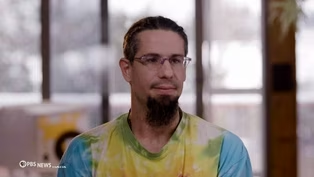
Army veteran was arrested# on conspiracy charges for his role in an## anti-ICE protest in Spokane, Washington,# last summer, it was the first time an## American had been charged with conspiracy# in connection with the ongoing ICE protests.
Some legal experts saw it as an escalation# of the administration's efforts to suppress,## even criminalize First Amendment rights.
Special correspondent Aaron Glantz has the story,## which was produced with the# support of the Pulitzer Center.
AARON GLANTZ: The sound of banging# on Army veteran Bajun Mavalwalla's## front door startled him awake at 6:00# a.m.
the morning of July 15, 2025.
BAJUN MAVALWALLA, U.S.
Army Veteran: Something's# not right.
And I went and I looked out the## upstairs window.
The street is all closed# off and there's a bunch of guys with rifles.
AARON GLANTZ: It was the FBI,and# they had come to arrest him.
BAJUN MAVALWALLA: My dad very,# very quickly after that was like,## Bajun, it's the FBI.
They have got a warrant.
AARON GLANTZ: Bajun was arrested# for conspiracy for his role in## an anti-ICE protest more than a month earlier.
BAJUN MAVALWALLA: I'm an Afghanistan# veteran.
I'm an American citizen.
AARON GLANTZ: Bajun kept his cool in# handcuffs while the FBI searched his pockets.
BAJUN RAY MAVALWALLA, Father of Bajun# Mavalwalla: Have you been read your rights?
AARON GLANTZ: His father recorded this video.
BAJUN RAY MAVALWALLA: My son is steady as a rock,## saying he's an Afghanistan# veteran, that this is unjust.
AARON GLANTZ: If convicted, Bajun# would face up to six years in prison.
BAJUN RAY MAVALWALLA: I don't think# that you really realize how far away## we have come from democracy until# you open the door and see federal## agents to arrest your son# for a nonviolent protest.
AARON GLANTZ: Bajun comes from a military family.# His parents both served in the army.
His father,## Bajun Ray Mavalwalla, a retired intelligence# officer, earned three Bronze Stars in Iraq and## Afghanistan.
He and Bajun served# in Afghanistan at the same time.
BAJUN RAY MAVALWALLA: I think that might be# my favorite photograph in the entire world.
AARON GLANTZ: The younger Mavalwalla provided# signals intelligence in Kandahar province,## one of the most dangerous parts of# Afghanistan.
His unit suffered casualties,## including one time a fellow# soldier stepped on an IED.
BAJUN MAVALWALLA: There was three amputations,## three traumatic brain injuries.# I was maybe 10, 15 yards back.
BAJUN RAY MAVALWALLA: My son's incredibly brave.## He believes that you should do# the things you're supposed to do.
AARON GLANTZ: After coming home from the war,# Bajun moved to the Pacific Northwest.
He felt## he'd done his duty.
Like many veterans,# he said he wanted to find some peace.
BAJUN MAVALWALLA: I bought the land and# it's beautiful.
There's tons of trees.
Like,## I have seen wolves on it.
There's been# moose.
There's been bears.
Like, it's quiet.
AARON GLANTZ: But, a few years later in# 2021, when Kabul fell to the Taliban,## Bajun felt compelled to serve# again, this time out of uniform,## volunteering to help dozens of America's# Afghan allies come to the United States.
BAJUN MAVALWALLA: Every single person here, except# for the people who are indigenous to the Americas,## is an immigrant or comes from immigrants.
It's# absolutely ludicrous to think that we can get away## with not bringing people in, especially people who# we told, hey, if you help us, we will help you.
AARON GLANTZ: Five weeks before his arrest,# Bajun saw a Facebook post from the former## president of the Spokane City Council.
Two# men with pending asylum applications had## been detained at a routine ICE check-in and# were going to be transported for deportation.
"I am going to sit in front of the# bus," he wrote.
"Feel free to join me."
BAJUN MAVALWALLA: Happened to be scrolling# through and saw it pop up and I was like,## huh, well, I have time.
I will# swing by and see what's going on.
I'm pretty upset about how this# country is treating immigrants.## The people they rolled up were legal# asylum seekers.
They have been doing## everything right.
There was no# reason for them to be detained.
AARON GLANTZ: The protest was, for the# most part, peaceful.
But, at times,## it turned contentious.
Bajun can be seen in this# video briefly tangling with masked federal agents.## One ICE agent pushes Bajun in the# back, knocking Bajun into another,## who grabs him.
Bajun and the agents# shove each other and then disengage.
Then demonstrators back up and link arms to# try to block the gate to stop ICE from taking## the asylum seekers away.
Dozens of people# were arrested, but Bajun wasn't among them.
Richard Barker, the acting U.S.# attorney for Eastern Washington state,## had monitored the protest from his office# on the other side of the Spokane River.
RICHARD BARKER, Former Acting U.S.
Attorney,# Eastern District of Washington: I went to bed## that evening feeling like this situation could# .. AARON GLANTZ: Barker had worked for# the DOJ for 11 years and focused on## prosecuting drug smugglers and murderers.# But the day after the Spokane protest,## the Justice Department sent him and the# 92 other U.S.
attorneys nationwide a memo## that demanded they prioritize# prosecutions of ICE protesters.
So Barker authorized an investigation.
His# staff started preparing a conspiracy indictment## against Bajun Mavalwalla and eight others,# something Barker knew he couldn't support.
RICHARD BARKER: Nobody was really hurt.
None# of the protesters were hurt.
Fortunately,## none of the law enforcement# officers were hurt either.
AARON GLANTZ: He was aware that# other U.S.
attorneys had been## ousted for refusing to comply with Trump# Justice Department orders.
And he worried## about his ability to act ethically if# he stayed on the job.
So he resigned.
RICHARD BARKER: I didn't feel in this case that# a conspiracy charge that would carry a six-year## term of incarceration was true to who I was# or who I wanted to be as a federal prosecutor.
AARON GLANTZ: Two days after Barker quit,# his successor signed the indictment,## charging Bajun and the others with conspiracy# to impede or injure a federal officer,## the first time conspiracy charges had# been brought against ICE protesters.
In a statement to the "News Hour," the DOJ# said it "respects the First Amendment and## the right of Americans to peacefully# protest, but will never tolerate the## obstruction of lawful immigration operations# or putting federal agents in harm's way."
BAJUN MAVALWALLA: Should we go in?
AARON GLANTZ: The day he was arrested,# Bajun was getting read.. a new house.
He and his girlfriend,# Kate, bought it with a VA mortgage.
KATELYN GASTON, U.S.
Army Veteran: This is# the service uniform.
I was in nine years.
AARON GLANTZ: Kate's also an Afghanistan# war veteran.
She deployed as a medic.
KATELYN GASTON: We're not weak people.
We# are willing to fight for what is right,## which is -- I mean, it's a First Amendment issue.
AARON GLANTZ: Bajun agrees# and is standing his ground.
They say that you were part of a felony# conspiracy to impede or assault a federal officer.
BAJUN MAVALWALLA: Conspiracy requires people# communicating and planning it out and saying,## yes, we're going to do this and this is why we're# going to do it and this is how we're going to do## it.
None of that happened, at least as far as --# not as far as I know.
I wasn't part of any of it.
AARON GLANTZ: Since Bajun's arrest in# July, the use of federal conspiracy## charges has spread.
Prosecutors have filed# them against demonstrators in Chicago and## also investigated Minnesota Governor Tim Walz and# Minneapolis Mayor Jacob Frey for the same crime.
BAJUN RAY MAVALWALLA: What these people are# doing to my son and that they're doing all## across the country is unconscionable,# and people need to know about it.
How you all doing today?
AARON GLANTZ: Inspired by Bajun's arrest a.. of government authority, his father announced# in January that he was running for Congress,## challenging Spokane's Republican incumbent.
It was a day after federal agents# fatally shot Renee Good in Minneapolis,## and he stopped by a demonstration in Spokane.
BAJUN RAY MAVALWALLA: This is me and my# son in Afghanistan.
He was arrested by## the FBI.
It's unconscionable and it's un-American.
AARON GLANTZ: The shock of Renee# Good's killing also inspired former## acting U.S.
attorney Richard Barker# to speak out about what he sees as## the government's hypocrisy.
This is his# first on-camera interview since resigning.
RICHARD BARKER: In the one instance, really,# nobody was hurt and the protesters were charged.## In another instance, somebody's life was taken,# and DOJ wants to give that person immunity.
BAJUN MAVALWALLA: These are things that# are supposed to be fundamentally American.## These are the things that, when I joined the# military, I thought I was joining to protect.## You have a right as an American to voice your# opinion.
You can't do it violently.
You can't## do it in a way that harms other people.
But you# have a right to stand up for what you believe in.
Oh, you got it.
AARON GLANTZ: Bajun's jury# .. For "PBS News Hour," I'm Aaron# Glantz in Spokane, Washington.
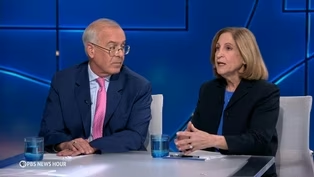
JOHN YANG:## The collapse of a deal to end the# partial government shutdown and## more fallout from the war in Iran give# us a lot to talk about this Friday.
And, for that, we turn to Brooks and# Marcus.
That's "The Atlantic"'s David## Brooks and Ruth Marcus of "The New Yorker.
"# Jonathan Capehart is away this evening.
So, we wake up to the news that, overnight,# the Senate Republicans and the Democrats## have cut a deal, unanimous -- passed by# unanimous consent.
Then, a few hours later,## the speaker of the House calls it# a joke, says he can't vote for it.
David, what do you make of all this?
DAVID BROOKS: Oh, we get to watch the# decline of American democracy in real time.
(LAUGHTER) DAVID BROOKS: I thought the Democrats# were wrong to start this thing.
I think,## if you don't like what the opposing# party does, you go to the voters and## you try to beat the other party in the next# election.
You don't shut down the government.
But it turns out the Republicans are -- don't# -- haven't learned democracy 101 either,## because when you only control 50# percent of the House, sometimes,## you have to compromise to make the ship run.
And# the House Republicans apparently don't understand## that.
And so they're unwilling to go with the# Senate compromise, which was a compromise.
And it had some things Republicans didn't like.# But guess what?
That's politics.
And so, to me,## what's happening in the country is that# people are not saying who's right and who's## wrong.
Are we blaming the Democrats# or are they blaming the Republicans?## They're saying the whole# ruling class is screwed up.
The entire elite establishment in this country# cannot run things.
And so that impulse,## which has been building for decades, is what# got Donald Trump elected.
And if we continue to## see Americans looking at their ruling class# and saying these people are total losers,## total incompetence, then we're going to elect the# craziest person we can, and Donald Trump is going## to look sane compared to whoever comes next,# whether it's the Democrat or the Republican.
JOHN YANG: Ruth, what can be done# about that to try to change that?
RUTH MARCUS, "The New Yorker": Oh, it's very# easy.
We will just fix it in a nanosecond.
(LAUGHTER) RUTH MARCUS: Look, you.. have lived through government shutdown after# government shutdown after government shutdown.
And I want to take a little bit of issue with you,## David, because Democrats don't# have a lot of levers of power,## right?
They don't have the control of the House.# They don't have control of the Senate.
They don't## have control of the White House.
They have# a grievance with the way DHS is being run.
They have a particular grievance with the# way ICE is being run.
And they have very## few levers of power to try to achieve# reform on that, which, by the way,## they weren't getting out of this deal.# So that's an important point to be made.
But when you have one party in charge# of these three axes of government,## and it can't even agree with itself on# funding one of these important agencies## and allowing TSA agents to be paid,# you are going to get blamed for that.
And I think, as much as people are just# generally frustrated with government writ large,## they are going to be particularly frustrated# at the end of this week and at the end of next## week and probably the week after that with# the operations of the Republican Congress.
People are furious at these delays at airports.# And I think they are unnerved by something else## that happened this week that's not really related# to the shutdown, but goes to trust in government,## which is the accident that -- the tragic# accident that happened at LaGuardia.
I think this all folds together and is# just a state of real public unhappiness.
JOHN YANG: Ruth, I want to stay with you.
You# talk about the reaction of the public.
And this## started out, as David pointed out, talking# about ICE, the Democrats talking about ICE.
Then it became the TSA agents.
And then# today the speaker made it firmly an issue## about border control.
Talk about the# messaging war that's going on here.
RUTH MARCUS: Well, the messaging war# is, I think, primarily for people,## what have you done for me lately or, more# accurately, what have you done to me lately?
And if you are making me -- this was completely# predictable, by the way.
If you're not going to## pay TSA agents, they're going to end up# not showing up on the job.
They're going## to leave.
The fallout from this is going to# take weeks, months to fix.
God forbid some## people who aren't adequately trained allow# something to sneak through in the interim.
So I think the messaging war of you are# inconveniencing me or you are making me## feel unsafe is going to win out over the# border messaging war.
Because, by the way,## there's so much money in the ICE bucket, pardon# that pun -- I didn't mean to make it -- that ICE## is fully funded.
So failing to fund DHS here# is actually not affecting border enforcement.
But it is affecting, as Lisa said in her very# good piece, so many thousands of other people.
JOHN YANG: David, the president tried to take# unilateral action to try to do something about## this.
He sent ICE agents into airports# to help TSA.
He signed an executive order## to have them -- have the TSA# paycheck start flowing again.
What do you make of that?
DAVID BROOKS: Well, it's unconstitutional.## But we have crashed through that so# many times.
I'm glad.. I flew a bit this week, and people were going# up to this the ICE -- the TSA agents wherever## I was and thanking them for showing up# to work.
And God bless those people.
If I could nurse our disagreement over... RUTH MARCUS: Oh, good.
(LAUGHTER) DAVID BROOKS: The Democrats controlled# all three branch or all three, House,## Senate and White House, through much of# the 20th century, through large sections## of the 20th century, and it didn't occur# to the Republicans, as I don't think it## would have occurred to the Democrats of# that era, to shut down the government,## because they assumed that making the U.S.# government function well and that democracy## was more important than the partisan fight of# the next two weeks and winning the news cycle.
And they assumed that, if# they degrade the government,## then the voters would punish them.
And# Newt Gingrich broke through that norm## a long time ago.
And now we're seeing the# norms degrade.
And so Congress has become## dysfunctional.
And TSA is becoming degraded# because of all this.
The federal agencies## are becoming degraded because of the repeated# government shutdowns and the Trump assault.
And so we're just seeing a destruction of# the basic functions of government.
And,## to me, that's the most important# -- more important issue than who## happens to get blamed and who's doing# what messaging on what cable TV show.
RUTH MARCUS: Well, that's# where actually we can agree,## because one of the really unfortunate fallouts# here is that the fundamentally important issue,## which is not who wins the messaging# war.
And we could keep going on that,## and we will keep arguing when we're# off the air, because that's what we do.
DAVID BROOKS: It's going to be a fun weekend.
(LAUGHTER) RUTH MARCUS: And another thing is that there does# need to be -- th.. fully well understands that ICE needs reform,# that what happened in Minnesota is not OK,that## what we're seeing across the country is not OK,# and that we need to put some controls there.
That is something that the way I think that# this budget fight is going to play itself## out is not going to end up happening, because# Republicans will manage to get the funding done## through a reconciliation measure.
I'm sorry# to use that word.
That will be done with a## majority vote.
And so we won't -- Democrats# will have lost their leverage for reform.
JOHN YANG: Well, another thing that# the American -- or a section of the## American public is questioning and# wondering about is the war in Iran The president has said at the# beginning that we had won militarily,## that we had pounded the Iranians.# And then he says that they're## negotiating.
And now he's sending# more troops.
What's going on here?
DAVID BROOKS: Yes, I guess my big picture is that# there's -- we are achieving militarily.
There's a## curve of the more and more we achieve militarily,# the more we degrade the Iranian regime, the more## we make it hard for them to build munitions that# going on to the future.
And that's all positive.
But there's another curve.# That's the economic pain curve.## And the economy is being hit.
The stock market is# being hit, the world economy.
Christine Lagarde,## the European -- former head of the European# Bank, is saying it's going to be a catastrophe.
And so, at some point, these two curves cross.# And that's when it's time to end the war, for## sure.
The problem is the downward sloping of the# economic curve is exponential.
We make incremental## progress in degrading Iran's ability, but the# collapse of the economy could go out of control.
And so, to me, I think Marco Rubio said today# to do two to four more weeks.
I'm rooting for## as short a time as possible.
They can say,# we degraded Iran seriously, they're not a## regional power, let's declare victory and get# out before we cause pain all around the world.
JOHN YANG: Yes, Ruth?
RUTH MARCUS: Ooh, I think you'.. in terms of your assessment# of the upward military curve.
Yes, the regime has been degraded militarily.# Yes, important people have been taken out.## Does that make us safer or does that make us# less safe?
Because let's be clear.
We have not## achieved what the president told us on night one# we wanted to achieve, which was regime change.
The regime is not changing.
If anything,# the regime may be coming more hard-line,## more inclined to insist on# developing nuclear power,## nuclear capabilities.
It may be more# incentivized to go after nuclear weapons,## which is the biggest potential threat to# the U.S.
And I take it very, very seriously.
It may be more incentivized by this latest# round of attacks then it was previously,## even after June, even after other# assaults.
And, in the meantime,## we are now negotiating to fix something# that wasn't broken when we started,## which is access to the Strait of Hormuz.
So# I do not see the military arc in the same## positive light, though I -- there have# been some achievements -- that you do.
JOHN YANG: And, David, there's some# elements of the president's supporters## who are questioning this, who say# they feel a little bit betrayed.
Joe Rogan earlier this month: "He# ran on no more wars."
And of this,## what's happening now: "We can't even# really clearly define why he did it."
Tucker Carlson: "This war is something he promised# he wouldn't do, not once, but countless times."
Megyn Kelly says: "No one should# have to die for a foreign country."
DAVID BROOKS: Yes, I'm puzzled by# this.
When you look at the polls,## I would not say too many MAGA people are# flaking off.
They're mostly supporting.
But the sort of MAGA people that I# know in the media and in podcast world,## the people I started "The Weekly Standard"# with all these years ago, Tucker Carlson,## a guy named Christopher Caldwell,# they're really upset because they're## more philosophically inclined.
This really is a# betrayal of what they thought they were getting.
But I wouldn't say it's yet a mass# movement among the Republican ranks.
JOHN YANG: Ruth?
RUTH MARCUS: I think we need# to wait and see, because t.. unhappiness with TSA is magnified# with the unhappiness at the gas pump,## the unhappiness at the grocery store.
And that# is something that the -- unhappiness with what's## going on in your 401(k), and that's something the# president is going to have to really deal with.
JOHN YANG: Ruth Marcus, David# Brooks, thank you both very much.
DAVID BROOKS: Thank you.
JOHN YANG:## And be sure to tune into# "Washington Week" tonight,## Jeffrey Goldberg and his panel assess# whether President Trump's war of## choice is becoming a war of necessity.# That's tonight on "Washington Week."
And tomorrow on "Horizons,"# William Brangham looks at the## risks and potential awards of A.I.
companionship.
And a special edition of "Compass Points" this# weekend.
Nick Schifrin takes the program to Tel## Aviv for an in-depth look at the unprecedented# U.S.-Israeli military and intelligence alliance.
For all those shows, check# your local PBS stations.
And that is the "News Hour" for# this Friday night.
I'm John Yang.
For all of us here at the "News Hour,"# thanks for watching.
See you later.
 New
NewBrooks and Marcus on voters fed up with gridlock in Congress
Video has Closed Captions
Brooks and Marcus on voters fed up with gridlock in Congress (11m 6s)
 New
NewDOJ targets anti-ICE demonstrators with conspiracy charges
Video has Closed Captions
Army veteran faces conspiracy charges after participating in anti-ICE protest (9m 21s)
 New
NewDrone swarms over key U.S. military bases raise concerns
Video has Closed Captions
Drone swarms over key U.S. military bases raise concerns (7m 2s)
 New
NewHouse Republicans reject Senate deal to end DHS shutdown
Video has Closed Captions
What's next after House Republicans reject Senate deal to end DHS shutdown (5m 51s)
 New
NewNews Wrap: Pro-Iran hackers say they breached Patel's email
Video has Closed Captions
News Wrap: Pro-Iranian group claims it hacked Kash Patel's email account (4m 26s)
 New
NewRubio says Iran war could end 'in a matter of weeks'
Video has Closed Captions
Israel launches new strikes on Iran as Rubio says war could end 'in a matter of weeks' (4m 43s)
 New
NewUkraine’s drone defense reshapes combat as warfare evolves
Video has Closed Captions
Ukraine’s drone defense tech reshapes combat as warfare evolves (8m 11s)
Providing Support for PBS.org
Learn Moreabout PBS online sponsorship
- News and Public Affairs

FRONTLINE is investigative journalism that questions, explains and changes our world.

- News and Public Affairs

Amanpour and Company features conversations with leaders and decision makers.












Support for PBS provided by:
Major corporate funding for the PBS News Hour is provided by BDO, BNSF, Consumer Cellular, American Cruise Lines, and Raymond James. Funding for the PBS NewsHour Weekend is provided by...