
Second Nature
Season 9 Episode 15 | 26m 24sVideo has Closed Captions
Sometimes what guides us most feels as natural as breathing.
Sometimes what guides us most feels as natural as breathing. Barbara Best discovers the power of faith and care in the midst of uncertainty; Healy Lange reflects on the lasting impact made by the woman who became her second mother; and, in a moment of fear, Amy Cuomo realizes her first instinct is to protect.
Problems playing video? | Closed Captioning Feedback
Problems playing video? | Closed Captioning Feedback
Stories from the Stage is a collaboration of WORLD and GBH.
Second Nature
Season 9 Episode 15 | 26m 24sVideo has Closed Captions
Sometimes what guides us most feels as natural as breathing. Barbara Best discovers the power of faith and care in the midst of uncertainty; Healy Lange reflects on the lasting impact made by the woman who became her second mother; and, in a moment of fear, Amy Cuomo realizes her first instinct is to protect.
Problems playing video? | Closed Captioning Feedback
Where to Watch Stories from the Stage
Stories from the Stage is available to stream on pbs.org and the PBS app.
Providing Support for PBS.org
Learn Moreabout PBS online sponsorship♪ ♪ BARBARA BEST: It was a scary time, but I remember having a deep sense of faith and trust that things would unfold the way they were meant to.
AMY CUOMO: And then that thing that happens that always happens when I am surprised and afraid: I am flooded with anger.
HEALY LANGE: And then she fell really hard back onto the concrete.
I didn't know what was happening, so I said, "Lucy, get up, it's not funny."
♪ ♪ My name is Healy Lange.
I'm originally from Boston, Massachusetts, but I spent my formative years in New York and Los Angeles, and now live in Atlanta.
And I'm an actress and writer-- screenwriter.
You know, you have a pretty impressive biography and, you know, a lot of accomplishments within the industry-- you write, you act, you produce.
How do you see all of those different roles connecting?
It's always about telling a story.
And for me, it's always about human behavior, like, why do people do what they do and how does it affect people?
And I've just kind of always seen things through stories.
So either I'm acting out someone else's story, or I'm telling my own.
It's incredible, because you can think your story is really unique, and, you know, it's never happened to anyone else.
And then someone will say, "Wow, that really... I really related," or, "Wow, that really moved me."
Or, "I never knew that," or, "I never knew something..." And it's just the coolest thing ever.
Tonight is your first time telling a story, really, in this mode.
Are you excited about it?
How are you feeling?
What's going through your head?
I just feel like it's so full-circle.
I grew up on WGBH, so I just feel like... And I just loved everything on it.
And I grew up on the stage, I am returning to the stage, and it's an intimate environment where I get to share one of the biggest things that's ever happened to me and be really vulnerable at the same time.
And it just felt so perfect to do that.
This is where I'm most comfortable, on stage, in front of people, live.
I feel really excited about it.
When I was four years old, my family moved from San Francisco to Boston's Italian North End.
My mom and dad were getting a divorce, and my older sisters were spinning out.
My whole family was in chaos.
My mother was checked out.
(chuckling): And I was a little toddler.
I was all alone.
We were moving into temporary housing until the building we eventually would move into was renovated, and all the tenants would move with us, so there were very few of us.
One day, I smelled food.
(chuckles) And I wandered out of my apartment toward the smell.
It was stuffed mushrooms.
I remember to this day, because it's still my favorite.
And I landed at this apartment.
The door was open, and I stood there like this.
And I listened to the sounds of love and joy and family, and waited.
And all of a sudden, these two old women came out.
And as soon as they saw me, they said, "Oh, she's so cute!
Come in, come in, come in!"
(audience laughs) And they fed me for hours.
I was so happy.
And one of those women was Lucy.
I remember she had a huge blonde beehive.
(audience chuckles) And she wore a purple housecoat, that's what she called it, and she had to cook in it.
And I was fascinated by her.
And a couple of months later, we all moved from that building to the new building.
And Lucy moved into apartment 23, and my family moved into apartment 25, just down the stairs.
And for all intents and purposes, she became my second mother.
I would go down there every single day.
I would knock on the door, she would feed me, take care of me.
She never got paid for it-- she just loved me.
She saw me through earaches and heartache and first friends.
I did have to watch "Lawrence Welk."
(audience laughs) And dance in her kitchen with her.
But I also got homemade meatballs.
We became inseparable.
When I was 11 years old, we were going to her family's for Christmas.
Yeah, I actually spent Christmas with her.
That's how close we were.
And we were going to her niece's house.
It was Christmas Eve, and I remember it was the coldest night of the year.
And we were coming back, and I was yapping about something-- I always was-- and she was carrying her shopping bags.
Her friends affectionately referred to her as "the bag lady"-- she always had shopping bags.
And I was saying, "Are you listening?
Are you listening?"
Of course she wasn't, and I kept talking.
And the next thing I know, she sort of rocked against the brick wall.
I kept talking, and then she fell really hard back onto the concrete.
And I was 11, so I, I didn't know what was happening.
So I said, "Lucy, get up, it's not funny."
She didn't move.
"Lucy, it's not funny, get up!"
She didn't move, and I panicked.
So I ran back to the house we had just come from.
And I banged on the door and I said, "Lucy collapsed!
Lucy collapsed!"
And everybody came running out.
And her two nieces started CPR.
One of them was a nurse.
And I remember screaming.
I just remember looking at her, and she was gone.
And a crowd started to form.
And for some reason, the firemen weren't coming.
They worked on her for a really long time.
I think it was, like, ten minutes.
And at some point, her niece, who was a nurse, looked up at me.
She didn't say anything, but I understood the expression to mean... ...she's dead, she's gone.
And all of a sudden, these expletives started flying out of my little 11-year-old body.
I was, like, "You keep going!
"You bleepity bleep, keep going!
"Don't you stop!
She's all I have!
She's all I have!"
And somebody was holding me back, and an old lady was crying, and the crowd was getting larger, and I kept screaming, "She's all I have!"
And suddenly she, she's stunned.
And she started CPR again.
And it was a couple minutes later, and the ambulance came.
And I was hyper-focused, I was listening.
And I heard, "We have a faint pulse."
(inhales) I was in Catholic school at the time.
It was Christmas break.
So I prayed every single minute of every single day.
I made bribes to God-- I mean, I promised everything.
I said, "You can't take her yet."
And three weeks later, she came out of the coma.
She was supposed to be my godmother at confirmation.
I had to have a proxy, but it was okay.
She was there in spirit.
And when she recovered, we were inseparable.
We were attached at the hip.
And when I went off to college, every single year, I would come back for Christmas.
And her sister, the same one that was there at the apartment, would say, "You're her angel.
"You're her daughter.
You saved her life."
And I would laugh, nod, "Sure."
And that happened every year.
And then 16 years after that event, I was in New York and I was jogging, nice March day.
And I felt chest pain.
Awful chest pain.
I thought I was having a heart attack.
(chuckles) So, I walked home to my apartment.
I told my roommates, "I just had a heart attack."
Of course, they were, like, "You did not have a heart attack."
I was, like, "No, I did, I had a heart attack."
And then ten minutes later, the phone rang.
It was my mother.
She said... ..."She's gone."
I didn't ask who-- I knew.
I didn't ask how-- I knew.
I waited.
And I said again... ..."She's gone?"
(voice breaking): And she said, "She's gone."
And then the next couple weeks were just a blur.
I didn't know what to do.
And I was at the service, and I remember all these old ladies lined up a bag, one at a time, in tribute to her.
(audience chuckles) And that year was the worst year of my life.
And I came home, I made it through.
It was Christmas.
And I saw her sister, that same one, at the apartment.
And she said... (voice trembling): ..."You were her angel.
You saved her life."
And I nodded and I laughed.
"No.
"No.
"The truth is... ...she saved mine."
Thank you.
(applause) ♪ ♪ BEST: My name is Barbara Best.
I live in Cambridge, Massachusetts, but spent many years in Houston, Texas.
I'm a community organizer, a youth advocate, and I'm passionate about building systems of care to empower our youth to thrive.
And what does that mean, systems of care?
What does that mean to you?
BEST: For me, it means ensuring that every young person has what they need to succeed in life.
So I think about justice, you know, housing justice and child and family well-being justice, immigration justice, transformative justice.
Making sure that every child has the support that they need to succeed and thrive.
Can you tell me a bit about how storytelling shows up in your standard, regular life?
I think stories are, are so powerful, and this has been a really powerful experience for me, because as a youth advocate, as a community organizer, I often tell stories about the needs of our community and, and our young people.
And this is the first time I'm really telling a personal story that's, that's deeply meaningful to me, a healing story.
And so I'm, been reflecting on the power of storytelling, that there's courage in our stories and knowing what our stories are.
And that can be a tremendous resource as we join together to build a more just and equitable world.
In July 2000, at age 26, I received an unexpected phone call after a routine annual physical that changed the course of my life.
It still feels cloudy and the words are a blur: a large ovarian tumor.
Emergency surgery.
In an instant, my world turned upside down.
Within a few days, I was in the hospital.
My mom, dad, and brother had flown in from out of state and were in the waiting room.
My mom fervently praying the rosary.
The caring nurses and hospital staff who watched over me day and night.
The meeting with the doctor after the surgery, my parents by my side, the words still a blur.
The tumor was benign.
We had to remove an ovary.
Fertility uncertain.
I remember the long recovery, the large scar on my abdomen that remains, and still, that web of care all around me, always expanding.
Friends who put together a calendar and bought me dinner every night to support me in my healing journey.
I poured myself into my work at the Children's Defense Fund to ensure health coverage for every child.
I had personally experienced how health insurance and deep and genuine care had saved my life.
I felt the maternal instinct, but wondered, will I ever be able to have a child?
It was a scary time, but I remember having a deep sense of faith and trust at a young age that things would unfold the way they were meant to.
A few years later, my now-husband, Jaime, and I were in France.
We felt a pull to visit Lourdes, a sanctuary and holy site in the Pyrenees mountains, where the Blessed Mother Mary is believed to have appeared in the 1850s.
Lourdes is a place of miracles.
People gather from all over the world in search of healing.
We lit a candle that we might be blessed with a child: a small flickering light and a mix of feelings-- faith and doubt, hope and anxiety.
I remember seeing people who were sick bathing in the healing waters, asking for miracles, praying fervently for healing, with stubborn hope and unshakable faith.
We promised that if we were blessed with a child, we would return.
A year later, we were married, and within a few months, we thought I might be pregnant.
We took pregnancy tests.
The directions on the package said the, to wait for the results.
The results immediately came back positive, so we thought the test kit must be flawed.
(audience laughs) We took six more tests, six more tests, all positive, but then, in a few weeks, we had realized our worst fears.
I thought my cycle had begun and that we had lost the baby.
I remember going to mass for the feast day of Our Lady of Guadalupe, and my husband, Jaime, had a dream that night of a dancing red bird who he believed was our child, and just sensed that it wasn't over yet.
We went to the doctor a few days later, and sure enough, I was already four months pregnant.
Past the first trimester.
In August 2005, our beautiful daughter, Elena Victoria, was born.
Named for her grandmothers from Italy and El Salvador, her name means "light," "victory," and she is a beacon of light and hope.
Many years later, I found myself in a demanding leadership role with immense downward pressure and high levels of stress.
With so many demands at work, I felt like I had no time or space to listen deeply to myself or others.
I had drifted from my core values as a servant leader and my roots in child advocacy.
I felt overwhelmed and lost, disconnected from my purpose.
I longed to crack open daylight in my own life, to feel more connected.
I remembered our promise to return to Lourdes.
We returned to Lourdes in the summer of 2019, before the pandemic.
I felt a pull to express our gratitude for our beautiful daughter and also to reconnect with my purpose.
Maybe I was looking for a sign about the path I was to follow.
We arrived in the evening after a long car ride from Barcelona through the Pyrenees mountains.
Our teenage daughter, now 14, was at first a little resistant after the long journey.
But the minute we arrived to the grounds and the sanctuary, she was hypnotized by the candlelight procession.
We started walking.
We each held candles, joining with people from all over the world, a sea of light.
And then something strange started happening.
It was beautiful and uncanny.
People started gathering around me, asking for my light.
There was a group of Spanish nuns, all dressed in white.
One woman came running up to me with a look of utter playfulness and delight, with a huge smile, like she was waiting for me.
She wore a name tag, Carmen, and asked in Spanish, "Can I have some of your candlelight?"
My heart felt overflowing with joy and gratitude.
All around me, I felt surrounded by an illuminated web of light.
A deep sense of peace that surpasses all understanding.
A sense of interconnection and being held kindly, with great love.
I felt that my journey had come full circle and that a path was being laid for me.
In summer 2000, I had been the recipient of care that I needed to survive.
Nearly 20 years later, I felt called to extend the web of care, to be a light for others as so many had been for me.
I did return to my roots in child advocacy.
I pursued doctoral studies in education and in partnering with school districts to build systems of care and strengthen family and community engagement to empower our youth to thrive.
A maternal instinct to light a candle, to walk out on faith, to join with others to extend the web of care.
Thank you.
(cheers and applause) ♪ ♪ CUOMO: I'm Amy Cuomo, I'm originally from Virginia, and I teach and work in Carrollton, Georgia, at the University of West Georgia.
You've taught a lot of students in your career, I imagine.
Beyond the subject matter itself, what do you hope that they take away from your time with them?
The ability to teach themselves, right?
And, and the ability to find within themselves what their strengths are, what their passions are, what they're good at-- not always the same things.
When you see them understand something they didn't understand before, when you see them grow, it's a gift to me.
It's a complete gift to me.
I have to ask of an educator, artificial intelligence, obviously, you're dealing with it, you're seeing it.
I'm wondering, what is your perspective on it, not only in education, but also in theater and performance?
I always tell students, just, like, "It is a tool for you.
Don't let it rule you," right?
"It is your tool to use.
"Do not give your brain over to it.
"It should help you flesh out your ideas, "not give you ideas.
That's not what its purpose is."
It may be the best thing that ever happened to theater in that it will be the only thing people know, entertainment-wise, is real.
A real actor before them, sweating, spitting, being.
It may be our last hope.
Can you tell us a little bit about how you got here tonight to share your own story on stage with us?
I tell stories all the time in the classroom, it's what I do.
Sometimes the students groan.
They're, like, "Oh, no, not another one."
But sometimes they laugh and they're delighted, and it's how I make connections with them, and I think that stories are important.
It's how we connect with each other.
It's how we understand our world.
I am 15 years old.
I am fighting with my mother again.
We are parked in front of the 1960s brick rancher that we live in.
She slams the car door.
I slam the car door.
Out we go, we're going up to the house.
My mom whirls around and she says, "Amy Lynn, "do not get married and do not have children.
You are too selfish."
She's absolutely right.
(audience laughs) I am 34 years old, and I have forgotten my mother's good advice when I see my future husband.
Oh, my, is he handsome.
All I can think is, "Make baby!
Make baby with man with jaw, make baby now!"
(audience laughs) I did marry him.
We did not make baby.
He has two children.
They are wonderful, all grown, and lights of my life.
Instead, I devote my energies to teaching.
I teach in a public university in the South, and I love it.
My colleagues are wonderful.
My subject matter is forever interesting-- I teach theater.
My students I adore.
As a friend once said, "They will break your heart."
It is sometime after Columbine and Virginia Tech, but before COVID and ChatGPT.
I'm teaching in Chemistry Lecture.
I don't know why.
(audience laughs) It is a gray, beige building that is just deplorable, but that's fine, because it makes me the most exciting thing in it.
(audience laughs) There is a door up right, a door down right, a huge granite table in the middle of the room-- a bulldozer couldn't get rid of that thing.
It's a chemistry lecture lab.
There's a sink there and a bunch of buttons.
I don't know what they do.
The students are filtering in.
I see them.
There is that kid who has not washed his clothes in a week and is going to sleep in the back row during the entire class.
There's a baseball player with dreams of the major leagues.
There's a sorority girl who's just been inducted.
Her feet barely touch the ground.
There's a chemistry student who is wondering why in the world he's in a theater appreciation class.
My favorite student, down center, she's read "Hamlet" more than I have, and she's ready to answer every question.
Tonight, it's Aristotle, the "Poetics."
Plot, character, thought, diction, music, spectacle.
Before I can get myself together and get to the front of the room, I look up, and at the top of the stairs, there's a masked figure.
White, viscous fabric covers his head.
Black jacket.
Black pants.
Black shoes.
White glove.
He stands there.
I hear the kids gasp.
Their eyes widen.
They don't move.
I don't move.
I am frozen behind that table.
For three seconds.
And then that thing that happens that always happens when I am surprised and afraid.
I am flooded with anger: How dare he!
How dare he walk in and scare my students!
I move around that table and I fly up the stairs.
I turn to a student and I say, "Dial security."
I move all the way up.
He's gone.
We wait.
We collectively exhale.
There's laughter, there's loud voices.
I walk down to the bottom of the lecture hall.
I regain my presence and I ask them, "Are you okay?
Are you all right?"
They assure me they're fine.
I begin-- "Aristotle said that tragedy is a..." They interrupt me immediately.
"Oh, no, no, we're not fine.
We're not-- we have to go home, now."
(audience laughs) I tell them that they have missed their opportunity and that they will be here with me.
So I teach the class.
At the end, I give them their homework, they gather their things, they leave.
I cross the quad, I walk straight to the theater building, and I do something I have never done.
I interrupt rehearsal.
My dear friend Shelly, and my colleague, is directing, and I pull her out, and I cry and I cry and I cry.
I shake.
I make sounds that only dogs can hear.
She pushes me out of the building.
She doesn't want her kids to hear.
She lets me tell the story.
I calm down.
She looks at her watch and says, "Amy, I got rehearsal."
I said, "Of course.
"Of course you have rehearsal-- go, go.
I'm okay."
Standing there, I realize... ...what if he had a gun?
What if he had a gun?
What would I have done then?
Would I have ducked behind that table and hid?
Would I have exited stage right?
I don't think I would have had the courage to cross in front and chase him up the stairs.
I'm not that brave.
Or idiotic, I don't know which.
What I do know is that those kids are mine.
They are mine and they are at risk.
They are also resilient.
So, we will live with the knowledge that we are fragile and we will go on with our lives.
University police did catch that guy.
It was just a big kid playing a stupid prank.
That night wasn't a tragedy, not even close.
It was a lesson.
It was a lesson about how ephemeral it all is, how utterly precious.
So my students and I will cherish the good times, we will survive the bad, and we will do what we do.
I teach.
Plot, character, thought, diction, music, spectacle.
Tragedy is an imitation of an action.
Theater has a beginning, middle, and an end.
Thank you.
(cheers and applause) ♪ ♪
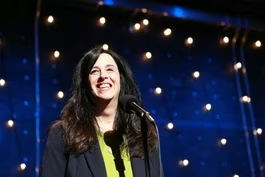
Video has Closed Captions
Preview: S9 Ep15 | 30s | Sometimes what guides us most feels as natural as breathing. (30s)
Providing Support for PBS.org
Learn Moreabout PBS online sponsorship
- Arts and Music

Innovative musicians from every genre perform live in the longest-running music series.





 New Episode




Support for PBS provided by:
Stories from the Stage is a collaboration of WORLD and GBH.