
Barton Gilley
Season 13 Episode 2 | 28m 45sVideo has Closed Captions
Barton Gilley is a self-taught animatronics artist, puppet maker, and special effects artist.
Barton Gilley is a self-taught animatronics creator, puppet maker, and special effects fabrication artist whose skill has earned him a reputation in Hollywood.
Problems playing video? | Closed Captioning Feedback
Problems playing video? | Closed Captioning Feedback
Art Rocks! is a local public television program presented by LPB
Barton Gilley
Season 13 Episode 2 | 28m 45sVideo has Closed Captions
Barton Gilley is a self-taught animatronics creator, puppet maker, and special effects fabrication artist whose skill has earned him a reputation in Hollywood.
Problems playing video? | Closed Captioning Feedback
Where to Watch Art Rocks!
Art Rocks! is available to stream on pbs.org and the PBS app.
Providing Support for PBS.org
Learn Moreabout PBS online sponsorshipMajor production funding for Art rocks is provided by East Baton Rouge Parish Library.
The library's art collection includes local and regional artists and highlights the diverse styles, themes, and techniques of their work.
The collection is located at branches throughout the parish or online at dot com, and by generous support from the Arts Council of Greater Baton Rouge.
The Louisiana Division of the Arts and the National Endowment for the Arts, with the Foundation for Excellence in Louisiana Public Broadcasting.
And viewers like you.
Thank you.
This week, Art rocks visits the studio of Louisiana animatronics artist Barton Jelly, whose whimsical and sometimes scary creatures have put the attention of the film industry.
We'll talk to Duane Sandberg, founder and artistic director of The 13th Gate, about the impression Barton's beasts make on visitors to his famous haunted house.
There's also a timely reminder that sometimes inspiration comes from unexpected sources to find out what we mean.
Don't go anywhere because those stories are this time on Art rocks.
Hello and welcome to Art rocks, the series that visits the studios and shares the stories of Louisiana artists all around the state.
I'm James Fox Smith, publisher of Country Roads magazine, joining you from deep in the bowels of the 13th Gate in Baton Rouge, one of America's top rated haunted attractions.
The 13th gate is the brainchild of Grant parish native Dwayne Sanborn, whose first foray into frightening people for fun and profit was at a haunted house he created in Alexandria, Louisiana.
Since 2002, though, it's here at the 13th gate, where Sanborn and his team deploy cutting edge innovations that make each year's Halloween experience more hair raising than the last.
Partly with animatronics created by this episodes featured artist Barton Jelly, one of the 13th gates recent innovations takes the form of a huge Frankenstein esque monster brought to life by jellies animatronics wizardry.
Duane will introduce Doctor Frankenstein's gothic creature and let us in on some more behind the scenes magic.
So stick around if you dare.
Duane Sanborn, thanks very much for the invitation to come to the 13th Gay today.
We're really looking forward to meeting Barton Jelly's Frankenstein monster in a few minutes when you introduce us.
But first, since we're here for the audience that may not have experienced it.
What do we need to know about the 13th Gate?
Huggins 13th gate has been going on for about 24 years now here at this location, downtown Baton Rouge, and it is a 40,000 square foot indoor and outdoor haunted attraction that has become one of the top haunted houses in the country.
And the reason that it's so nationally known is because of people like Barton, who has worked here and have created some of these crazy things that they that they come up with out of their mind.
It's just amazing.
You'll see some of the things coming up.
Yeah.
We really can't wait to see.
Well, tell us a little bit.
Like, how many visitors do you generally expect to welcome here over the is welcome the right word.
Should we call it welcome to terrify.
To terrify with care of people for a living heritage folks, do you get come through?
Thousands and thousands of people come through the 13th gate every year from locals who make this a Halloween tradition, to people who fly from all over the country to come down to see what we do each year.
You've been doing this since, well, 2002, in this location, but that wasn't even the beginning of your foray into haunted houses, was it?
That's an interesting career choice.
Tell us a little bit about how you decided to spend your life scaring people for fun and profit.
Teller one it's my mother's thought.
She brought me to a haunted house when I was 15 years old.
Where was that?
In Beaumont, Texas.
The haunted hotel.
Who's that?
Still in business today?
Actually.
And I just fell in love with Halloween and haunted house and all things scary.
And that just stuck with me throughout the years.
And I knew that that's what I wanted to do from then on.
And I made that my goal to open up a haunted house.
And I was able to do that in Alexandria.
And which is where you you grew up near Alexandria.
Right.
I'm from the Alexandria area and opened up my first haunted house, Louisiana Nightmares, in 1994.
And then in 1998, we had an opportunity working with the Forge Foundation to put a haunted house on LSU campus.
Oh, it wasn't at the Livestock Show arena.
We put a portable haunted house in every year and it was a hugely successful event.
Grew bigger and bigger every year, and we decided to start looking for a building here.
And in 2001, we found this building downtown Baton Rouge, and we moved in here and created the 13th cave.
This is not something that someone does on their own, right?
So obviously you have a team of people who are working on this through the year.
Tell us a little about the process.
It's not like you just flip on the lights and stuff.
Right.
So a lot of people don't realize this.
We work year round on the haunted house.
I have a crew of about 20 people that work year round, different artists and as well as artists like Barton who come in for special projects.
So it's a huge team of people who are very, very talented.
And then during the season, we hire about 150 actors to run the haunted house.
Okay, so tell us about those folks.
So these are people who are in theater, in movies, in TV, who what kind of person comes along and works?
You know, we have a lot of people from theater, local Baton Rouge theater, LSU theater.
But we also have just people who are 70 years old who just want to come out and have a good time and scare people, all ages, all walks of life.
It's it's really an amazing job to have to to come out and scare people.
It's a lot of fun.
People come back year after year.
We are a big family here and everyone just loves working here.
When did you first meet Barton Jelly?
Tell us a little bit about that.
And how did that collaboration get underway?
Well, I met Barton through Ken Decker, who owns CFX, which is a big mass company for the horn industry here in Baton Rouge.
And Barton started first building things for our escape rooms.
He built an amazing animatronic mermaid for one of our games over there.
And then I asked him if he was up to the challenge of building a Frankenstein monster here.
And boy, did he.
He was.
He went above and beyond.
Let's just say that, yeah, he doesn't leave any stone unturned, does he really?
He give him a job and he's going to make it bigger than anybody.
Imagine.
Yeah.
Okay.
Talk.
Let's talk a little bit about animatronics.
So this is something that that this has been had a big place in the haunting industry for a long time.
Correct.
Tell us a little bit about the role of animatronics in haunt and what it does for the presentation.
Well, over the years, haunted houses have become very, very detailed and more and more complex.
And one of the things that has grown bigger and better every year is animatronics.
There's a trade show that we go to every year, and honey houses purchase off the shelf.
And but for us, we wanted to have something a little more unique, something that you wouldn't see it, another haunted house.
And that's how Barton comes into the picture for us.
Well, I think I'm really looking forward to meeting Barton's greatest creation, his grandest Mr.
Prometheus.
Perhaps you can take us to introduce Frankenstein's monster.
All right, so, Duane, here we are finally, in the presence of Doctor Frankenstein's monster himself.
He's absolutely huge.
Yes.
Can you talk a little bit?
What was the process of getting him in here?
Oh, goodness.
He is so big that he had to come in and pieces.
And we actually reassembled him here in place.
Took about eight people.
He's really heavy and really huge.
Yeah.
I mean, so how how tall does he stand in the city?
He's about 12ft.
But if he stood up, I think he reached at least 16, 17ft.
He's he's huge.
And how many how much is that headway?
Over 100 pounds.
Wow.
So Frankenstein's monster arrived as part of the 13th gate haunted house for the 2025 season.
Right?
Right.
What was the response like?
How did people react?
Oh, everyone was blown away.
We try to make one big spectacle every year that people talk about in this was absolutely it for 2025.
I can certainly see why.
Absolutely.
So obviously when you work with an artist like Barton, with some of them like this, you have an idea in your head you want to make a splash.
But then like, how much creative input do you give to an artist like Barton?
And then at what point do you kind of step back and get out of his way?
You know, I've learned a long time ago that when you have someone who's really talented like Barton, you give him an outline of things that you wish, list of things that you would like to see in their creation, and then you step back and let them do the rest, because you never want to constrain his creativity.
And he always, along with the other people who work for me, always come up with something much better than I could think of them all.
So you work with a lot of people.
Obviously, this sort of thing takes more than one vision and one set of skills, right?
So what kinds of skills and techniques do you find?
The folks who are on your team most often bring to the bring to the project that really elevate what you're able to provide?
A lot of the guys who work for me have worked in the movie industry, and so they bring skills like scenic artistry, electronics, animatronics, electrical, carpentry, set carpentry, things like that to all of us make a very cohesive team that we could create anything.
So basically the 13th gate and any big haunted house project like this is the sum of a lot of creative energy coming from a lot of different places and pulling towards a whole.
Right?
That's right.
Right.
We we hire a lot of amazing people here.
And the great thing is they love the haunted house as much as I do.
And it absolutely shows.
And it really does show.
Yeah.
Thank you.
Well, Duane Sandman, thanks so much for the introduction to 13th gate.
It's phenomenal what you've built here.
And last question, we wouldn't be completing lest we did this.
Doctor Prometheus, can we wake the monster up?
You want to do the honors?
Oh, why wouldn't I?
Am I ready for this?
You ready?
Okay.
It's a long.
Now.
You've met Frankenstein's creation in the flesh, so to speak.
Let's meet the man behind the monster.
When Barton Jelly was young, he says he was obsessed with understanding how movie magic got made.
Cut to the present, and the artist credits his childhood curiosity for helping him to develop the skills required to create movie magic of his own.
Jellies work in the entertainment industry includes stints on the Jim Henson Mechanics team, behind the dark Crystal series, and Closer to Home.
We're proud to say he's also the animatronics wrangler for LPB children's puppet series, Ziggy's Arthur Venture.
Come with us now and see how imagination serves as the operating system that powers Barton Jellies otherworldly animatronic creations.
Hi, my name is Barton.
Julie and I build animatronics and puppets for the entertainment industry.
From when I was a little kid.
I used to take things apart and I was always a tinkerer.
Whenever I saw the movie Short Circuit, I always wanted to build something like that.
And then The Terminator and Gremlins labyrinth was a huge influence, so I started going down the road of building creatures and animatronics.
So my dad passed away in 2010, but he owned Julie's Gallery and bought and sold artwork and a lot of local Louisiana art.
Clementine Hunter was he had become an expert on her.
He wrote a book about her called Painting by Heart.
You know, it was just inspiring to always be around art.
My house always had nice artwork in it.
It was just an appreciation for all types of art.
People like to dismiss abstract art and say, like, anybody can do it, but there's like so much more to it.
There's so much skill involved, so much life experience that brought that person to that point.
What he always emphasized was the story behind the art.
You know, really think about the history behind it, what was going on in the world at that time, what brought this thing into existence?
Now, I've never been a big sports guy, but I've always had all my friends love LSU football and everything, and I've always tailgating with them.
And we were sitting around one night in.
A friend of mine just made a joke about like, oh, what have we had?
Because we had a really big tailgate and he just and we would get kegs and everything.
And he was like, what if we had R2d2 serving beer?
And I was like, look, actually, I can do that.
That'd be kind of fun.
So I built an entire R2d2 that that rolled around and did everything, and you can fit a keg inside of it.
And he actually would serve beer at our tailgate.
When I was in college, around 2007, I got a job at CFX, which is a mask making company here in town where I learned about all these kind of materials like silicone and fiberglass and all that working for them.
I learned a lot of how to sculpt, learned a lot of things that really brought me to another level on what I wanted to create.
When I got to building R2, I had had all these processes under my belt, so I knew how to make molds and castings and but it was like a really good way to take all that knowledge and just put it all that energy into this thing and prove that I can do it.
A being who is very essence defies your understanding.
How do you propose to justify this transgression?
This is a animatronic creature for an escape room in Oklahoma.
He is air powered.
All all pneumatic.
So yeah, whenever I was sculpting this, the guy was making it for.
We weren't quite sure what it was going to look like, but he said he definitely wanted to have a long neck and look like some kind of all powerful being.
So I kept trying different things out and I didn't have ears on it, didn't have a nose, but it so thought it looked too much like an alien.
So I started adding, added the cute little ears to it, and kind of.
I was looking at pictures of E.T.
to try to get him, you know, more kind of cute looking, but also wise.
For what purpose?
What drives you to seek entry into a realm that exists beyond the comprehension of your limited senses?
So usually it would be a discussion over what the character is and what it looks like, and then I'll do some drawings of it.
If the client likes the drawings, I'll start sculpting the character out of clay.
And then I make fiberglass molds.
So once there's a mold from the clay sculpture, this is a silicone skin that would be poured into the mold.
It's like a liquid two part mix that hardens and becomes rubber.
And then I would use that to make a skull.
And then this is actually what gets cut up.
You can see where I drew lines like that's the jaw brow.
Cut all that up, add some motors and cables and whatever I need.
And then that'll basically be a moving mechanical skull that the skin can just sit right back over and then it gets glued down.
And then, you know, turns into an animatronic.
My first big project in the industry was the dark Crystal Netflix series.
So I was called out to the Jim Henson Shop to come help them in the mechanic shop.
And I was building eye blinks and I movement and all these different little elements for these, these puppets.
I worked on Five Nights at Freddy's, the first movie, and there's a second one coming out.
It was a huge team of people that I was helping to build the characters for that.
And then I went to set as one of the on set mechanics.
If anything broke, I was there to repair things.
And the little motors, they tend to burn out here and there.
So you got to replace those screws, start to back out after after over, you know, using them right now it will be you, me and my brain though.
Ask your questions, talk to me.
Let me know how you're feeling.
The most complex animatronic that I've built is the Mind Flayer.
He was a character from D and D, so he has like a tentacles for a mouth and he ended up being the host of the show.
So it was like people playing D&D live.
We were remote controlling in live.
During the show, we had a voice actor that was coming over the House.
Speaker.
The idea was to have my boss told me, make the mouth tentacles so that we can just wiggle them around.
We don't have to actually sync up lip movement.
So every time the guy talk, we kind of just tried to follow along with what he was saying, and it ended up looking like he was actually talking.
I got one, one thing, I got a hook up real quick, noticed that.
Once the skins glued on it, you know, the lips will pull up and snarl.
And currently I'm working on a 12ft tall Frankenstein for the 13th gate.
He's going to be fully animatronic, probably the most complex thing I've built to date just for the size of it.
As soon as things get bigger, the way to move things has to change.
I usually use these tiny little motors called servos for something that large.
I had to move over to New Maddox, which is air powered cylinders that can lift a lot more weight, and this thing is going to have full head movement, neck movement, lips, eyes.
He's going to bend at the waist and his arms are going to move.
So he's he's sitting in a chair, he's chained down and he's going to be, you know, screaming and, you know, trying to get trying to break free, you know.
My favorite project is probably whatever I'm currently working on ends up being the thing that I fall in love with.
And then I'm sad to see it go, you know, like whenever, whenever that time to hand it over to the client.
I've got a connection to this thing and it's gone.
Every time I make something new, I feel like it's it's always a different new challenge.
The way that I build things now is probably the way it was done in the 1980s.
I really like hand making stuff.
I really like that.
You know, that that little buzz I get from, I just made this whole thing.
Thank you, Barton, for lifting the curtain on your inspired artwork.
This show began with a reminder that sometimes inspiration strikes from unexpected sources.
What did we mean during today's segment, you heard Barton credit his father's gallery with supplying the inspiration in the form of artwork by legendary Louisiana folk artist Clementine Hunter.
Today's vault Rock segment revisits a favorite story from LPB archive, one that explored the life, the work and impact of Clementine Hunter, as described by the artist Maurice Taft Thomas of Alexandria.
A lady used to come here.
They call him his Alberta Kinsey from y'all.
And she complained.
The magnolias and Arlen flowers.
And when I was cooking, she leave all the things she leave.
She gave it to me.
And that's what I think.
That's what I never did do.
Nothing.
She worked day and night.
And each day she was like a little child.
She would bring her work and let me know.
I'll take a look at it.
He always praised her.
What she painted her subjects.
It was based upon life experiences.
She painted things that she was exposed to as a young woman working in the cotton fields.
She painted cotton field scenes.
She painted bacon harvest, Saturday night fish fries and all those things.
But she also was a religious person and one of the most fascinating things that this was not a painting was crucifixion of Christ in the African house upstairs.
It was a beautiful mirror.
She took me up there to see that mirror.
It was about six feet tall.
And these.
And I was amazed because of her, not a vast age, because she was up at the age when she started painting, late 17 and 80s, when she really kind of blossom.
But at that time, everyone called her a primitive artist.
I would say folk art.
I don't like the word, the terminology, I know the adjective are very similar, but I don't like the word primitive.
She was not primitive.
So when she saw someone standing on the tree and because were fall out of the tree, they were waiting to catch the.
Because I said, that's nothing wrong about that.
I said, even today in modern day society, when you find someone, they get a stick and throw up and knocks, becomes down their way to catch him.
It's the same stereo fresh from new.
Start writing about her.
And there's a lot of curiosity because the newspaper went all over the state as a press as well.
And so she became a household name in terms of something for someone to read.
When she became fatigued, she announced her grandson, who was about 12 years old at the time.
He finished his painting for me, and he did.
And so the difference between him being able to recognize Mrs.
Hunter's actually original work, she painted using all paint, basically out of the tube, but I mixing colors, see if that's put one called Heavy and Pastel.
She had put one heavy stroke on top of the other stroke, and that's it.
But her grandson, who had little art experience in school, he would mix this colors and blend them in.
And the colors will vary in terms of warm color, school colors.
He could do that, but you had to have some similarity between what he did and what grandmother did.
That's the way you can distinguish a difference.
A burst of always the same because she didn't know how to change him.
Very simple.
1 or 2 strokes.
And that was basically it.
So even if you attempted a copy of her work, it was difficult because you have to look at it real close to try to get the brush strokes.
And her brush strokes was weighty because of a nervous condition, and so her strokes were not perfect.
They had a lot of movement in it.
I call it rhythmic movement.
And so that's another way of being a to recognize otherwise her grandson, he could had straight lines, vertical lines, horizontal lines.
And it was very easy to say Mrs.
Hunter didn't make this, but they didn't know that and it didn't really care.
The most important thing to them was to see and h a signature.
Once the signature was on something, that's all they wanted.
She could have command in the price.
She wanted to, but she didn't know what to do.
She couldn't write.
Because first of all, I mean, you're on say he called it Clinton.
You need to learn how to write your name.
I don't know how to write your name, he said, let's do the same.
And the h. It's okay.
And so she practiced and she practiced.
She practiced.
But if you notice not of work, the C is reversed.
She said, I want to do this.
Look like I have my arms open.
Meeting ingredient people.
Someone make my seed like this.
Mama closer with my H. That's how I came about as individuals.
Like from academia to modern millionaires have her work in that collection.
That's one of the first things you want to get.
I want to come in time, honey.
This guest book is approximate 35 or 40 years of age.
You can see the watermarks on here because I had an about.
And this belonged to Mrs.
Clementine Hunter, one of her clients.
Her some of the individuals who came to purchase one of her works.
So you need a book to sign.
And so they gave her this.
And so the first person who scientist was from the Smithsonian Institution in Washington, D.C., and the list goes on and on.
There are people from across America signed this book.
And so when she had a chance to spend a lot of time outdoors on a porch, rocking in a rocking chair, if not just outside with a pigs, with her chickens, with the dogs, the things that she loved growing up as a young woman, they still had a something, some relevance, and that made her feel comfortable to see.
The complete segment about Clementine Hunter plus Art Brock's digital extras such as yours truly being transformed into a zombie by the 13th gates make up wizards visit LPB, slash art rocks, and if you enjoy stories like these, I invite you to also visit Country Roads magazine.
Com, which makes a vital guide to exploring Louisiana's cultural life all across the state.
That is, that for this edition of Art Rock.
So until next time, I've been your host, James Fox Smith.
And from all of us here at LBB.
Thanks for watching.
Major production funding for Art rocks is provided by East Baton Rouge Parish Library.
The library's art collection includes local and regional artists and highlights the diverse styles, themes and techniques of their work.
The collection is located at branches throughout the parish or online at dot com, and by generous support from the Arts Council of Greater Baton Rouge, the Louisiana Division of the Arts, and the National Endowment for the Arts, with the Foundation for Excellence in Louisiana Public Broadcasting.
And viewers like you.
Thank you.
 New
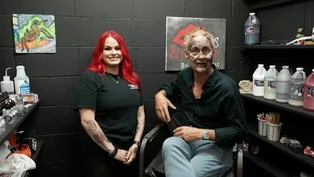
Behind the Makeup at 13th Gate | Art Rocks Unframed
Video has Closed Captions
Clip: S13 Ep2 | 3m 33s | Head of makeup Sarah Best Brown demonstrates the artistry that brings characters to life. (3m 33s)
Providing Support for PBS.org
Learn Moreabout PBS online sponsorship New Episode
- News and Public Affairs

Top journalists deliver compelling original analysis of the hour's headlines.
 New Episode
- Drama

Hugh Bonneville stars in a crime drama inspired by one of the largest robberies in British history.
 New Episode

 New Episode


 New Episode





Support for PBS provided by:
Art Rocks! is a local public television program presented by LPB