
Brandon Surtain
Season 13 Episode 1 | 28m 45sVideo has Closed Captions
New Orleans artist Brandon Juan Surtain.
Meet New Orleans artist Brandon Juan Surtain, whose interest in art and architecture are rooted in cultural preservation and life in New Orleans both before and after Hurricane Katrina.
Problems playing video? | Closed Captioning Feedback
Problems playing video? | Closed Captioning Feedback
Art Rocks! is a local public television program presented by LPB
Brandon Surtain
Season 13 Episode 1 | 28m 45sVideo has Closed Captions
Meet New Orleans artist Brandon Juan Surtain, whose interest in art and architecture are rooted in cultural preservation and life in New Orleans both before and after Hurricane Katrina.
Problems playing video? | Closed Captioning Feedback
Where to Watch Art Rocks!
Art Rocks! is available to stream on pbs.org and the PBS app.
Providing Support for PBS.org
Learn Moreabout PBS online sponsorshipMajor production funding for Art rocks is provided by East Baton Rouge Parish Library.
The library's art collection includes local and regional artists and highlights the diverse styles, themes, and techniques of their work.
The collection is located at branches throughout the parish or online at dot com, and by generous support from the Arts Council of Greater Baton Rouge.
The Louisiana Division of the Arts and the National Endowment for the Arts, with the Foundation for Excellence in Louisiana Public Broadcasting.
And viewers like you.
Thank you.
This time on Art rocks, meet Brandon One Seton, whose winsome storytelling paintings attract new fans with each exhibition.
We'll learn what Baton Rouge Gallery's Jason Andriessen thinks makes Brandon's work so relatable.
And every successful artist has someone who helped nurture that creative flame who lit the match for this dynamic young Louisiana artist.
We'll find out right now on Art rocks.
Hello and welcome to Art rocks, the LPB series that tells the stories and takes us into the studios of Louisiana artists all across the state.
I'm James Fox Smith, publisher of Country Roads magazine, and I'm pleased to be wearing my Art rocks hat today outside Baton Rouge Gallery's Center for contemporary Art.
Inside the gallery, artist Brandon One Satin is winning new fans and earning new collectors with every exhibition.
A native New Orleanians, Brandon earned his Bachelor of Fine Art from Louisiana State University, while he was also a member of the LSU football team.
Afterwards, he went on to earn master's degrees in architecture and sustainable real estate development from Tulane University.
All while continuing to make a name for himself as a fine artist.
A recent exhibition at Baton Rouge Gallery proved so popular that every piece sold while the work was still on the walls.
In a moment, Brandon will join us to discuss how the drive to create has been with him since early in life.
But first, let's hear what Jason Andriessen, Baton Rouge Gallery president and CEO, thinks makes Brandon Saturns work so sought after.
Baton Rouge Gallery's mission is to connect artists and audiences through exhibitions and innovative cultural programing.
There's a body of about 75 artists who typically are housed inside the state of Louisiana.
So Brandon Sartain has been an artist who's been with us a handful of years now.
I believe this is his third exhibition with us, and he is just an absolute, I would say, a fan favorite at this point.
His exhibitions typically sell out or get very close to selling out.
He is an artist that people look forward to seeing on the calendar, on the schedule, and I think his works, his paintings tend to come with a, a sense of joy and whimsy that people have really, really responded to.
And he's been an absolute wonderful addition to the artist roster here.
My first introduction to Brandon, I think, was actually as a football player and kind of that transition where he was making going from the football field as a as a starting defensive back for the LSU Tigers and then becoming a painter.
He was certainly studying painting while at school, but I think more and more people are becoming aware of him as a painter first.
And then the fact that he was a star football player is kind of a secondary story in his career at this point.
But to know that he is not only an artist, but also somebody who works in urban design and architecture only adds to the level of depth that you can see in his work and in understanding Brandon as an artist himself.
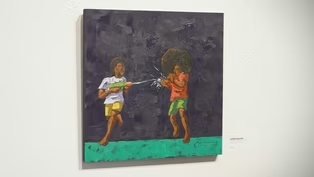
I think one of the things that I enjoy about Brandon's work is that it can have a sense of familiarity to it, in the sense that that we all have memories of, you know, aiming a squirt gun at a friend and getting them soaked.
Like you'll see in one of the pieces in this show, or maybe bouncing on a trampoline with a friend.
But there's also a level of imagination, maybe even some level of of abstracted to the works as well.
For example, the piece with the trampoline, you know, it is clearly obvious that the number of kids seen bouncing on the trampoline is not realistic.
There can't be that many kids on a trampoline of that size.
The fact that you see kids playing with one another against kind of a color blocked background.
It is, you know, inherently not a photo photorealistic, not necessarily indicative of the setting they're in.
So it allows you to really focus in on the subject and focus in on the interaction between these people, or on the action of an individual in some instances.
So there is there's kind of a play between the realism of the memory and maybe the fuzziness of, of that memory at the same time.
I think a lot of what Brandon's work conveys to people is something that is both Louisiana at its core, but also universal in the sense that a lot of his works will center characters, that that might be seen as inherently Louisiana based.
But somebody in a state far away can also get a sense of joy.
Get the idea behind the work, even if they have no reference to Louisiana as a state or as a culture.
And I think it's one of the things that makes his work particularly successful.
Oftentimes in his works, you'll see figures that you would only see in Louisiana, that you would only see in New Orleans.
You'll see images of second lines and things of that nature.
This show in particular really focuses on on childhood joy and, and play.
And so for people to walk into the gallery, and hopefully immediately see somebody they know be able to connect with them, but also to see, to connect with a memory that these paintings might evoke for them individually.
I think only added to the level of, of fun, of levity that that we experienced during that opening reception for this show to see the way that Baton Rouge as a community has responded to his work, and not just Baton Rouge, Louisiana as a whole, has responded to his work.
And seeing collectors get excited about adding his work to their collection is really exciting.
To see that level of support for artists at this stage in their career is something that gets us very excited, certainly.
He has also shown at Arthur Rogers Down in New Orleans, which is an incredible gallery space, a well-respected gallery space, because I think he has seen Baton Rouge and seen Louisiana collectors really respond to his work and excited about his work.
And yet every time that he is at an opening reception and watches a red dot go up on the wall next to a piece, meaning that that the piece is sold.
He is just as taken aback now as he was the first time that we put a red dot next to his work.
He is genuinely, it seems, moved by the fact that his works are moving to people and seeing them make the decision that that is something they want to have in their home, that they want to live with day in and day out, is really, I think, moving to him.
And it's something that's fun for us to see happen in real time as well.
As far as the work itself goes, the way that he handles paint is, is just phenomenal.
The brushwork is great.
And seeing the color combinations that he comes up with in particular I think really are resonates with people.
It makes for an exceptional exhibition as well, when you can take the show in its totality.
But the, the vibrance and the fun that comes with a brand in certain show is really exciting.
Recently, we visited Brandon Satin in his home studio in Mid-City New Orleans, just three blocks from where the artist grew up.
In other words, this is the neighborhood where the games Brandon played with childhood friends laid down the memories that continue to provide his subject matter and inform his creative process today.
Brandon didn't always call New Orleans home, though.
When he was 11 years old, Hurricane Katrina forced his family to relocate to Baton Rouge.
And this is the move that Satan credits with awakening his artistic impulse for real.
Let's listen as Brandon shares his earliest inspirations and explains how that unexpected upheaval surrounding a catastrophic storm led him to exactly where he was supposed to be.
I remember like yesterday, two nights before Katrina made landfall, there was a mandatory evacuation that came on news.
We were just sort of thinking and thinking of it as a way to get out of school for a day or two and then come home.
That's how we were, you know, kind of imagining it will work, because growing up here, that's what it was.
You know, there would be a storm and the lights would be out for a few hours or a day.
And after a few days, things were mostly returned to normal.
When Katrina happened, it was a much different story.
We evacuated to Baton Rouge.
From my age group, you know, sort of middle school age.
I was the only one within my family that went to Glasgow, and it was because of the talented art designation attached to my name and starting at Glasgow.
That was the first time I'd been in a school where there was such a robust, talented art program.
And there I had Miss Dave, who was maybe the first person to hold me, hold me to a standard as an artist that went beyond, you know, sort of making cute drawings.
It was my first time being exposed to critical conversations around the art.
My relationship to Hurricane Katrina as it pertains to my art practice, something that I hadn't even really kind of synthesized until years later, was that in a lot of ways, once I began to kind of find my voice and working with Miss Darby, was that a lot of my work was referencing my time in Mid-City pre Hurricane Katrina going into college.
I didn't start in the art program originally, and I had some conversations with mom and with my older sister and, just inquiring about what I was passionate about.
That was an interesting time to say the least.
Being in the art program and playing football.
There was this really big dichotomy in terms of, you know, sort of the ethos of those different environments.
It was a fascinating time because I got to learn that a lot of my teammates were very into art, and a lot of the art students, you know, thought it was compelling to kind of have football players hanging out around the art studios.
So it was a really funny world where I would be at practice sometimes and have teammates asking me, they say, hey, man, you know, are you going to the studio after this?
When I wrapped up undergrad and had this show that was very much about the building and community and agency and displacement, I didn't realize that a lot of those terms were architectural and, sort of referencing the built environment explicitly.
Ken Schwarz, the dean of Tulane's architecture, saw the paintings and reached out and, you know, sort of said that he thought the work was architectural.
And shortly thereafter kind of inquired about my interest in trying architecture school.
And I didn't have much going on at the time.
And so I said, you know, yes, I'll try it.
And four days later, I was in New Orleans for orientation.
My art, architecture and development practices, they if there were sort of a Venn diagram, I think the common thread with all of those is, celebrating community in different ways.
So my art practice is a lot about, you know, celebrating the movement and the colors and the people and very intentional about creating work with a narrative that seeks to make people feel good in some capacity.
In New Orleans, we we have this, you know, kind of culture of monument that moves.
So if you think of a second line, right, like we're using the built environment, but we're, you know, walking through the streets like the porches become a stage.
Think about music, right?
Music is this ephemeral thing.
You here.
Brass band.
You you can't really contain that sound, right?
It like comes and it and it's gone like that.
And so with that starting to kind of document some of the second line crews and starting to document musicians and street dancers, the, the architecture question in a lot of ways sort of inform the artistic direction, because I was just trying to think through sort of creative ways to document sound and color and movement music in terms of composition.
I find something there's something satisfying for me, you know, having these two homes this slightly jarred, it isn't centered and thinking about, you know, intriguing ways to create color relationships.
I love painting a big sky, trying to kind of capture the ethos of the community and joy and parading in the streets, in a makeshift way.
Memory and place plays a huge role in my work.
Again, particularly because I want to honor people's time with my work.
If you're gonna, you know, spend a few seconds looking at my work, I would love for you to gain some positive feeling or association with it.
An example of that.
There's a I made a painting recently of a child back flipping on a mattress.
The, you know, kind of additional context with that is we're back flipping on mattresses and backyards because, I mean, there wasn't access to, you know, trampolines or gymnastics or things like that, but there's a story, you know, children just making do, right?
I want to just be very intentional about kind of documenting those things in a way that that leaves people, feeling a bit more full somehow.
I'm grateful.
You know, coming from a big family community is very important to me in a lot of ways.
I, you know, seek to try to encourage people to find community through the paintings.
And I think there is something beautiful about us needing each other.
Right.
I don't really know the the distinction between, like where I end and where my love one begins and vice versa.
You know, so, that's something that's very important to me and that I'll continue to sort of weave into the work and different capacities.
My relationship to the figure has evolved over time.
When I was in high school, I was starting to approach sort of a photo realistic figure in a way that was, you know, about correctness in the academic sense.
Over time, I became much more interested in the feeling I wanted to convey, and correctness became less a part of sort of how I wanted to convey that.
And so in a lot of ways, I think of my myself as an abstract painter in that the, you know, the figures are abstracted, the colors are abstracted.
To some degree, you can actually start to see a little bit of kind of the process here.
But many times I can start with a stick figure and try to think of kind of the most gestural, figure that people might believe.
A lot of times the limbs are too long.
You know, the, the color palette is sort of limited in a way.
So much of the figure is sort of executed in a dual tone or tritone color palette.
When you stare at it long enough, you kind of see that, oh, the, you know, the background is starting to seep through the painting a little bit, which is something that I personally find intriguing.
Confetti was a fun project.
That body of work started from this.
I made this sketch on my iPhone where I wanted to have, you know, these kids jumping on a trampoline, but it was a little bit abstract and surreal and that there's probably more children kind of flying in the air than could realistically even fit onto the trampoline.
So it was this, you know, element of suspending disbelief.
And as I began kind of executing that body of work, the children.
So the namesake, you know, the trampoline, confetti painting, the, you know, sort of the theme being them on a trampoline sort of morphed because I looked at like, oh, they're flying in the same way that sort of confetti does.
And it was this really interesting observation that like when we look at, you know, actual confetti, for example, you read it as like a singular body, but then you zoom in and there's little bits and pieces.
Right?
That kind of tells the story of this body of confetti.
I was sort of looking at memory and exploring like how our memories work.
We have these bits and pieces that we sort of form into this cohesive body, to the point that eventually, you know, we're telling stories based off of our memory of the story we told.
I hope that the work resonates in a way that's universal, but it's also like very place specific and very much, you know, about here in Louisiana, Louisiana's, it's home.
You know, first and foremost, it imbues me with a sense of pride.
I'm excited to tell people about it and tell people that I'm from here.
Everything that I've talked about as it pertains to community, as it pertains to memory, as it pertains to agency, it's been encased in this context.
My mom, she's just proud of anything that I'm doing.
I think my mom and family in general, they just they get a kick out of being able to resonate with the stories.
She's excited anytime I can make something that, you know, that I'm proud of.
What I'm most looking forward to is to sort of like, have it unite people.
I try to pay it forward whenever I can.
I'm having a lot of conversations lately, you know, people who have either been painting a long time and haven't shown it, or people who want to get into the art practice.
If something is important enough to you to just pursue it and understand that it won't be graceful.
But you can start somewhere and, you know, through iteration and repetition, you might, you know, eventually find something that people resonate with.
We've heard how celebration of community is at the heart of every Brandon Satin painting, with tender depictions of childhood memories so central to the artist's work.
Telling Brandon's story from City Park, Baton Rouge is own community playground feels like an appropriate backdrop.
You heard Brandon credit his mom and family and the educators who encouraged his urge to create, beginning when he was still very young.
But when it comes to mentors, Brandon holds special reverence for Louisiana painter and muralist Gita Davis, who, as luck would have it, was the subject of a profile during season two of Art rocks.
So for this episodes vault Rock segment, we're listening back to part of Jesus story.
I'm a teacher, and also I'm a professional artist, and I'm working with lots of community involvement project with my student because I wanted to teach my student that it is very important to be a part of community, and when you give it to the community, it becomes permanent.
After many years.
When you come and visit it, it's always enjoyable.
You bring your children to there.
I started working with the Gifted and Talented program.
This is a great opportunity for the student who is extremely talented in art, and that gives me the great challenge to teach them.
I take it as a challenge to bring it out as much as I can from them, and and give it to the community.
Almost every other year.
We have a large amount of community project.
We do students works are everywhere and in wherever they go.
They they feel proud of it.
I born in a family, my father who is an artist.
So since I was young, I was working with him all the time and being a third child always, like I got more attention because I knew me better than other siblings.
So I worked with him and then that is the way I developed my interests day by day.
And I really wanted to be like him, to be an artist.
Dove went on to receive her master's degree in India, where she began teaching and working with murals.
She married and at 27 moved to America without knowing any English.
I like challenging my life and I like adventure in my life.
Devi brings memories of a rich cultural heritage to her paintings.
Inside me, the Indian traditional art never dies, you know?
So I always tried to include the combination of touch of or unconsciously the style of Indian art.
That is what who I am.
And that's, that's a representation of me.
There are symbolic meanings for animals in her artwork.
The snake is a favorite figure that represents rebirth, new beginnings, and desire.
But Dave expresses an aspect of Indian culture in the deep spiritual connection she feels with birds and animals, where people exist in harmony with nature in a man made world that parallels the natural beauty and diversity of life on the planet.
This painting came in response to the plight of dwindling animal populations., To endangered species and its vanishing.
And that was the reason I painted that.
It was a strong statement.
I wanted to put it through the painting, and that is why I painted that, both of them going in an opposite direction.
It was my exhibition To The Vanishing Life.
So I decided to start a series of painting which called Unknown Journey.
There is a lot animals, birds, which is symbolize the people, people's feelings, people wishes, peoples atmosphere, the environment, daily living in.
We are going on unknown journey and we don't know where we are going to end up, who, who, who is going to come with you and what kind of experience you had.
You are on your own journey.
No matter how much people try to help you, how much people around you.
You think and you have a total trust on your skill.
You are on your own journey.
Dove has met many challenges in her journey, but through her talent and persistence, she has influenced a generation of students and left a mark in the community she now calls home.
It's a wonderful thing to go back and see that where you were and what you are becoming today.
And what was your journey of life.
Want more?
You can visit LPB dog Art rocks any time to explore past episodes of the show and also find digital extras, including a tour of Brandon Saturns Baton Rouge Gallery exhibition.
If you enjoy stories like these, I'd also invite you to visit Country Roads magazine.
Com a useful guide to exploring what's taking shape in Louisiana's cultural life all across the state.
And that is that for this edition of Art rocks!
So until next time, I've been your host, James Fox Smith.
And from all of us at LPB.
Thank you for watching.
Major production funding for Art rocks is provided by East Baton Rouge Parish Library.
The library's art collection includes local and regional artists and highlights the diverse styles, themes, and techniques of their work.
The collection is located at branches throughout the parish or online at dot com, and by generous support from the Arts Council of Greater Baton Rouge, the Louisiana Division of the Arts, and the National Endowment for the Arts, with the Foundation for Excellence in Louisiana Public Broadcasting and viewers like you.
Thank you.
Brandon Surtain | Art Rocks Unframed
Preview: S13 Ep1 | 4m 37s | A look in to the works of Brandon Surtain (4m 37s)
Providing Support for PBS.org
Learn Moreabout PBS online sponsorship New Season
- Drama

Hugh Bonneville stars in a crime drama inspired by one of the largest robberies in British history.
 New Episode
- News and Public Affairs

Top journalists deliver compelling original analysis of the hour's headlines.

 New Season
 New Episode
 New Episode
 New Episode

Support for PBS provided by:
Art Rocks! is a local public television program presented by LPB