LA64
DeSoto Parish
5/21/2026 | 26m 46sVideo has Closed Captions
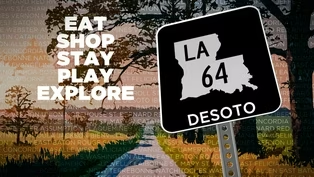
History and rural life continue to shape community identity in DeSoto Parish.
in DeSoto Parish, history, agriculture, and small-town life remain deeply connected.
Problems playing video? | Closed Captioning Feedback
Problems playing video? | Closed Captioning Feedback
LA64 is a local public television program presented by LPB
LA64
DeSoto Parish
5/21/2026 | 26m 46sVideo has Closed Captions
in DeSoto Parish, history, agriculture, and small-town life remain deeply connected.
Problems playing video? | Closed Captioning Feedback
Where to Watch LA64
LA64 is available to stream on pbs.org and the PBS app.
Providing Support for PBS.org
Learn Moreabout PBS online sponsorshipSupport for LA 64 is provided by: Office of the Lieutenant Governor Billy Nungesser, Keep Louisiana Beautiful and the Louisiana Office of Tourism.
In this episode of LA 64, hit the road with me to explore DeSoto parish, where Civil War history, frontier legends and homegrown Louisiana flavor come together.
We train for the Battle of Pleasant Hill reenactment, explore the African American legacy of Rosenwald schools, discover why Logansport is a Sand Bass Capital and explore wine country in Keachi.
From battlefields to bass fishing, this is DeSoto parish like you've never seen it before.
I'm Karen LeBlanc, a travel journalist and Louisiana native.
Join me on LA 64, a journey through all 64 parishes, exploring Louisiana's less traveled paths.
DeSoto parish sits in northwest Louisiana along the Texas border just south of Shreveport.
I start in Pelican, where I join a Civil War reenactment before criss crossing the parish to Mansfield, the parish seat, then on to charming Grand Cane and historic, Keachi and then Longstreet█s cherished Rosenwald School before ending in Stonewall to check out its new social scene.
Let's go.
It's the day before the annual Battle of Pleasant Hill, and I'm training to join the battlefield.
This is the largest Civil War reenactment in Louisiana.
Staged on the actual battle ground where the battle unfolded.
More than 20 cannons lined the field, and apparently, one of them is waiting for me to fire it.
Hello, Karen.
Welcome to the Battle of Pleasant Hill.
Thank you.
We're going to make you an official member of the Fourth Louisiana Field Artillery.
And we're going to teach you how to fire a cannon today.
All right, well, let me salute my new my new comrades.
Here we go.
All right.
Ease back.
Ready?
Ready.
Pull Good, good.
I learned to fire a cannon loaded with gunpowder rather than real cannonballs.
But the effect is just as realistic.
The boom and the smoke.
As I pull the pin, the cannon shoots a distance of 1800 yards, and it takes an entire team to fire it, including a spotter to focus and calculate the aim.
Now that I'm officially a member of Cameron's Battery, I join the soldiers for a conversation about what inspires these men to take part in what they call “a pastime, with a purpose”.
Men that die on this field.
We don't want them forgotten.
How do you decide what side to fight for?
I mean, do you toss a coin?
Confederate or Union?
They figured that out ahead of time.
When we arrive, we are, advised as to whether we're going to be Confederate or Union.
We are going to time travel back in history to the Civil War.
Imagine it is April 9th, 1864.
The day before in Mansfield, about 15 miles northeast of here.
Confederate troops defeated the Union troops and then the Union troops retreated.
They came here to Pleasant Hill.
The next day, a fierce, chaotic battle took place with heavy, heavy casualties.
I joined the 47th Pennsylvania Volunteer Infantry group of re-enactors, and we are fighting for the Union side.
Which leads me to why I'm dressed as an infantry soldier.
I'm about to go to battle at the Battle of Pleasant Hill.
Historians say two women disguised as men fought alongside the soldiers here.
So naturally, I felt called to represent.
The day begins with drills, learning military formations and how to respond to commands barked across the field.
It looks graceful from the sidelines, but once you're in formation, it is a whirlwind of timing, choreography, and split second reactions.
Let's just say I quickly learned I needed help.
A lot of choreography, a lot of training.
And it's hot in these wool uniforms.
Can you imagine being out in the battlefield?
Louisiana heat and humidity.
The Battle of Pleasant Hill takes place on the actual battlefield with permission from the private property landowner.
It is a spectacle worth experiencing, starting with the camp ground of participants dressed in historically accurate uniforms and clothing.
They camp in tents, cook over campfires and train for battle and basically just hang out like it's 1864.
We're out here with 450 people.
The battle had 25,000 people.
So it is a big difference in what actually happened.
The battle erupts in a thunder of cannon fire and smoke.
As Union and Confederate forces surge toward one another across the field.
Calvary riders tear through the battlefield and the ground trembles beneath pounding hooves.
Gunfire cracks through the haze while soldiers clash in hand to hand, combat falling where they stand, and scenes that blur the line between victory and defeat.
Charge!
I'm hit!
Up the road at the Pleasant Hill Battle Park, more than 1200 soldiers who died in battle are buried, many in this mass grave.
The day before, just a few miles down the road, The Battle of Mansfield unfolded in a fierce Confederate victory that changed the course of the Red River Campaign Today, the Mansfield State Historic Site preserves the story of that pivotal battle, a turning point in the Union's failed attempt to capture Shreveport, the Confederate capital of Louisiana.
I want to just point out that you're on the actual battleground where one of the only, welcome centers, few of them that are actually on the battleground.
So while you're walking yet, you're going to get to see exactly where the different units were, where they were standing, and kind of get to feel that experience as you're walking it.
A map leads me on a self-guided walking tour of the battlefield, with numbered stops detailing strategic moments in combat.
The Mansfield Female College became a triad center during both battles, and locals say some of the spirits who passed through these halls never left.
We'll get the ghost stories in just a minute.
But first, a little history.
Mansfield Female College was established in 1855 by the Methodist Church, and it's recognized as the first female college west of the Mississippi River.
Today, a museum occupies what remains of its once grand three story administration building.
A fire destroyed the upper floors, leaving behind a single story.
This is the last class in 1930.
The college did great up until 1930, when the Great Depression hit.
The college, trained women to become teachers and offered studies in the fine arts.
During the Civil War, the college served as the administration offices for Confederate forces, and out of necessity, became a hospital.
From here, they would do any emergency surgery like amputating arms or legs, and then move them off to different triage points.
There was one young Confederate soldier named Peter, who died here after his amputation.
And, rumor has it that he still roams looking for his lost limb.
So we actually have a ghost here.
You have a ghost?
Yes, we do.
This place is haunted?
Have you met the ghost?
Yes.
I have been several instances.
Like things missing or misplaced or door slamming.
And, we have all kind of manifestations.
It's it's been hilarious.
DeSoto parish was established in 1843, carved out of Natchitoches Parish and Caddo Parish.
Mansfield became the parish seat, and it's where the original DeSoto Parish Courthouse still stands.
A log cabin dating back to 1843.
Today, that rugged individualism and attachment to the land still resonates.
It's like a melting pot.
It's almost its own folk culture in that area.
And they still celebrate it today.
We still celebrate it in our food and in our festivals.
DeSoto parish became a big fish in the oil and gas industry.
In the early 2000, with the discovery of the Haynesville Shale.
It was one of the largest natural gas formations in the United States, and with advances in drilling technology, they were able to access the gas underneath my feet, deep within rock formations, and this brought new wealth to DeSoto parish, and it launched a modern energy boom.
So how would we describe the economic drivers today in the parish.
What are they?
In the parish, primarily natural gas, the main driver.
We send the most severance tax to the state of all the parishes in the state, out of 64 parishes, millions of dollars.
And that's mostly natural gas severance tax.
Today, beef cattle remain an important part of DeSoto parish's economy and culture.
Many local farmers sell directly from their land, creating a true farm to table experience.
From cattle pastures to river banks, DeSoto parish█s economy has long been shaped by the water and land.
Logansport is known as the Sand Bass Capital, and it sits where the Sabine River feeds into the Toledo Bend Reservoir, making the town both a historic crossing point and a gateway to one of the South's premier fishing destinations.
Toledo Bend is a very large reservoir just south of here.
Every spring, the white bass lead Toledo Bend come up this tributary to do their spawning run.
And for some reason, crawfish here, shad here, are the nutrient grow the white bass.
They're fairly large, larger than a lot of parts of the country.
And so people from all over the United States come here to fish with them.
And when is that spawning season?
That the month of February and the month of March.
Public boat launches, riverbank fishing spots, and annual fishing tournaments have helped make white bass fishing part of the town's identity and culture.
Logansport began as a frontier town and a gateway to No Man's Land, a disputed territory born after the Louisiana Purchase of 1803 that created a 30 mile wide strip with no government and no clear authority.
Even today, the welcome sign at the edge of town reflects that rugged pioneer spirit.
At the time of the Louisiana Purchase, Logansport was at the farthest westernmost point of the United States at that time across the Sabine River was Mexico at that time.
So Doctor Logan, who founded Logansport, started a ferry here back in the 1830s.
And that was how it was the Commerce Center.
Logansport at one time had more saloons than they had churches back in the late 1890s, and it was kind of a lawless little town.
A stroll down historic Main Street reveals revitalized storefronts, and Logansports personality, from wooden totem poles to a retired water tower turned community icon.
Today, a new generation of entrepreneurs is helping reinvent the town with food.
As a part of Logan's sports comeback story.
On my road trips throughout Louisiana, I'm always on the lookout for big flavors and small towns.
Which leads me to Big Zach█s Place here in Logansport.
Locals swear by it, and it's earned its reputation, one plate at a time, being featured in magazines and TV shows and now LA 64.
But what I like most about this restaurant is its commitment to community.
Owner Big Zach, intentionally located here in historic Logansport to help revitalize the area.
Let's go meet him.
Big Zach invites me into the kitchen to watch him prepare one of the restaurant's signature dishes.
Redfish DeSoto.
It's a family recipe served with a grilled peach, fruit and seafood.
All right.
I'll admit I questioned the combination at first, but when a dish becomes one of the menu's best sellers, you trust the chef.
Try to get a bite of everything at one time.
I can taste the different dimensions of flavor.
This peach really gives it a kick.
Big Zach traded a career in the oil fields for a restaurant kitchen, opening his business in historic Logansport to fill a need for a gathering place rooted in community.
We're trying to bring the town back to where it used to be.
You know, live and lively pop and, you know, people everywhere downtown.
After lunch, I had six miles north of Logansport, to check out the only surviving historical boundary marker in the United States.
This international boundary marker marks the end of no man's land.
At that point, the United States and Spain had settled its boundary dispute.
The United States sent out surveyors to establish the boundary between the nation and what was in Spanish, held territory, which is now Texas.
Literally right here, I could I could step over this.
And I'm in Texas.
One of the joys I have of filming LA 64 are the unexpected encounters, like this impromptu reunion of former students and teachers at the Longstreet Rosenwald School.
After word spread that we wanted to learn about the school's legacy.
Louisiana Rosenwald Schools educated African American students and mostly rural areas.
They were constructed between 1912 and 1932 for educational equity.
Druzella Moham taught at the school.
So at age 94, I'm glad to sit here and look at you and share this with you because it's phenomenal and it's not to be forgotten.
The Longstreet Rosenwald School grew from a partnership between Booker T. Washington and philanthropist Julius Rosenwald, president of Sears and Roebuck, whose vision helped build nearly 5000 schools across the South during the Jim Crow era.
We had a lady by the name of Miss Scarlett Green played that piano.
That one on that one and had one of the best choirs over here.
And I would like for you to hear them sing now, some on Sundays with Joseph Pippin back there, one of my students as the pastor.
I interviewed your teacher, and she said you were one of her favorite students.
That's high praise.
I became one, after she put that switch on me.
She, she whipped me into doing right.
She whipped me.
She whipped me into doing right.
She must have whipped you pretty good, because now you're a man of God preaching the Word.
Why is this school so important to the community?
It█s so important to the community, it did two things.
First, it educated us, our mind, but it helped us morally.
The Louisiana Trust for Historic Preservation says of the nearly 400 Louisiana Rosenwald schools constructed, only 20 remain.
Today, the school serves as a community center and an extension of the Traveler's Rest Baptist Church, established in 1878 and led by Pastor Joseph Pipkin.
I had a few miles north to Keachi, a town established in 1858 and named after the Native American word for big black cat.
I met up with Keachi's mayor Travis Whitfield, an artist and passionate preservationist who first came here in the 1970s to paint the town's old general store and never left.
Together, we wander through Keachi's historic buildings, many built by settlers in the 1800s and now in various stages of restoration.
One of them is Liberty Lodge Number 123, listed on the National Register of Historic Places.
We're inside the Masonic Hall.
And it was organized here in 1853.
Originally this this was this was leased out as a as a as a grocery store a store.
The whole that was historically the way Masons did that in order to, to make the money to keep, stay alive.
The ruins of Keachi College, built in 1856, still stand as a reminder of the school that later served as a Civil War hospital.
Greek Revival architecture shapes much of the town, including several beautifully restored churches listed on the National Register of Historic Places.
Before we leave, Travis takes me to the Keachi Cemetery to see one of the town's strangest curiosities.
This is the gravesite of Miss Oliphant, who passed away in 1884, and her husband didn't want it to rain on her face.
And so he built this, this little house over her.
Next, I'm headed to wine country in DeSoto parish.
Yes, you heard it right.
In Keachi a former dairy farm, has transformed into a vineyard where grapes grow and wine flows at Kickapoo Twist Winery and Vineyards, former dairy farmers, Eddie and Tracy Jordan, discovered that their old grazing land was perfectly suited for wine grape vines.
You went from milk to wine.
I taught school for, in between those years.
So what is it about the land here that makes it conducive to winemaking and producing?
It's it's pretty tough with the humidity and that sort of thing.
But we do have some varieties that grow well.
And, we have a good soil.
I mean, it's raised crops and supported families are here for since the middle 1800s.
After my tour, I now get to sample the grapes I saw growing in the Kickapoo Twist Vineyard with Tracy, the co-owner.
So you█re going to pour me a wine flight.
And this is some of how many different types of wine.
We do about 20 different custom wines.
This is one of my favorites, as I call it Sabine River Red.
It's a blend of, Pinot Noir and our Crimson Cab 25.
I follow the gas Station Eat food trail which runs through DeSoto Parish to Sunrise Cookies.
It's located in a former gas station and as you might expect from the name, they are famous for their homemade cookies.
Let's go.
Owners Felicia and David Warren worked side by side, baking cookies, breads and their famous king cakes from scratch each day.
They make king cakes year round, and their chicken salad sandwich bag lunches are bestsellers.
The secret is, is that the dough is made from scratch.
It's not from a mix.
I use flour, sugar, salt, butter.
We make our dough from scratch.
We make our filling from scratch.
And then after they are baked and after they come out, David fills them with the cream cheese filling.
And then we ice the cakes.
The railroad gave birth to many Louisiana settlements, including Grand Cane, that once prospered as a train stop.
At its peak, the village population numbered more than 500.
Then the highways came, or, as the mayor of Grand Kane says, the big slab was laid and the people moved out and others just passed through town.
More than 125 years later, Grand Cane stands as one of Louisiana's greatest small town comeback stories.
They have been all declared historical.
Sometimes it gets hysterical to take care of the historical buildings.
But they are.
They belong to the town.
We own every building.
Down the street, Back Alley Community Theater stands as the cultural anchor, drawing audiences from across the region.
It's certainly the strongest theater in the parish of of DeSoto.
And really, for a town this size, to have a theater that this quality that we do as many products, plays as we have.
We do 5 or 6 shows a year.
We have youth program that, several kids came up through the theater in that we do improv to work on developing new talents.
We have improv nights here, and we keep a packed show in a packed theater.
Stonewall's homegrown pride is rooted in a mix of legacy family businesses and newcomers helping shape this booming bedroom community of Shreveport.
Leah and Angelo Deprimo decided Stonewall needed a social life, so they opened Brassica Farm.
The outdoor entertainment space includes food trucks and repurposed shipping containers that now housed boutiques, art, fitness studios, and other small businesses.
We had a vision to create something in Stonewall for families to come hang out and enjoy, and also give small businesses an opportunity to open up a storefront or their live out their dream to.
Welcome to the Cook Hill House.
It is my home base.
While exploring DeSoto parish.
It's a mid 1800s home, restored as a bed and breakfast.
Here in Grand Cane.
It's about just two blocks from the Grand Cane Charming Historic District.
Come on inside.
I'm going to give you a tour, and I'm going to share a story about the home's roots.
The Cook family, who has deep roots in DeSoto parish, donated the family home to the Grand Cane Historic Association, which owns and operates it and restored it.
Step into the parlor and I'll tell you more about the family story.
Four Cook siblings grew up in this home, including Lloyd Elmer Lod Cook.
He was a successful oil executive and an active philanthropist for Louisiana State University.
He served as Chairman of the Board of Supervisors, and the Cook Hotel and Conference Center on campus is named after Lod Cook.
Honoring all of his contributions.
Here's my takeaway from my time in DeSoto parish.
I followed stories across battlefields, backroads, fishing spots, historic main streets, and even a vineyard.
I marched into the chaos of a Civil War reenactment and listened to former Rosenwald students reflect on a school that shaped generations during segregation.
I found Greek Revival churches, cemetery legends, and inspiration in the moxie of an 88 year old mayor leading one of Louisiana's greatest small town comebacks.
DeSoto parish is a rare place where the pioneer spirit perseveres, reimagined through charming communities and homegrown pride.
But don't just take my word for it.
Go experience it for yourself.
Support for LA 64 is provided by: Office of the Lieutenant Governor Billy Nungesser, Keep Louisiana Beautiful and the Louisiana Office of Tourism, and by the Atchafalaya National Heritage Area, the St.
Landry Parish Tourist Commission, Northwestern State University, and by the Foundation for Excellence in Louisiana Public Broadcasting.
And viewers like you.
Thank you.
Video has Closed Captions
History and rural life continue to shape community identity in DeSoto Parish. (28s)
Providing Support for PBS.org
Learn Moreabout PBS online sponsorship









Support for PBS provided by:
LA64 is a local public television program presented by LPB