LA64
Jefferson Parish
2/10/2026 | 26m 47sVideo has Closed Captions
LA64 explores Jefferson Parish.
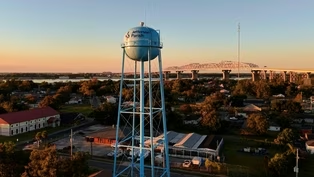
Jefferson Parish unfolds along Louisiana’s working coast, where water and commerce shape daily life.
Problems playing video? | Closed Captioning Feedback
Problems playing video? | Closed Captioning Feedback
LA64 is a local public television program presented by LPB
LA64
Jefferson Parish
2/10/2026 | 26m 47sVideo has Closed Captions
Jefferson Parish unfolds along Louisiana’s working coast, where water and commerce shape daily life.
Problems playing video? | Closed Captioning Feedback
How to Watch LA64
LA64 is available to stream on pbs.org and the free PBS App, available on iPhone, Apple TV, Android TV, Android smartphones, Amazon Fire TV, Amazon Fire Tablet, Roku, Samsung Smart TV, and Vizio.
Providing Support for PBS.org
Learn Moreabout PBS online sponsorshipSupport for LA 64 is provided by: Office of the Lieutenant Governor Billy Nungesser, Keep Louisiana Beautiful and the Louisiana Office of Tourism.
Just outside New Orleans, a different Louisiana comes into view.
On this episode of LA 64.
I'm traveling through Jefferson Parish from Kenner█s riverfront to Westwego█s.
shrimp boats, Gretna█s German roots, pirate lore in John Lafitte, and all the way to Grand Isle, where the road ends and the Gulf begins.
This is Louisiana.
Just beyond the obvious.
I'm Karen LeBlanc, a travel journalist and Louisiana native.
Join me on LA 64, a journey through all 64 parishes, exploring Louisiana's less traveled paths.
Jefferson Parish is in southeastern Louisiana.
Our road trip starts in Kenner on the East Bank, crosses the Mississippi to the West Bank through Westwego, Gretna, and Jean Lafitte, and ends where the land gives way to the sea in Grand Isle.
Jefferson Parish was established in 1825 and named in honor of Thomas Jefferson, who played a role in the 1803 Louisiana Purchase.
It's the international gateway to Louisiana as home to the Louis Armstrong New Orleans International Airport.
Kenner might just be one of the most overlooked stops near New Orleans, but its east bank location along the Mississippi River has always made it a gateway first for river trade, then for rail and highways, and today, as the front door for many visitors arriving by plane.
Historic Rivertown feels like Kenner█s front porch, inviting you to stop, stay a while, and stroll around its walkable blocks.
Home to museums, restored homes, local eateries, mom and pop shops, and even a planetarium.
With one of only two space station prototypes in the country.
The Kenner Planetarium and Science Center invites visitors to step inside its NASA International Space Station prototype for an out of this world experience that starts with a live view of the space station in orbit.
This is the one that was built in New Orleans East at the Michoud Facility.
And, this cost of $1 million to make this, which was a small price to pay to try to get the job to build the space station.
Unfortunately, this was one of the losing designs, but it's still special.
The one that one was the Boeing Company.
I tried on life in space from this suit to an up close look at the module airlock and the space station's hydroponic gardens.
Even the toilet with feet, straps, all the realities of daily life in orbit.
So this module will represent more of what kind of small places they live in.
So and of course they're not walking or floating from one place to another.
So that's what these handrails are for.
The other side of the complex houses the Science Center and Planetarium, including a mega dome cinema that hosts immersive laser light shows.
So we're we're the largest in the greater New Orleans area.
We have a 50ft dome with 118 seats.
So we're second really only to Baton Rouge.
So we're a very unique and, local attraction.
Heritage Park marks the end of Williams Boulevard, Kenner█s historic main Street.
Locals come for the paved levee trail.
Visitors linger for the views of the Mississippi River.
I came for both, and every so often an airplane lifts off overhead.
Just a little reminder that this river town also happens to be a gateway city.
There's a little bit of everything here and the mom and pop shops.
You can either do pottery, there's a pastry shop around the corner, we have reception halls.
We have, locally owned restaurants where you can eat.
It's amazing how they work together.
I cross the Huey P. Long Bridge, which links East and West Jefferson Parish across the Mississippi River and ahead to Westwego.
When the bridge opened in 1935, it was an engineering marvel.
The first bridge in Louisiana to carry both rail and automobile traffic, connecting communities once separated by ferries and shaping the parish█s future.
Westwego proudly calls itself Gator Town, and you'll see it on murals and signs all around town.
This place grew out of fishing and farming and today it's where locals come when they want seafood as fresh as it gets.
Right here at the Westwego Shrimp Lot.
Hey, everyone.
Hi, Karen.
Welcome to Westwego and the Westwego Shrimp Lot.
Hi.
Must be the family business.
So nice to meet you.
The family.
We got to take you on a tour round about here.
And, before you do, you just want to be part of the crowd with a pair of shrimp boots.
Cut!
I'll be back.
Okay, I have my shrimp boots on.
I'm ready to take a tour.
All right.
You ready to go.
Let's do it.
Ronnie Temento started the Westwego Shrimp Lot back in 1979 with his father.
Today, it's a true family operation run by Ronnie alongside his daughter, Anne, and his grandson, Andrew.
And many of these stands have been in the same families for generations.
These are hard working people and you almost have to be born in this business to succeed.
The consumer benefits a lot of ways because they can save money.
Most of the time the shrimp will be 2 or 3 days old.
You go to a regular place, you're going to find shrimp in there for months Seafood shopping here is a conversation.
Vendors pop open their ice chest and say, “Hey, come take a look ,” while you get to choose shrimp straight off the boat, live crabs, oysters by the sack, even gator meat.
On the surface, this seafood super-mall looks basic.
A gravel parking lot surrounded by tin roof stalls and hand-painted signs.
But behind the scenes, there is a lot of smart infrastructure keeping everything clean, safe and environmentally responsible.
They actually created small ecosystems behind the stalls to retain the shrimp water, dump sites.
Basically, whenever there have seafood or things like that.
So it's not just throwing it back into Mother Earth, it's more of recycling into the ecosystem.
When shopping for fresh crabs, Mr.
Ronnie gave me a tip.
If I want a male crab, they have the blue claws.
If I want a female crab, they have oh, I got two, painted fingernails.
I catch a whiff of smoked alligator sausage and follow my nose straight to Market We-Go.
They're known for their alligator sausage, crawfish sausage, boudin and hot cracklin█.
And once you smell it, you're already in line.
From the Shrimp Lot, I head down Historic Sala Avenue, which runs straight to the levee where colorful murals cover the remains of the old Westwego Canal locks.
Folk artist Joshua Wingerter is behind the work, and his artistic imprint shows up all over town.
Locals call him the creative catalyst of Westwego's art scene, and you'll usually find him right here in his gallery on Sala Avenue.
I'm with a pop art scientist.
Pretty edgy stuff.
Yeah, it's pretty cool.
For Westwego.
Yeah.
I mean, I would say so, but that's the response that I usually look for when people come out and, check out what we have going on.
There's a bunch of emerging young people that have different small businesses, whether it be art or coffee shops or whatever the case may be.
And I get to just be like another flavor in the neighborhood.
Joshua's gallery is pure eye candy, packed with pop art, painted objects and layers of stenciled and spray painted imagery.
He'll paint on just about anything, from car parts to Storm Troopers.
I asked Joshua to paint his vision of LA 64.
Then I stood back and I watched as he brought it to life.
Stenciling the logo in bold purples and pinks and adding a paper airplane that captures the show█s: eat, shop, stay, play and explore ethos.
Looks like we have a new LA 64 logo.
An original by Josh Wingerter.
Well done.
Brilliant.
The creative genius.
I walk a few blocks down from the gallery to Salaville's original general store.
Today, it's the Westwego Historical Museum, and it feels almost like it's still open for business.
With shelves stocked the way they once were.
This 1800s building is listed on the National Register of Historic Places.
I continue east on the West Bank to Gretna to explore its German roots and reputation as the bedroom community for New Orleans.
At the Gretna Historical Society on Lafayette Street.
I met up with the mayor, a sixth generation Gretna resident with deep family ties to the city.
We were established in 1913, but a village long before that, in the mid 1800s.
We were established by German immigrants who came here, from across the pond to dig canals, specifically the Harvey Canal on the West Bank of the Mississippi River.
Which was an incredibly important job at the time.
So we have a strong German, representation here in the city.
In the last 12 years, people have sought to come back to our boutique community because of our architecture, because of our nice little shotgun homes, our double shotgun homes, and it's been a true resurgence of residential and and commercial alike.
And I'm so excited to see it come back again.
And be a city of choice for young professionals across the metropolitan area.
Gretna█s Historic Center is a snapshot of early life here, including two homes, a blacksmith shop and a fire station that honors the oldest continuously active volunteer fire company in Louisiana.
The David Crockett Firehouse is home to the volunteer fire company founded in 1837.
Inside you'll find a rare 1876 steam pump, an early version of a fire engine.
Our Crockett Fire Department is the oldest continually active volunteer fire department in the entire United States.
And of the 73 steam pumpers that were made, this is the only one left in existence.
Funny thing is, they purchased this for $3,500, and then they didn't have enough money to purchase the horse that you needed to pull this.
So they would put 2 or 3 firemen on the front and drag it down the street.
The company took its name from the American folk hero Davy Crockett, reflecting his ideals of bravery and service.
The David Crockett Fire House is just one chapter in Gretna German story.
The next stop takes me deeper into that heritage at the German-American Cultural Center and Museum.
The first Germans who came to Louisiana in 1721.
So they were here, in fact, before the Cajuns came from Canada.
The Germans were here to say Wilkomen, when when the Acadians came.
So those that history of how they came to be drawn here, brought here by the French government to help populate, populate the the area.
Just as you'd expect, there are lederhosen and beer steins on display, but also historic photos and maps that tell the story of the German immigrant communities that came together to form Gretna.
From the museum, I stroll down Huey P. Long Avenue, passing a train depot and civic buildings as the Jefferson Memorial Arch comes into view.
A monument honoring all Jefferson Parish veterans.
About 30 minutes south of Gretna, I'm greeted by a giant pirate ship sculpture welcoming me to the town of John Lafayette, named for the famous buccaneer.
Pirate imagery pops up everywhere, and locals proudly call themselves Lafittians, embracing the folklore that helped put this town on the map.
Scenes from John Lafitte's swashbuckling past come to life at the John Lafayette Visitor Center and Tourism Museum where animated pirate puppet shows tell the tale.
Was the town of John Lafitte the home of this pirate or the hiding place or home and hiding place?
I would say it's both.
It is a place where we feel like he actually, when he was on a boat, Bayou Barataria, he actually threw his treasures out.
So we feel like along Bayou Barataria is where a lot of the treasure is.
We were also told that he is buried in the cemetery in Lower Lafitte.
So this sounds like legend and lore and fact.
Have we actually unearthed any of this treasure or his remains?
Not at this point.
We're still searching.
John Lafayette is a young town founded in 1974.
The pirate himself didn't establish it, but his story became part of the town's identity, where pirate legend and coastal living meet.
We have generations of people, families that have stayed here.
Our family and a lot of the residents here, their families have come from Manila Village, Clark, Cheniere, where there were dried shrimp, platforms.
So, you know, you introduced yourself as a Lafittian.
What does it mean to be a Lafittian?
It's just a proud person that loves Lafitte with all her heart.
I just love it, like all of our residents do.
And we won't leave from here.
We just going to keep fighting to make sure that it's a better community, better place to live and, just make it better for the next generation.
The water and the wetlands are the main attractions in Jean Lafayette.
I'm taking you on the Jean Lafayette Nature Trace.
It's a cypress boardwalk that runs through the swamps.
There's also a trail for biking and walking along the levee.
It was built by the town of Jean Lafayette, and it also leads to a wetlands education center.
Along the boardwalk, winding through cypress forest and marsh Jean Lafitte█s story unfolds through interpretive signs with a covered pavilion offering a quiet place to rest and reflect on this walk through history and Mother Nature.
John Lafitte once moved through this maze of bayous and waterways tied to the Gulf, using the Barataria Bay as his home base.
The marshes, bayous, and hidden inlets made it easy to slip in and out, sight unseen.
To retrace some of those swamp paths, I hop on an airboat with my captain, Shane Guidry, a Jean Lafitte native, an 11th generation Cajun whose family has called this place home since 1765.
In Bayou Barataria, his crew, Jean Lafitte█s crew called the Baratarians.
He and his brother Pierre did invade enemy British ships, but they preferred privateer or buccaneer.
Basically just a pirate that works for the government.
It's early November and a bright, sunny day as we glide through the swamp connecting to the intercoastal waterway.
Gators swim up to the boat.
It's a Bayou State's version of a wildlife safari.
My final stop is Grand Isle, the southernmost tip of Jefferson Parish and Louisiana's only inhabited barrier island.
Highway one connects Grand Isle to the mainland, passing fishing camps and a sign proclaiming the home of the International Tarpon Rodeo, a tradition that's drawn anglers here since 1928.
The 90th Meridian West slices straight through Grand Isle all the way to the Gulf.
And I'm standing right here on this line that marks the globe at 90 West Park in Grand Isle.
This geographical line is where the land gives way to the water.
The island is also a prime spot for bird watching.
Hundreds of species use Grand Isle as a rest stop on the Mississippi Flyway, one of North America's major bird migration routes.
Places like Lafayette Woods Nature Preserve foster the habitat the birds depend on during migration.
I am headed out on a hike here in Grand Isle with two guides today.
I have Karen McKinney.
She's an architect and a historian.
I have Jean Landry, and she's a preservationist with the Nature Conservancy.
And she's also a historian.
She's a long time resident of Grand Isle.
So, ladies, are you ready?
Yes.
Let's go take a hike.
At the entrance to the Grilleta Tract, a birding checklist shows just how important this area is for songbird migration.
Jean tells me that birders start arriving as early as mid-January.
Spring and summer bring colorful plumes, while winter draws birders hoping to spot rare birds blown off course during migration.
Every year, it seems that we have a bird that is unusual for this area.
So, we must have had 500 visitors come four years ago when we had a red legged honey creeper.
Grand Isle was mapped by the Spanish in the 1500s and settled in 1781.
Its land divided into early grants that shaped life on this barrier island.
Oak trees have kept it safe from countless storms throughout the centuries.
The live oaks are also an important facet of the historic preservation of buildings on the island.
Some of the oldest structures that are now included on the National Register of Historic Places, survived storms because they're within that tree line of the mature oaks that helps to both mitigate the tides coming in and break down the winds coming through.
So the buildings are more likely to survive.
Grand Isle State Park feels like the edge of Louisiana, where the road ends and the gulf begins.
I walk a mile of beach with hardly another soul in sight from above.
The park's calm really comes into focus, showing how this stretch of coastline connects open water, marsh and the people who come here to camp, fish and enjoy serenity.
Jefferson Parish is known for its fresh seafood, especially oysters, so much that the parish blazed the Louisiana Oyster Trail, linking restaurants known for serving some of the best oysters around.
Each marked by its own oyster sculpture.
For the original Charbroiled oyster, head to Drago's in Metairie.
Klara Cvitanovich still runs the restaurant.
She opened with her husband, Drago, a Croatian oyster fisherman, back in 1969.
It was their son, Tommy, who created the now iconic charbroiled oyster.
And he is the one who said what would happen if we take open oyster., we put it on a grill and we put on it our garlic butter sauce.
A star was born.
Oysters doused in garlic butter hit the flames, igniting in a burst of fire that gives them Drago's signature charbroiled flavor, a dish often imitated but arguably never quite matched.
For dessert, I follow my sweet tooth to Kenner, where locals swear by the doberge cake at Debbie's on the Levee in Rivertown.
The moment I walk in, the smell of cakes baking fills the room and I'm instantly drawn to the glass case.
Rows of doberge cakes in every flavor and color.
Owners Charles and Charlotte are in the kitchen, finishing up a fresh batch, and Charles steps out to greet me.
Charlotte takes care of the icing and slicing with at least a dozen layers in a doberge cake, it's part precision and part patience.
That's the thing about a doberge cake.
It's so labor intensive.
I mean, look at all these layers and then you have the ice in them, and then make it beautiful.
A steady hand is really key to making sure that you're consistent in every single step, and making sure that everything comes up exactly as it did before.
Louisiana has a long, delicious habit of borrowing European desserts and making them its own.
And the doberge cake might be one of the sweetest examples of that Creole creativity.
It's tied directly to New Orleans and the surrounding area.
Coming from an Eastern European recipe, adobo torte adapted for an American palate by Beulah Ladner and then Frenchifying the name to fit in with our, bastardized tongues, calling it doberge instead of adobo torte.
She really built this cake for this region and for the people that live here and love it.
While exploring Jefferson Parish, I stayed at Bayou Segnette State Park one of those rare places that feels worlds away, yet just sits 15 minutes across the Mississippi River from New Orleans.
I've stayed at a lot of state parks.
This one is super unique because the cabins float.
My cabin literally juts out onto the bayou and it floats.
In fact, when boats go by, you can kind of feel it rocking.
Now, I will say that this state park really caters to fishing.
There are a lot of amenities, a great boat launch.
You can fish for saltwater or brackish fish and every cabin has its own fish cleaning station.
In Kenner's historic Rivertown.
I stayed at the Clancy House, named after long time Sheriff Frank James Clancy, who built the home in the 1920s.
Hi, Karen, welcome to the Clancy house.
Come on in and make yourself at home.
This is so charming.
Thank you so much.
Andrée Dupépé is the great granddaughter of Sheriff Frank James Clancy.
She restored the home as an overnight events venue.
The property includes the main house, a carriage house and an outbuilding.
This mural behind us, shows the the immigrants which Kenner was mostly Italian and Irish immigrants and they were the lifeline to all of the produce that would go to the city of New Orleans.
The two bedroom, two bathroom home is part gathering place and part getaway.
It claims to be River town's only venue, with an overnight option.
Here's my takeaway from exploring Jefferson Parish.
In many ways, it's a microcosm of Louisiana itself.
Less obvious at first glance, but essential to understanding the state.
From river towns and seafood docks to wetlands and barrier islands.
Each stop reminds me that sometimes the most meaningful journeys happen just beyond the places that we think we already know.
Support for LA 64 is provided by: Office of the Lieutenant Governor Billy Nungesser, Keep Louisiana Beautiful and the Louisiana Office of Tourism, and by the Atchafalaya National Heritage Area, The Saint Landry Parish Tourist Commission, Northwestern State University, and by the Foundation for Excellence in Louisiana Public Broadcasting.
And viewers like you.
Thank you.
Providing Support for PBS.org
Learn Moreabout PBS online sponsorship











Support for PBS provided by:
LA64 is a local public television program presented by LPB