
June 24, 2026 - PBS News Hour full episode
6/24/2026 | 57m 46sVideo has Closed Captions
June 24, 2026 - PBS News Hour full episode
June 24, 2026 - PBS News Hour full episode
Problems playing video? | Closed Captioning Feedback
Problems playing video? | Closed Captioning Feedback
Major corporate funding for the PBS News Hour is provided by BDO, BNSF, Consumer Cellular, American Cruise Lines, and Raymond James. Funding for the PBS NewsHour Weekend is provided by...
June 24, 2026 - PBS News Hour full episode
6/24/2026 | 57m 46sVideo has Closed Captions
June 24, 2026 - PBS News Hour full episode
Problems playing video? | Closed Captioning Feedback
Where to Watch PBS News Hour
PBS News Hour is available to stream on pbs.org and the PBS app.
Providing Support for PBS.org
Learn Moreabout PBS online sponsorshipGEOFF BENNETT: Good evening.
I'm Geoff Bennett.
AMNA NAWAZ: And I'm Amna Nawaz.
On the "NewsHour" tonight: President Trump ratchets up tensions with Senate Republicans after abruptly canceling plans to sign a landmark housing affordability bill.
GEOFF BENNETT: The Democratic Party's progressive wing wins a series of high-profile primaries, signaling the mood of some Democratic voters ahead of the midterms.
AMNA NAWAZ: And as the United States approaches its 250th anniversary, we speak to author Walter Isaacson about what he calls the greatest sentence ever written.
WALTER ISAACSON, Author, "The Greatest Sentence Ever Written": There's a deep contradiction in the sentence and a contradiction in the way America was founded, and our narrative is how we resolve that contradiction.
(BREAK) AMNA NAWAZ: Welcome to the "News Hour."
President Trump has upended Congress' plans for a major housing bill, refusing to sign legislation that passed with veto-proof majorities as he tries to force action on his voting reform agenda.
GEOFF BENNETT: The tactic is familiar.
Earlier this year, the president derailed a bipartisan deal on intelligence and surveillance legislation while pressing lawmakers to adopt that controversial voting bill known as the SAVE Act.
Now he's using a housing package that many lawmakers expected would be signed into law today as a new point of leverage.
Andrew Desiderio covers the Senate for Punchbowl News and joins us now.
Andrew, always great to see you.
So, the White House had prepared for this signing ceremony.
Lawmakers were gathered there on Capitol Hill, and then President Trump says via social media that he's not going to sign the bill after all.
You have to tweet up on the screen right there.
You were there with the news broke.
How did Republican senators react?
ANDREW DESIDERIO, Punchbowl News: They were shocked, I mean, dumbfounded.
As you mentioned, the president has done this a lot lately where he has blindsided Republican leaders.
But a signing ceremony usually happens at the White House.
This one was set up in the Capitol Building itself here in what's known as Statuary Hall.
They had a stage set up.
They had the presidential emblem there, a desk for him to sign it.
And just about an hour before he was supposed to leave for the Capitol, he put this message on TRUTH Social, saying that he wasn't going to sign it into law until the Senate and the House sent him, as you mentioned, the SAVE America Act, which is legislation that has virtually no chance of passing either chamber, frankly, at this point, but especially in the Senate, where the filibuster exists.
And what's fascinating about this particular rift between Senate Republicans and the president is that the president was already scheduled to attend a lunch meeting with Senate Republicans right after the signing ceremony, which he came to anyway.
And the conversation ended up devolving into mostly an argument between himself and Senator Bill Cassidy over the Iran war.
And the president really didn't open it up for Q&A at all about the SAVE America Act issue and the fact that he's blocking now the bipartisan housing and affordability bill, which, by the way, got 85 votes in the Senate and nearly 400 votes in the House.
GEOFF BENNETT: Right, bipartisan, veto-proof majority.
What leverage does the president really have at this point as it relates to this bill?
ANDREW DESIDERIO: Well, he has leverage in the sense that he could just hold out in not signing it.
But there is a 10-day clock that starts to run, but only when the speaker of the House officially transmits the bill to the White House.
Speaker Johnson, of course, a close ally of President Trump, has not officially done that yet.
So, if he doesn't actually transmit this bill to the White House, that 10-day clock doesn't start to run.
And if he does, then the 10-day clock runs, and, at the end of it, the bill automatically becomes law without the president's signature.
Now, if the president were to get the bill eventually and then veto it, Congress could vote on overriding that veto, but it takes two-thirds in both chambers.
If you take into consideration the fact that it got huge margins in both chambers to begin with, you would think that they would be able to easily override this veto.
But veto override votes tend to be very interesting, in the sense that a lot of members back off of their initial support for a piece of legislation when it comes to a veto override because they don't want to be seen as crossing the president.
So who knows, honestly, what's going to happen with this bipartisan housing affordability bill, which Republicans really, really want to focus on, because they know that affordability is the number one issue for voters in the midterms.
GEOFF BENNETT: Well, yes, let's talk more about that, because the president dismissed this housing bill as being of minor importance.
That was the phrase that he used.
But housing costs, affordability remain a top issue for voters heading into November.
So, how much of a political vulnerability does this open up for Republicans?
ANDREW DESIDERIO: It's a major political vulnerability.
The president's poll numbers are already at historic lows.
Voters are already saying that they in these surveys are very dissatisfied with the state of the U.S.
economy, the cost of living, again, affordability concerns, and they want to see Congress and the president addressing that.
And, instead, what we're seeing is, of course, the president having this fixation, this obsession on the SAVE America Act, which, as I mentioned before, has virtually no chance of actually becoming law.
And it's something that Republican leaders think they can use against Democrats to show that they're against voter I.D., for example, which is usually an 80/20 issue in this country, right?
So what the president is also doing is, he's preventing Republicans from even seeking political benefit from that issue on its face.
And so it really is not just blindsiding them, but dumbfounding the Republican leadership up here, to the point where I have Republican senators coming to me and openly questioning whether this president is intentionally, deliberately trying to blow up their congressional majorities.
GEOFF BENNETT: Wow.
Andrew Desiderio covers the Senate for Punchbowl News.
Andrew, thanks again for your time this evening.
ANDREW DESIDERIO: Thanks, Geoff.
AMNA NAWAZ: All right, let's turn now to the substance of that landmark bipartisan housing bill.
The new legislation, the biggest overhaul of federal housing policy in decades, contains no new spending, but it does seek to boost supply by making it cheaper and easier to build across the country.
That includes, among other things, new provisions that would streamline environmental reviews, remove restrictions for the construction of manufactured homes, increase access to small-dollar mortgages, and, moving forward, bar large institutional investors like private equity firms from owning more than 350 single-family homes.
To break down the potential impact, we're joined now by Shaun Donovan.
He served as secretary of housing and urban development under President Barack Obama.
He's currently the president and CEO of Enterprise Community Partners.
That's a housing nonprofit.
Secretary Donovan, welcome to the show.
Thanks for being with us.
SHAUN DONOVAN, Former U.S.
Housing and Urban Development Secretary: My pleasure.
Thanks for having me on.
AMNA NAWAZ: So it's clear reform is needed when it comes to housing when you look at the numbers.
Home prices are up 54 percent since 2020.
The median cost of a mortgage has nearly doubled.
By some estimates, we have a housing shortage of nearly seven million units.
You called this bill the most important, most comprehensive housing bill of this century.
Why?
What would it change?
SHAUN DONOVAN: Well, we'd need the entire "News Hour" to get through all of the provisions There are literally dozens of them in this bill.
But you got it exactly right.
The core of this bill is to say, for decades now, we have not been building enough housing in this country.
That is at the center of what is the greatest housing affordability crisis we have ever recorded in the U.S.
And that is really what this does.
It unleashes local communities and the private sector to do more to build housing.
And it gets regulations and other steps out of the way to help do that.
AMNA NAWAZ: One of the provisions that got a lot of attention was this ban on institutional investors buying single-family homes.
How significant is that?
Would that really move the needle?
SHAUN DONOVAN: Well, I think what's really important here about the provision is that, as it was originally drafted, it actually would have had an unintended consequences.
It might have stood in the way in some ways of building more affordable housing.
And so, through good bipartisan negotiations, those unintended consequences were fixed.
But I think, stepping back, there is no single silver bullet in this bill.
It is really the sum total of the pieces that make it the most comprehensive legislation that we have seen.
And I do think those are provisions that are a wide range, but will really take local implementation to have an impact on families' lives in this country.
AMNA NAWAZ: So let's talk about that implementation, because the reforms, as you mentioned, range from environmental reviews to zoning restrictions, single-stair buildings.
They seem very specific and niche, taken one by one.
But the timing has to be an issue, right?
It's going to take years, if not decades, for some of these new rules have a real impact on the housing market.
So can the bill have enough of a change fast enough for it to make a difference in Americans' lives?
SHAUN DONOVAN: Look, I think you have put your finger on a really important point here.
We didn't get into this crisis overnight, and to solve the housing supply challenge, we're not going to get out of it overnight.
And my organization, Enterprise Community Partners, was central to helping to shape some of the provisions, but we're now gearing up.
In some ways, we have been saying here, Congress did its job.
Now it's time for all the rest of us to do our jobs, and it really is going to take mayors and governors and local councils, state legislatures to get on to this.
The good news is that they know this is the number one economic issue for most American families.
Affordability is at the center of our politics, as you have just said, and housing is the single most expensive thing in people's -- American families' lives.
And so I'm seeing real urgency on the ground, and that's what it's going to take to move this as quickly as possible.
AMNA NAWAZ: I'm sure you have seen some of the criticism that says this is sort of a collection of reforms around the edges that won't really, truly combat sky-high housing prices.
And we also heard from the president today, who sort of dismissed the bill of minor importance, as he put it.
He focused on interest rates.
He said it's all about interest rates if you want to cut into this problem.
What's your response to those concerns?
SHAUN DONOVAN: Look, it it's very clear that interest rates have a big impact on housing, but that impact waxes and wanes, right?
It goes up and down with interest rates.
We have a long-term building crisis in this country around supply.
And the sooner we take it on, the sooner we're going to solve that crisis.
And what I would also say is that there are key provisions in here that could be transformational.
It will depend on how they're implemented.
Just to take one we build housing in this country in a very similar way that we did 50 years ago, before the computer was invented.
And there are other countries in this world that are leading on manufactured and modular housing that is dramatically reducing the cost.
The problem is, we have thousands of different building codes in this country.
And so just one piece of this bill, the changes to manufactured housing, if implemented correctly, could be transformational.
And so I disagree with the idea that none of these provisions could have a real impact.
But, again, Congress did its job.
It is time for the rest of us to get on this at the local level, in the private sector, in the nonprofit sector, and make the promise real.
AMNA NAWAZ: That is former HUD Secretary Shaun Donovan us tonight.
Secretary Donovan, thank you for your time.
It's good to speak with you.
SHAUN DONOVAN: My pleasure, and thanks for covering this.
GEOFF BENNETT: Progressive Democrats dominated last night's midterm primary elections in New York in a resounding show of strength for the Democratic socialist mayor of New York City.
All three candidates endorsed by Mayor Zohran Mamdani won their races, two of them ousting sitting congressmen.
Darializa Avila Chevalier, a Democratic socialist, beat five-term incumbent Adriano Espaillat in New York's 13th congressional district.
Claire Valdez, another Democratic socialist, won the open seat primary in New York's Seventh Congressional District.
And Brad Lander bested incumbent Congressman Dan Goldman in New York's 10th Congressional District.
Lander won by some 30 points in a race that heavily focused on the candidates' differences over Israel policy.
BRAD LANDER (D), New York Congressional Candidate: Democrats are painfully divided by our differences over the U.S.
relationship to Israel and Palestine, and we have to face up to it squarely.
Our party needs to admit that Joe Biden's hug Bibi strategy was a catastrophic failure.
(CHEERING) REP.
DAN GOLDMAN (D-NY): The enemy to all that we want and all that we hope for is in the White House, not in our own party.
(CHEERING) GEOFF BENNETT: President Trump, for his part, responded to the results in several social media posts, one saying -- quote -- "America the beautiful will never be a communist country."
To break it all down, we're joined by Brigid Bergin, senior politics reporter for New York Public Radio.
Brigid, thanks for being with us.
BRIGID BERGIN, WNYC: Great to join you.
GEOFF BENNETT: So, the mayor of New York City, Mayor Mamdani, he spoke at one of the victory parties last night.
Here's a bit of what he had to say.
ZOHRAN MAMDANI (D), Mayor of New York City: We are showing that last June a year ago tomorrow was not an anomaly.
(CHEERING) ZOHRAN MAMDANI: It was not the end.
It was the beginning.
(CHEERING) GEOFF BENNETT: So, how much of what we saw last night is unique to New York City politics, its demographics, its activist networks, its political culture, and how much should Democrats elsewhere view as a signal of what might come in the November midterms?
BRIGID BERGIN: Yes, I mean, I think it's fair to say that Democratic politics in the country have their roots right here in New York City.
It's where Democratic House Leader Hakeem Jeffries represents a district in Brooklyn, and it's also where Senate Minority Leader Chuck Schumer is from, also in Brooklyn.
And so I think part of what we're seeing here is, when we talk about a challenge to the establishment, that challenge lands right at the footsteps of the leaders of the Democratic Party.
I think it is likely, as we are seeing in elections in other parts of the country -- I think of the mayor of Washington, D.C., as a recent example -- an increased number of Democratic socialist candidates running for office and potentially challenging incumbents.
And, as in the case of New York City, they may be successful.
GEOFF BENNETT: These Democratic socialists, how do they define themselves?
What are their policy goals?
What distinguishes them from mainstream Democrats?
BRIGID BERGIN: So, they center working-class New Yorkers, in this case, and they censor the needs of those individuals.
They are definitely more pro-Palestinian and take a lot of objection to the current position of the Democratic Party or its traditional position when it comes to Israel and being an ally of Israel without question.
They also take a strong stand on things like Medicare for all, making sure there's universal childcare, essentially talking about making more accessible benefits that would make the lives of working people easier.
GEOFF BENNETT: And how significant was the Gaza issue in the outcomes last night?
BRIGID BERGIN: I mean, that was a big issue in multiple races.
It certainly was at play in the Seventh Congressional District, where we saw assembly member Claire Valdez defeat Brooklyn Borough President Antonio Reynoso.
Both of them have called what has happened in Gaza a genocide.
But the issue there was that Valdez has been someone who has been outspoken on this that issue sooner.
Similarly, we saw in the 13th Congressional District, where Darializa Avila Chevalier defeated incumbent Representative Adriano Espaillat.
One of her main lines of attack was that they needed to support more in the district to pay for babies, not bombs, was her line.
And, in particular, she went after Espaillat for not doing more to help Mahmoud Khalil.
He is a Palestinian activist who she worked with as part of their pro-Palestinian anti-Israel encampments at Columbia University.
Mahmoud Khalil was arrested by ICE in the district.
And when they reached out to Espaillat's office for help, they say they did not get the help that they needed from their representative.
Khalil and his wife went on to make an ad that was paid for by a super PAC that supported Avila Chevalier.
So I think you see that was an issue that was certainly animating voters in that district as well.
GEOFF BENNETT: In the 30 seconds we have left, what did these results say about Mamdani's influence right now in New York City politics?
BRIGID BERGIN: There was a get-out-the-vote rally in Brooklyn just before primary day with Vermont Senator Bernie Sanders.
And at that rally, Mamdani said he's often asked about the state of the Democratic Party.
He said it needs to change.
And he's also asked, when does 2028 begin?
And he said it begins now.
It begins on primary day.
And I think he and the Democratic Socialists of America are looking to have a big influence going forward, specifically in 2028.
GEOFF BENNETT: New York Public Radio senior politics reporter Brigid Bergin.
Brigid, thanks, as always.
BRIGID BERGIN: Thanks, Geoff.
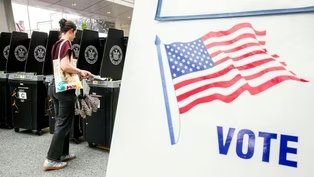
AMNA NAWAZ: The Trump administration has made multiple efforts to reshape how elections are run with just months before the midterms.
And the debate over election security has led to tension between the White House and election administrators, as the president falsely claims voter fraud is rampant nationwide.
Our Liz Landers has more.
LIZ LANDERS: The Trump administration has taken broad efforts over the last several months to assert control over elections.
Today alone, a federal judge blocked the administration from using a revamped immigration database to check voter rolls.
And the postmaster general told the Senate the Postal Service won't deliver mail ballots in states that refuse to hand over their voter lists.
For perspective on what all this means heading into November, I'm joined by Gabe Sterling of the Georgia Secretary of State's Office.
Gabe, thank you so much for joining "News Hour."
GABRIEL STERLING, Georgia Election Official: Happy to be here.
LIZ LANDERS: So we mentioned this testimony today that the postmaster general had on Capitol Hill saying that they will not deliver these mail ballots if states don't comply with this demand to provide a list of names of who is voting in that state.
If the Postal Service denies this kind of service, how many people in your state would be impacted by that?
GABRIEL STERLING: Well, it's interesting.
Vote by mail is really big out West.
They really -- because the large land masses and everything.
It would really affect people in Alaska and California and Washington and Utah.
I mean, the irony -- and Florida is the biggest one in the east of Mississippi who uses the.
So you're talking about millions of voters being affected by this potentially.
But I don't understand the legal mechanism hook that would allow them to say, if you don't do this, then we will do that.
Congress has been silent on this.
I cannot see any legal way that will actually come to fruition, because we are 132 days away from the election.
LIZ LANDERS: Yes, we're close.
You're certainly right about that.
The president canceled a bill signing ceremony earlier today on housing legislation, saying that he was canceling it until the SAVE America Act has passed.
That legislation would require voters to show proof of citizenship when they're registering to vote and photo I.D.
at the time of voting.
It's already illegal to vote in this country if you're not a citizen.
So is that legislation necessary, in your view?
GABRIEL STERLING: Look, I think, as a public policy, it's good to have guardrails in place to prevent noncitizen voting.
The reality is, it is microscopically small in existence right now.
But this adds a lot of layers of problematic issues for lots of voters.
I'm not sure where my birth certificate is.
But, in Georgia, we already have all these kinds of systems in place.
But there are other states, the reality is, it would take millions, if not billions of dollars, and two to three years of planning and thought and execution, so you would make sure you're not disenfranchising voters.
You can't just pass a law and all of a sudden these things happen.
This would cause chaos.
Again, there's normally -- in federal lawsuits, we have the Purcell doctrine, which basically says you can't change the rule so close to an election.
We have already been through the primaries, and a lot of the states, they will be wrapping up in September.
Trying to do massive changes like this would just cause chaos.
LIZ LANDERS: And what sort of precedent does it set when the federal government uses federal resources as a leverage over decisions that the Constitution has assigned to states?
States are the body that implements elections in this country.
GABRIEL STERLING: Time, place and manner.
It's very clear.
Now, the Congress can pass laws, and they can legitimately put what they want to have in there.
But one of the great systems of security we have in this country is the fact that there's 10,000 separate jurisdictions running these things, not running them under the same rules.
And as a Republican, I think the idea of a centralized national database of voters is a horrifically bad idea, because, at some point, a Democrat will take this over as the president, and they can wave a magic wand and say, I am now -- they're saying all these people are now ineligible to vote, despite any state laws.
We have to make sure we protect the federal rules and laws that say the states do this, the states empower this, and then even the states, the localities run the elections.
LIZ LANDERS: Final question for you.
You ran in the Republican primary for secretary of state, and you lost in that contest recently.
You were the only candidate to defend the 2020 election and the administration of that election.
What does that say about the Republican Party in Georgia and across the country right now?
GABRIEL STERLING: There's still a massive belief that the president is right.
But just because he says it doesn't make it true.
There's people who are undermining people's faith in the elections.
And it's not good for either party to do this thing.
In Georgia in 2018, Stacey Abrams said it was stolen.
In 2020, we had Donald Trump.
The only thing stolen in 2020 was Stacey Abrams' playbook.
And the reality is, there's a grifting community that will always talk about this.
And there's an entire industrial complex that gets money and power and prestige from saying the election is stolen.
Every court case, every single one has shown it hasn't been.
And that's how you're supposed to do this in this country.
And every two years, you come back and fight again.
If you lose an election, you concede.
I called the two people I lost to in the run-off and conceded, because that's the right thing to do, because we need the loser's consent.
That's how the system works.
LIZ LANDERS: Gabe Sterling, thank you for your time.
GABRIEL STERLING: Thank you.
AMNA NAWAZ: We start the day's other headlines with the latest conflicts stemming from the interim U.S.-Iran agreement.
An Iranian diplomats says inspectors won't visit the country's nuclear enrichment sites until a final deal with the U.S.
is reached.
However: RAFAEL GROSSI, Director General, International Atomic Energy Agency: There's a word of words here.
Some say yes.
The others say no.
AMNA NAWAZ: The head of the International Atomic Energy Agency, Rafael Grossi, says that inspections will take place in cooperation with Iran.
In the meantime, U.S.
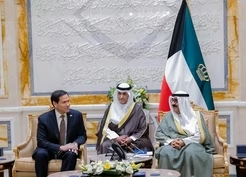
secretary of state Marco Rubio is holding meetings across three Gulf nations.
Speaking to reporters in Kuwait, Rubio stressed that the Strait of Hormuz must be open to maritime traffic and toll-free.
MARCO RUBIO, U.S.
Secretary of State: When we mean open the straits, we mean open the straits free in international waterways.
I know of no country on the planet that supports tolling or a fee for the use of the straits.
That's just not -- that's not going to happen.
The president has been abundantly clear.
AMNA NAWAZ: Earlier, Rubio met with the president of the UAE.
And the secretary posted this photo, which includes Donald Trump's son-in-law Michael Boulos sitting next to Rubio.
The husband of the president's daughter Tiffany Trump has no official role in these talks.
And when asked about his presence, Rubio said he's a friend and -- quote - - "We had a chance to catch up."
In Texas, Camp Mystic filed for bankruptcy protection today nearly one year after flooding killed 28 people there, most of them campers, the majority just 8 years old.
The filing follows a scathing report from state investigators earlier this month that found the camp lacked detailed emergency plans and did not respond quickly enough to the disaster.
The operators of the all-girls Christian camp says its debts range from $10 million to $50 million.
They had intended to reopen this summer, but reversed course amid public backlash.
A federal judge in California is banning federal officials from making arrests at immigration courts nationwide, in a setback for the Trump administration's crackdown.
Judge Casey Pitts ruled the policy was -- quote -- "arbitrary and capricious" and said -- quote -- "The chilling effect of courthouse arrests could undermine the proper enforcement of immigration laws."
An official at the Department of Homeland Security fired back, calling the ruling -- quote -- "naked judicial activism."
It is the second such action on courthouse arrests after a judge banned them in New York City last month.
Federal prosecutors have charged a chief of staff to former New York Mayor Eric Adams with bribery, money laundering, and fraud.
Frank Carone, his brother and two others were arrested earlier today.
They're accused of accepting more than $100,000 in bribes to steer a city contract from migrant housing to a hotel in Queens.
They each face up to 20 years in prison, if convicted, and they have pleaded not guilty.
Adams himself has not been accused of any wrongdoing in the case, though he has been previously indicted on bribery and other charges that were later dismissed.
In Colombia, progressive candidate Ivan Cepeda conceded the presidential election today to Trump-backed political outsider Abelardo de la Espriella.
Election officials confirmed today that the business owner and lawyer beats Cepeda by about 1 percentage point.
Cepeda and the current president, Gustavo Petro, had initially said they would challenge the results.
But in remarks today, Cepeda said that while he plans to put up a vigilant and constructive opposition, he would indeed concede.
IVAN CEPEDA CASTRO, Colombian Presidential Candidate (through translator): I do so as an act of democratic responsibility.
I do so because we deeply believe in democracy and because we are convinced that political differences should be resolved through citizen participation, respect for institutions, and public deliberation.
AMNA NAWAZ: Cepeda also lashed out at President Trump for his support of de la Espriella, calling Trump's social media posts -- quote -- "improper foreign interference in Colombia's internal affairs."
Turning now to the World Cup, Switzerland and Canada are heading to the knockout round.
Playing in front of a sea of red and white jerseys in Vancouver, the co-host nation lost 2-1, but has performed well enough in the tournament to advance for the first time ever.
In the meantime, Bosnia-Herzegovina helped their chances of advancing after a 3-1 win over Qatar in Seattle today.
If they do move forward, it would also be the first time for that country.
Notably absent today was Qatar's mid-fielder Assim Madibo, who was handed a five-match ban after a tackle that broke a Canadian player's leg last week.
Madibo can appeal can appeal FIFA's decision.
On Wall Street today, stocks ended mixed amid ongoing weakness in big-tech shares.
The Dow Jones industrial average gained nearly 200 points by the close, but the Nasdaq fell about 100 points, or nearly half-a-percent.
The S&P 500 posted a modest loss of just seven points.
Still to come on the "News Hour": another top military commander resigns following a clash with the secretary of defense; millions across Europe face extreme temperatures amid a record-breaking heat wave; and anti-ICE protesters are sentenced to decades in prison in the latest crackdown on dissent.
Today, the Army confirmed that one of its most prominent generals would soon be retiring, ending his career and leaving his current job long before expected.
It's just the latest example of senior officers leaving the military early or being fired under Secretary Pete Hegseth.
Nick Schifrin has that story.
NICK SCHIFRIN: When the U.S.
military needed to respond to Russia's full-scale invasion of Ukraine, it deployed General Chris Donahue and the unit he commanded to Europe to coordinate U.S.
assistance.
When, the year before, the military needed to withdraw quickly from Afghanistan, it also turned to Donahue and his unit, and he became the last American soldier to leave Kabul after 20 years of war.
For years before that, Donahue led the Army's most elite troops during the wars in Iraq and Afghanistan.
Today, the Army said he would be retiring and leaving his current job as the top Army officer in Europe early, the sixth Army three- and four-star officer to announce early retirement just in the last year-and-a-half.
To talk about this, I'm joined by Jim McPherson, the undersecretary of the Army during the first Trump administration.
Jim McPherson, thanks very much.
Welcome back to the "News Hour."
REAR ADM.
JAMES MCPHERSON (RET.
): Thank you.
NICK SCHIFRIN: What's your response to C.D.
Donahue, as he was known, announcing this early retirement?
REAR ADM.
JAMES MCPHERSON (RET.
): It's a continuation of a very distressing pattern, where senior officers are asked to resign or they are fired or they are reassigned to a command that would require them to be a lower rank, and they tender their resignation.
And we don't know why.
There's no explanation.
And so we're left to conjecture as to why these officers were let go.
And, unfortunately, that conjecture turns to politics.
Maybe they were let go because they weren't in line with the current administration's politics, which is a sad commentary.
NICK SCHIFRIN: But doesn't the secretary, doesn't his staff have the authority to reject officer candidates, to choose their own military leaders?
REAR ADM.
JAMES MCPHERSON (RET.
): They do.
By law, they review the promotion list that comes out, and they can remove names from that promotion list.
But, historically, that's never been done for just pure political reasons.
An individual would be removed from a promotion list for cause, and they would be notified as to what that cause is and have an opportunity to respond to it, whether it's alleged misconduct or whatever it may be.
This administration seems to have departed from that historical perspective and is just firing people, and we don't know why.
Again, there's no explanation given whatsoever.
I think we go back to February of last year, in which four former secretaries of defense wrote to Congress and expressed their concern over what they saw as the beginning of this when the president fired the chairman of the Joint Chiefs of Staff, the C.O., and others.
And they said it was reckless.
They said it undermined the all-volunteer force, and it put at peril our national security.
Here we are 16 months later, and that trend is continuing.
NICK SCHIFRIN: I want to put a point on something you have been saying, which is the lack of explanation.
I asked the Pentagon for an explanation for why General Donahue was leaving early, and the office of the secretary referred me to the Army, whose statement did not provide any reason.
So, just again, what is the impact of a lack of public explanation, especially when it comes to someone who internally was so respected like General Donahue?
REAR ADM.
JAMES MCPHERSON (RET.
): You're absolutely right, internally so respected.
I mean, one of the things that Secretary Hegseth has said many times is, he wants to make us more warrior-like.
He wants to make warriors.
Well, there's no more warrior than there was General Donahue, as you outlined in the introduction.
I think this goes to two things.
One is the morale of the senior officers.
They don't know what's in store for them.
Is the administration going to go back and look at something they said or did when they were much lower rank years ago?
That seems to be what's happening.
But there's also an aspect here that is very concerning, and that's civil-military relations.
That's the relationship that the civilian community has with their military.
And the foundation of that relationship is, the military is apolitical.
They don't get involved in politics at all.
Well, now we see this administration involving senior officers in politics.
And that erodes the trust that the civilian community has in their military.
It impacts that civilian-military relationship.
NICK SCHIFRIN: I talked to a lot of former senior officials today who weren't willing to speak for the record.
But one of them said this, a former three-star.
The three-star said to me: "It would be OK if generals were being relieved for cause, but relief without cause only leads to speculation about the secretary's motives and undermines trust within the officer corps."
Does that sound right to you?
REAR ADM.
JAMES MCPHERSON (RET.
): I couldn't agree more.
And I was part of the process when I was on active duty in the Navy that reviewed promotion lists and those names to determine, are any of those names, has there been alleged misconduct in their past?
We don't even get that explanation from this administration now.
It just happens, and we are left to speculate as to why, and that speculation turns to political reasons.
NICK SCHIFRIN: And one former four-star who knew Donahue for decades told me this, that, when all of those Army officers have been fired over the last year-and-a-half, he received calls from colonels, from lieutenant colonels, and they questioned whether they should stay in the military and -- quote -- this person told me: "The military is losing talent left and right."
What message does his removal send to the next generation of officers?
REAR ADM.
JAMES MCPHERSON (RET.
): It sends just that message, Nick.
It sends the message that you can't trust the civilian leadership of this administration, because they're going to want to have individuals promoted who think like them, who believe as they believe, which is not what the military is all about.
And I'm sure that there are a number of captains and colonels now who are wondering whether or not they should remain in or take advantage of that job offer they just received for more money, and they get to spend more time with their families, a tough decision.
NICK SCHIFRIN: Jim McPherson, thank you very much.
REAR ADM.
JAMES MCPHERSON (RET.
): Thank you.
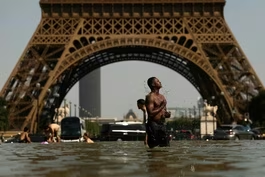
GEOFF BENNETT: A major heat wave is shattering records across Europe, leaving tens of millions of people under sweltering conditions.
France topped a record for the country's hottest day ever for the second consecutive day, and the U.K.
and Spain both hit record highs for the month of June.
Stephanie Sy has our report.
STEPHANIE SY: In London today, the temperature hit 96 degrees, and outdoor workers felt it.
JOHNNY O'CONNOR, Construction Worker: Awful, to be honest.
It's horrible, this heat.
STEPHANIE SY: These kids didn't seem to mind the heat much.
A spray-down was also in order for this crowd waiting in line to attend a concert in Milan, Italy.
At the Vatican, the faithful fluttered their fans while Pope Leo held his weekly audience.
And while the beer may still be cold in Munich, in the kitchens, the chickens weren't the only ones roasting.
SASCHA MEYER, Beer Garden Manager (through translator): Just run quickly to the sink and splash your face with cold water.
Then drink loads of water.
That's our little secret.
STEPHANIE SY: Today, more than a dozen countries in Europe were under high heat alerts in the second major heat wave for the continent in two months.
A heat dome, a high pressure system trapping hot air, is covering the region, says Clair Barnes, an extreme weather and climate researcher at Imperial College in London.
CLAIR BARNES, Research Associate, Imperial College: It means that it's drawing warm air up from North Africa, from the Sahara, and that's why we have this really intense heat, and it's very slow moving, and it means there's kind of no winds, no breeze for respite.
STEPHANIE SY: With temperatures reaching more than 110 degrees, France has been on the front line.
Heat-related deaths are climbing, including 40 drownings in recent days that authorities attribute to people seeking relief in rivers and lakes.
ZOUZOU HOBBS, Tourist in Paris: My friend who lives here says she's -- there's no way she's going to be swimming in hooks, because it's so dirty, but it's hot.
I'm going to risk it.
STEPHANIE SY: Earlier this week, police in Paris tried to stop young people from turning a footbridge into a diving board.
The Eiffel Tower and the Louvre were shut down early, and the classic gray zinc roofs that cover much of the skyline are making things unbearable for those living in attic units.
AMELIE KENNY, Parisian Student: It's been the worst week that we have had in this apartment.
STEPHANIE SY: Air conditioning is a rarity across Europe, making fans a hot commodity.
VICTORIA YAKUBOV, Filmmaker (through translator): It's pure coincidence that I have this electric fan because someone left it aside.
Everything was gone in less than 30 minutes.
STEPHANIE SY: For decades, many European countries didn't need air conditioning since extreme heat was relatively rare.
But, more recently, environmental concerns, energy costs, and health worries have all been part of the resistance to A.C.
Oscar Brousse works on urban climate and health at the University College London.
OSCAR BROUSSE, University College London: Adding air conditioning on the energy grid would require basically more energy to be produced when -- during cooling hours, which is something that the E.U.
has been trying to prevent to not have to rely, for example, on fossil fuels to cope with this energy demand.
STEPHANIE SY: Europe is the world's fastest warming continent.
Temperatures have been increasing at twice the speed of the global average since the 1980s.
OSCAR BROUSSE: There has been heat waves, of course, in the past already, but their intensity and their frequency has become really problematic due to global climate change, and especially supraregional or would I say continental climate change that we experienced in Europe.
STEPHANIE SY: More than 200,000 people have died from heat-related causes in the past four years across Europe.
Many countries are taking care to engage elderly populations, who are more vulnerable to heat-related illnesses.
These Italian seniors had their morning workout moved to an air-conditioned space.
And movie theaters in Geneva are offering free daytime screenings for the elderly.
LAURENT DUTOIT, Cinemas Manager (through translator): The hotter it gets, the more the cinema becomes a place of refuge.
So we will also have a few more people, I imagine, in the coming days.
STEPHANIE SY: In Madrid, the city reopened its climate shelter in city hall for the third year in a row, offering cool air, food, water, and a place to shower for the homeless.
JUAN CARLOS ARELLANO, Samur Social, Madrid (through translator): On Saturday, one person came.
Yesterday, three came.
Our experience from previous years is that, as the days go by, many more people start coming.
I seem to recall that, last year, we had around 170 people.
STEPHANIE SY: Experts say this is likely just the start of this summer's heat across Europe and the globe.
OSCAR BROUSSE: In the U.K., we have broken records nearly every year now.
These are things that we don't see usually and that we know are related to global climate changes.
So we could expect future summers to become warmer, and more regularly so.
STEPHANIE SY: For the "PBS News Hour," I'm Stephanie Sy.
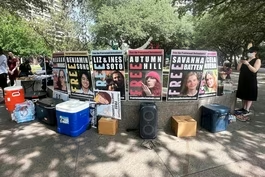
AMNA NAWAZ: In two federal courts yesterday, a group of protesters received unusually long sentences after the Justice Department accused them of being members of the far left movement Antifa.
The sentences range from 30 to 100 years in prison, longer than the harshest sentence handed down to any of the convicted rioters in the January 6 attack on the U.S.
Capitol in 2021.
All of those people have since received pardons or commutations from President Trump.
Our justice correspondent, Ali Rogin, has more.
ALI ROGIN: These nine protesters were arrested after they demonstrated outside a migrant detention facility in Texas last year.
During the protest, a police officer was shot in the neck.
He survived.
Their case is the first to incorporate new guidance from a presidential declaration last year that labels Antifa as a domestic terrorist organization.
That's despite the fact that Antifa is a decentralized movement, not a single organization, and that there is no federal charge of domestic terrorism under existing U.S.
law.
To discuss the implications of this sentencing, I'm joined by Georgetown law professor and former federal prosecutor Paul Butler.
Paul, good to see you.
Welcome back to the "News Hour."
PAUL BUTLER, Professor, George University Law Center: It's great to be here.
ALI ROGIN: I'd like to ask first about these decades-long sentences that were passed down.
The longest was 100 years in prison.
Most of the others received sentences of 50 to 70 years.
You're familiar with the allegations against these defendants.
Were these sentences - - are these sentences typical?
PAUL BUTLER: No, they're not.
The sentences are extremely harsh.
They're sentences that are more typical for people who have committed murder or stolen millions of dollars.
Compare these defendants to two other sets of defendants, one, their co-defendants who were accused of the same conduct, but pled guilty.
They are going to be sentenced next month, and they're looking at around 15 years.
We can also think of the 1,500 people who were prosecuted in connection with the attack on the Capitol on January 6, 2021.
The most any of those defendants received was 22 years, compared with the 30 to 70 years that these defendants received.
ALI ROGIN: Acting Attorney General Todd Blanche released a statement, in which he said in part: "The sentences handed down today make clear that the Antifa terrorists who attack law enforcement and federal facilities will face swift and uncompromising justice," calling them Antifa terrorists.
What do we know about Antifa and whether or not this terrorism label is really accurate?
PAUL BUTLER: Antifa is not a formal organization.
It doesn't have a leadership structure or a list of members.
It's more of a network of people on the far left who are opposed to fascism.
President Trump has labeled it a domestic terrorist organization.
Now, there is such a thing as a foreign terrorist organization, but the law doesn't provide any classification for domestic terrorist organizations.
More significantly, five of the alleged Antifa members pled guilty, and they supported the prosecution.
But on the stand, they denied that they and any of the co-defendants were members of Antifa.
They said what brought them together is that they were a member of a book group, of the Emma Goldman reading society, that read books by revolutionary authors.
ALI ROGIN: Named after a famous anti-fascist protester.
What sort of message do you think the Department of Justice was sending in pursuing these sentences?
And do you think we're going to see this in future cases against protesters, especially those who are protesting administration policies like the immigration crackdown?
PAUL BUTLER: Last year, after the murder of Charlie Kirk, President Trump signed the National Security Presidential Memo 7.
It's a directive that says that the government should use its law enforcement resources to focus on domestic terrorist organizations.
And he said domestic terrorist ideology could include anti-capitalist views, people who have extreme views on race and gender and immigration, and even people who are opposed to what the directive described as traditional teachings on marriage and the family.
The concern is that prosecutions based on this directive chill free speech.
People who demonstrate, even people who are resisting the administration, have First Amendment rights to free speech and freedom of assembly.
Now, when they cross the line, as these defendants did with acts of vandalism, of course, they should be brought to justice.
The concern is, when people are labeled terrorists based on their political views, that chills free speech.
ALI ROGIN: Professor Paul Butler, thank you so much.
PAUL BUTLER: Always a pleasure.
GEOFF BENNETT: Ahead of America's 250th anniversary, author Walter Isaacson has turned his attention to a single sentence in one of the nation's founding documents.
Judy Woodruff speaks with Isaacson now about the enduring power of those words for her series Crossroads: America at 250.
JUDY WOODRUFF: People line up to see it, the Declaration of Independence, protected behind bulletproof glass inside the National Archives, the faded nearly 250-year-old document that is America's defining statement of purpose.
For Walter Isaacson, one line stands out.
He calls it the greatest sentence ever written, the title of his most recent book.
That sentence: "We hold these truths to be self-evident, that all men are created equal, that they are endowed by their creator with certain unalienable rights, that among these are life, liberty, and the pursuit of happiness."
WALTER ISAACSON, Author, "The Greatest Sentence Ever Written": Maybe I shouldn't write a really big long book.
I should just do the most important sentence and I should explain it very succinctly, how we should all rally around it.
JUDY WOODRUFF: Isaacson and I recently discussed the many meanings behind those words at the Larz Anderson House in Washington, D.C., home to the Society of the Cincinnati, the nation's oldest patriotic organization formed just after the Revolutionary War.
Do you truly believe it is the greatest sentence ever read?
WALTER ISAACSON: If you look at that sentence, it creates something new on the face of the earth, a country that's power comes from the consent of the government, that respects individual freedom, but also respects the idea of having common values and common ground and diversity.
And the world had not seen a place like that.
And it becomes a mission statement around the world, as more and more countries sort of embrace the idea of democratic freedom.
JUDY WOODRUFF: But it's also full of contradiction, because for them saying all men are created equal, there was an inherent contradiction there, because all people living at that time were not equal.
WALTER ISAACSON: There's a deep contradiction in the sentence and a contradiction in the way America was founded, and our narrative is how we resolve that contradiction.
When they wrote that sentence, it clearly was aspirational, because one-fifth of the people living in the colonies were enslaved.
And even Thomas Jefferson, when he's drafting the sentence, his valet, he's enslaved.
So Jefferson has to get over these contradictions.
And so do we, as a country, as, over the course of generations, we have lived up to the promise in fits and starts.
JUDY WOODRUFF: Do you believe the founders understood at the time what a big contradiction it was?
WALTER ISAACSON: The founders fully understood that slavery was a contradiction.
Jefferson writes denunciations of slavery in his first draft of the declaration, and then they have to take some of them out because the South Carolina delegation won't put up with it.
And, certainly Franklin, John Adams, they all understand that there's this contradiction, but they're setting the nation on a course, a course that has this definite problem from the very beginning, and each new generation has to wrestle with it.
JUDY WOODRUFF: Did they have an inkling at the time of the consequences of what they were doing when they drafted this?
WALTER ISAACSON: They absolutely knew they were creating two great ideals for a nation.
One is a nation based on individual liberty, but in which you share common ground in the rights of everybody, secondly, a diverse nation where you don't impose a religion or a creed or a way of thinking.
You have to remember every nation up until then pretty much had either been ruled because of the divine right of kings or the sword of conquerors.
They had tended to be ethnic nationalist nations.
But, in Philadelphia, you have a great diversity.
You have Anglicans and Quakers and Moravians and Jews and slaves and freed slaves and Presbyterians.
And they're saying, we're a new type of nation, in which diversity can be part of our strength.
JUDY WOODRUFF: You used a word or the term common ground just now, although the word common is hardly in the document.
Where did that notion of common ground come from?
WALTER ISAACSON: Common ground comes from John Locke, who says, we can all have private property, but when you have disparities of wealth, sometimes people who own property should put things in the common.
That's why you have Clapham Common, or here you have Boston Common and Cambridge Common, is where people without property, known as commoners, could graze their sheep, bury their dead, plant their gardens.
But it becomes a symbol for larger things, where we put schools in the common, we put the fire department in the common, we put police in the common, libraries in the common.
They're writing the Declaration to say, here's our common values.
But they also say, we're creating a nation where everybody has a right to life, liberty, and the pursuit of happiness.
So we have to create the type of society that allows a land of opportunity, that allows some common ground in which we can all flourish.
And that became known as the American dream.
JUDY WOODRUFF: And as you write, over time, though, this has changed.
WALTER ISAACSON: Nowadays, we have lost the notion of a common ground of information.
We all go to our different ends of the talk radio dial or down different rabbit holes on the Internet.
Likewise, we sometimes lose that notion that, in order to have an American opportunity, an American dream, we need to have things in common.
If you look at the idea that all men are created equal, and you realize it doesn't really describe the way it was in 1776.
But you think of it as a forcing mechanism.
Four score and seven years later, Lincoln invokes it, as he's burying 7,058 young men who died to make the sentence more equal.
At the Seneca Falls declaration, they invoke it.
Dr.
King invokes it in one of his last speeches.
Lyndon Johnson invokes it when he signs a civil rights law.
So it's a sentence that keeps pushing us forward, even though our progress comes in fits and starts.
JUDY WOODRUFF: As you look at what the founders ultimately wrote in this sentence, was there something you would change?
WALTER ISAACSON: I'm an editor.
I love editing.
What if I had been in the room, and I went word through word, even words like self-evident, which seemed a bit inflated to me, and then I realized Franklin is talking about a very specific type of truth.
All of those words are carefully chosen.
I can't see I'd change any one of them.
JUDY WOODRUFF: Even coming from an editor?
WALTER ISAACSON: Even coming from a longtime editor.
JUDY WOODRUFF: Walter Isaacson, thank you for talking with us.
WALTER ISAACSON: Judy, great.
Thanks.
GEOFF BENNETT: And that's the "News Hour" for tonight.
I'm Geoff Bennett.
AMNA NAWAZ: And I'm Amna Nawaz.
On behalf of the entire "News Hour" team, thank you for joining us.
 New
NewAnti-ICE protesters sentenced to decades in prison
Video has Closed Captions
Anti-ICE protesters sentenced to decades in prison in latest crackdown on dissent (5m 24s)
 New
NewHow Trump is trying to reshape how elections are run
Video has Closed Captions
How the Trump administration is trying to reshape how elections are run (5m 19s)
 New
NewMillions in Europe face record-breaking heat wave
Video has Closed Captions
Millions in Europe face extreme temperatures from record-breaking heatwave (5m 34s)
 New
NewNews Wrap: Rubio meeting leaders across three Gulf nations
Video has Closed Captions
News Wrap: During Gulf nations tour, Rubio stresses Strait of Hormuz must remain open (5m 37s)
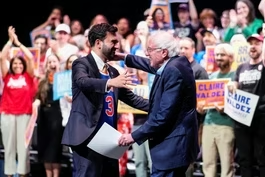 New
NewProgressive victories signal mood of some Democratic voters
Video has Closed Captions
Progressive victories signal mood of some Democratic voters ahead of midterms (6m 13s)
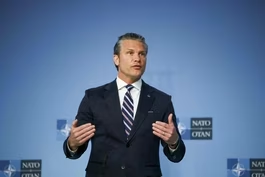 New
NewTop military commander resigns following clash with Hegseth
Video has Closed Captions
Another top military commander resigns following clash with Hegseth (6m 8s)
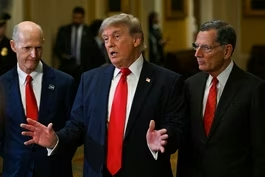 New
NewTrump scraps housing bill signing to press GOP on SAVE Act
Video has Closed Captions
Trump scraps housing bill signing to pressure Senate GOP on SAVE Act (5m 1s)
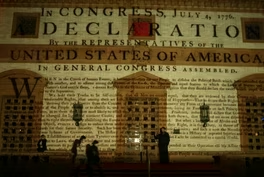 New
NewWalter Isaacson on 'The Greatest Sentence Ever Written'
Video has Closed Captions
Walter Isaacson on what he calls 'The Greatest Sentence Ever Written' (7m 15s)
 New
NewWhat's in the housing bill that Trump refused to sign
Video has Closed Captions
What's in the housing affordability bill that Trump refused to sign (6m 21s)
Providing Support for PBS.org
Learn Moreabout PBS online sponsorship New Episode
- News and Public Affairs

Today's top journalists discuss Washington's current political events and public affairs.
 New Episode
- News and Public Affairs

FRONTLINE is investigative journalism that questions, explains and changes our world.



 New Episode
 New Episode
 New Episode
 New Episode
 New Episode
Support for PBS provided by:
Major corporate funding for the PBS News Hour is provided by BDO, BNSF, Consumer Cellular, American Cruise Lines, and Raymond James. Funding for the PBS NewsHour Weekend is provided by...